Depth-one foliations, pseudo-Anosov flows and universal circles
Junzhi Huang
Yale University, New Haven, USA

Abstract
Given a taut depth-one foliation in a closed atoroidal 3-manifold transverse to a pseudo-Anosov flow without perfect fits, we show that the universal circle coming from leftmost sections associated to constructed by Thurston and Calegari–Dunfield, is isomorphic to Fenley’s ideal boundary of the flow space associated to with natural structure maps. As a corollary, we use a theorem of Barthelmé–Frankel–Mann to show that there is at most one pseudo-Anosov flow without perfect fits transverse to up to orbit equivalence.
1. Introduction
There has been an important theme in 3-manifold topology to study the interaction between flows and codimension-one foliations in 3-manifolds. The simplest examples of codimension-one foliations of a 3-manifold are fibrations, which are exactly the foliations with all leaves compact. The theory of Thurston norm organizes different ways of fibration of into a finite number of fibered faces, and there is a one-to-one correspondence between fibered faces and isotopy classes of suspension pseudo-Anosov flows [22
D. Fried, Fibrations over with pseudo-Anosov monodromy. In Travaux de Thurston sur les surfaces, pp. 51–266, Astérisque 66–67, Société Mathématique de France, Paris, 1979 Zbl 0446.57023 MR 0568308
, 31W. P. Thurston, A norm for the homology of manifolds. Mem. Amer. Math. Soc. 59 (1986), no. 339, 99–130 Zbl 0585.57006 MR 0823443
]. The aim of this paper is to study one of the next simplest classes of foliations, namely depth-one foliations, and their interaction with transverse pseudo-Anosov flows, by comparing the actions on that arise in both settings.A foliation in a closed 3-manifold is called a depth-one foliation if the restriction to the complement of compact leaves is a fibration over the circle. More precisely, there are a finite number of compact leaves, called depth-zero leaves, and the rest of the leaves (namely the depth-one leaves) are infinite-type surfaces spiraling into the depth-zero leaves. One way to construct depth-one foliations is to “spin” a fibration around an embedded surface (see [6
D. Calegari, Foliations and the geometry of 3-manifolds. Oxford Math. Monogr., Oxford University Press, Oxford, 2007, 363 pp. Zbl 1118.57002 MR 2327361
, Example 4.8]).Given a taut depth-one foliation in a closed 3-manifold a result of Candel [8
A. Candel, Uniformization of surface laminations. Ann. Sci. Éc. Norm. Super. (4) 26 (1993), no. 4, 489–516 Zbl 0785.57009 MR 1235439
] shows that there exists a Riemannian metric on such that the restrictions to the leaves of are hyperbolic, giving every leaf a standard hyperbolic structure in the sense of [10J. Cantwell and L. Conlon, Hyperbolic geometry and homotopic homeomorphisms of surfaces. Geom. Dedicata 177 (2015), no. 1, 27–42 Zbl 1359.37097 MR 3370020
] (see also Section 2.3). In particular, there is a natural circle at infinity associated to the universal circle of any leaf of An unpublished construction of Thurston [32
W. P. Thurston,
Three-manifolds, foliations and circles, II. Unfinished manuscript, 1998
], which was later written down by Calegari–Dunfield [7D. Calegari and N. M. Dunfield, Laminations and groups of homeomorphisms of the circle. Invent. Math. 152 (2003), no. 1, 149–204 Zbl 1025.57018 MR 1965363
], produces a circle associated to We will call this circle a universal circle from leftmost sections. The circle is acted on faithfully by and is equipped with a equivariant collection of monotone structure maps to the circles at infinity of all leaves, where is the lift of to the universal cover of In general, there is an axiomatized notion of a universal circle associated to a taut foliation (Definition 4.1). The universal circle is a universal circle of in this general sense but not a canonical one. However, when is a taut depth-one foliation transverse to a pseudo-Anosov flow without perfect fits (see Section 2.1 for discussions on pseudo-Anosov flows), we will see that it is possible to relate the to a more natural object, which is the ideal boundary of the flow space of
For a pseudo-Anosov flow the flow space associated to is the space of orbits of the lifted flow in It is homeomorphic to by [2
T. Barbot, Caractérisation des flots d’Anosov en dimension 3 par leurs feuilletages faibles. Ergodic Theory Dynam. Systems 15 (1995), no. 2, 247–270 Zbl 0826.58025 MR 1332403
, 14S. Fenley and L. Mosher, Quasigeodesic flows in hyperbolic 3-manifolds. Topology 40 (2001), no. 3, 503–537 Zbl 0990.53040 MR 1838993
, 16S. R. Fenley, Anosov flows in manifolds. Ann. of Math. (2) 139 (1994), no. 1, 79–115 Zbl 0796.58039 MR 1259365
], and there is a compactification given by Fenley [13S. Fenley, Ideal boundaries of pseudo-Anosov flows and uniform convergence groups with connections and applications to large scale geometry. Geom. Topol. 16 (2012), no. 1, 1–110 Zbl 1279.37026 MR 2872578
]. The ideal boundary is homeomorphic to a circle, and the action on extends continuously to If has no perfect fits, we will see that the shadow of any leaf of provides a natural structure map from to the circle at infinity of (see Section 3). For these structure maps, we prove the following theorem.Theorem 1.1.
Let be a closed atoroidal manifold with a pseudo-Anosov flow without perfect fits, and let be a taut depth-one foliation in transverse to Then the circle together with the structure maps is a universal circle for
While writing this paper, the author learned that Landry, Minsky and Taylor show a much more general version of Theorem 1.1 (recently appeared in [24
M. P. Landry, Y. N. Minsky, and S. J. Taylor, Simultaneous universal circles. J. Topol. 19 (2026), no. 1, article no. e70054, 28 pp. Zbl 08143171 MR 5009301
]). More precisely, they prove that given a taut foliation almost transverse to a pseudo-Anosov flow in a closed hyperbolic manifold the boundary of the flow space naturally has the structure of a universal circle for Nevertheless, we show in our setting that the universal circles and are isomorphic, as made precise by the following theorem.
Theorem 1.2.
Let be a closed atoroidal manifold with a pseudo-Anosov flow without perfect fits, and let be a taut depth-one foliation in transverse to Then the actions on and on are conjugated by a homeomorphism Moreover, for any leaf of we have
Corollary 1.3.
Let be a closed atoroidal manifold, and let be a taut depth-one foliation in Then there is at most one pseudo-Anosov flow without perfect fits transverse to up to orbit equivalence.
Proof.
Suppose there are two pseudo-Anosov flows without perfect fits and that are transverse to Since is atoroidal, both and are transitive (we say a flow is transitive if it has an orbit that is dense in both positive and negative time) [27
L. Mosher, Dynamical systems and the homology norm of a manifold, I: efficient intersection of surfaces and flows. Duke Math. J. 65 (1992), no. 3, 449–500 Zbl 0754.58030 MR 1154179
]. Since the construction of makes no use of the transverse flows, the actions of on the ideal boundaries of the orbit spaces of and are conjugate by Theorem 1.2. By [3T. Barthelmé, S. Frankel, and K. Mann, Orbit equivalences of pseudo-Anosov flows. Invent. Math. 240 (2025), no. 3, 1119–1192 Zbl 08038253 MR 4902161
, Theorem 1.5], and are orbit equivalent. Remark 1.4.
In personal conversations, Michael Landry told the author that using the construction by Gabai–Mosher for almost transverse pseudo-Anosov flows to finite depth foliations, one can construct different pseudo-Anosov flows transverse to the same depth-one foliation, but these flows have perfect fits. While there is currently no complete proof of Gabai–Mosher’s construction in the literature, the monograph [28
L. Mosher,
Laminations and flows transverse to finite depth foliations. Preprint, 1996
] by Mosher contains an outline and the main ideas of the theory. See also the paper [25M. P. Landry and C. C. Tsang, Endperiodic maps, splitting sequences, and branched surfaces. Geom. Topol. 29 (2025), no. 9, 4531–4663 Zbl 08152702 MR 5017754
] by Landry–Tsang and their upcoming work [26
M. P. Landry and
C. C. Tsang,
Pseudo-Anosov flows from sutured hierarchies. In preparation
], which are aimed at revisiting the theory using veering triangulations.Remark 1.5.
In [30
A. Parlak, Mutations and faces of the Thurston norm ball dynamically represented by multiple distinct flows. Geom. Topol. 29 (2025), no. 4, 2105–2173 Zbl 08084075 MR 4929474
], Anna Parlak constructs examples of closed and cusped hyperbolic 3-manifolds with a non-fibered face dynamically represented by two topologically inequivalent pseudo-Anosov flows using mutations of veering triangulations. However, the properties of the resulting flows, for example, whether they have perfect fits or which foliations they are transverse to, are not so clear.A conjectural picture of “pseudo-Anosov packages” is developed in [5
D. Calegari, Promoting essential laminations. Invent. Math. 166 (2006), no. 3, 583–643 Zbl 1106.57014 MR 2257392
] by Calegari in the hope that the different structures from taut foliations, laminations, universal circles and pseudo-Anosov flows are organized and compatible in the most natural way, and it is asked to what extent the picture is true.In particular, given a universal circle for he constructs a pair of invariant laminations on In our case, one can apply the construction to the universal circle and get a pair of laminations on On the other hand, the endpoints of the singular foliations also induce a pair of laminations on by taking the pairs of endpoints of regular leaves and faces of singular leaves. We partially verify Calegari’s picture by showing that and coincide.
Theorem 1.6.
In the setting of Theorem 1.2, the invariant lamination (resp. ) on the universal circle equals the induced stable lamination (resp. ) under the isomorphism
The organization of the paper is as follows. In Section 2, we briefly recall some knowledge about pseudo-Anosov flows, depth-one foliations and circle laminations. In Section 3, we summarize the structure of the shadows of leaves of in developed by [12
D. Cooper, D. D. Long, and A. W. Reid, Bundles and finite foliations. Invent. Math. 118 (1994), no. 1, 255–283 Zbl 0858.57015 MR 1292113
, 19S. R. Fenley, Surfaces transverse to pseudo-Anosov flows and virtual fibers in manifolds. Topology 38 (1999), no. 4, 823–859 Zbl 0926.57009 MR 1679801
] and carefully study the infinity of shadows. From there, we introduce the restriction maps and a relative version of restriction maps. We start Section 4 with a brief review of the construction of the universal circle from leftmost sections following [7D. Calegari and N. M. Dunfield, Laminations and groups of homeomorphisms of the circle. Invent. Math. 152 (2003), no. 1, 149–204 Zbl 1025.57018 MR 1965363
], and we relate to the universal circle structure of we developed in Section 3. We prove Theorem 1.2 in Section 5 by explicitly constructing the homeomorphism and proving the desired properties. We conclude with a discussion of invariant laminations and the proof of Theorem 1.6 in Section 6.2. Preliminaries
Convention 2.1.
We consider a closed Riemannian atoroidal manifold with the Riemannian metric to be determined later. For a partition, (e.g., a flow or a foliation) of a space and a point we let be the atom of containing More generally, if is a subset of we use to denote the saturation of by atoms.
2.1. Pseudo-Anosov flows
We refer to [1
I. Agol and C. C. Tsang, Dynamics of veering triangulations: infinitesimal components of their flow graphs and applications. Algebr. Geom. Topol. 24 (2024), no. 6, 3401–3453 Zbl 1552.57031 MR 4812222
, 14S. Fenley and L. Mosher, Quasigeodesic flows in hyperbolic 3-manifolds. Topology 40 (2001), no. 3, 503–537 Zbl 0990.53040 MR 1838993
, 27L. Mosher, Dynamical systems and the homology norm of a manifold, I: efficient intersection of surfaces and flows. Duke Math. J. 65 (1992), no. 3, 449–500 Zbl 0754.58030 MR 1154179
] and the recent monograph [4T. Barthelmé and K. Mann, Pseudo-Anosov flows: a plane approach. [v1] 2025, [v2] 2026, arXiv:2509.15375v2
] for detailed discussions of pseudo-Anosov flows in 3-manifolds. The following definition follows [13S. Fenley, Ideal boundaries of pseudo-Anosov flows and uniform convergence groups with connections and applications to large scale geometry. Geom. Topol. 16 (2012), no. 1, 1–110 Zbl 1279.37026 MR 2872578
].A flow in is a pseudo-Anosov flow if it has the following properties:
- each flowline is and not a single point;
- the tangent line bundle is continuous;
- there are a finite number of singular closed orbits, and a pair of 2-dimensional singular foliations and in so that
- each leaf of or is a union of orbits;
- outside of the singular orbits and are regular foliations whose leaves intersect transversely along orbits;
- for each singular orbit the leaf of or containing is homeomorphic to whereis an prong and is a homeomorphism from to The orbit is the image of and is always greater than 2 in our case;
- orbits in the same leaf are forward asymptotic, and orbits in the same leaf are backward asymptotic.
The singular foliations and are called the stable foliation and the unstable foliation of respectively. When the set of singular orbits is empty, is an Anosov flow.
Fix a universal cover of and let be the lifts of to respectively. The quotient of by is the flow space which is homeomorphic to [2
T. Barbot, Caractérisation des flots d’Anosov en dimension 3 par leurs feuilletages faibles. Ergodic Theory Dynam. Systems 15 (1995), no. 2, 247–270 Zbl 0826.58025 MR 1332403
, 14S. Fenley and L. Mosher, Quasigeodesic flows in hyperbolic 3-manifolds. Topology 40 (2001), no. 3, 503–537 Zbl 0990.53040 MR 1838993
, 16S. R. Fenley, Anosov flows in manifolds. Ann. of Math. (2) 139 (1994), no. 1, 79–115 Zbl 0796.58039 MR 1259365
]. We orient so that the coorientation coincides with the flow direction, and the pictures in this paper are drawn in a way that the flow is flowing toward the reader. The deck transformation on descends to an orientation-preserving action on and the singular foliations and descend to a pair of invariant transverse singular foliations on denoted by and The singular leaves of and are pronged with The union of two adjacent prongs in a singular leaf of or is called a face.A orbit is periodic if there exists a non-trivial deck transformation of with In this case, acts on by translation, and covers a closed orbit of in Similarly, a leaf of or is called periodic if it is fixed by some non-trivial deck transformation of In particular, singular leaves are periodic. Finally, we call a point or a leaf of or in periodic if the corresponding orbit or leaf in is periodic. The following fact is well known and can be found in [4
T. Barthelmé and K. Mann, Pseudo-Anosov flows: a plane approach. [v1] 2025, [v2] 2026, arXiv:2509.15375v2
, Proposition 1.4.3].Lemma 2.2.
If is a leaf of or fixed by a non-trivial in then the action on has a unique fixed point. In other words, any periodic leaf of or contains a unique periodic orbit.
A ray of or is an embedded closed half-line contained in a leaf with the interior disjoint from singularities. Two rays and are said to form a perfect fit if there is an (possibly orientation-reversing) embedding
mapping horizontal lines to leaves, vertical lines to leaves, to and to We say a pseudo-Anosov flow is without perfect fits if no two rays in and form a perfect fit. The notion of perfect fits is introduced and studied by Fenley in [17
S. R. Fenley, The structure of branching in Anosov flows of manifolds. Comment. Math. Helv. 73 (1998), no. 2, 259–297 Zbl 0999.37008 MR 1611703
, 18S. R. Fenley, Foliations with good geometry. J. Amer. Math. Soc. 12 (1999), no. 3, 619–676 Zbl 0930.53024 MR 1674739
]. In particular, we have the following lemma which is an immediate consequence of [18S. R. Fenley, Foliations with good geometry. J. Amer. Math. Soc. 12 (1999), no. 3, 619–676 Zbl 0930.53024 MR 1674739
, Theorem 4.8].Lemma 2.3.
If has no perfect fits, then any non-trivial element of has at most one fixed point in
Fenley introduces a compactification of in [13
S. Fenley, Ideal boundaries of pseudo-Anosov flows and uniform convergence groups with connections and applications to large scale geometry. Geom. Topol. 16 (2012), no. 1, 1–110 Zbl 1279.37026 MR 2872578
] by building an ideal boundary homeomorphic to and the resulting compactified space is homeomorphic to a closed 2-disk. We orient as the boundary of and the action of on extends continuously to an orientation-preserving action on Each ray in or has a well-defined endpoint, and the endpoints of every leaf are distinct. When the flow has no perfect fits, a ray in and a ray in always have distinct endpoints. If we moreover assume that is not conjugate to an Anosov suspension flow (which is automatic when is atoroidal), the action of on is minimal [13S. Fenley, Ideal boundaries of pseudo-Anosov flows and uniform convergence groups with connections and applications to large scale geometry. Geom. Topol. 16 (2012), no. 1, 1–110 Zbl 1279.37026 MR 2872578
, Main Theorem].Convention 2.4.
We assume that is a pseudo-Anosov flow without perfect fits in
2.2. End-periodic automorphisms
We briefly recall the basics of end-periodic automorphisms of infinite-type surfaces, which arise naturally in the study of depth-one foliations. Readers are referred to [11
J. Cantwell, L. Conlon, and S. R. Fenley, Endperiodic automorphisms of surfaces and foliations. Ergodic Theory Dynam. Systems 41 (2021), no. 1, 66–212 Zbl 1464.57022 MR 4190052
] for a more complete treatment of the theory.Let be an infinite-type surface without boundary with finitely many ends, all of which are non-planar. Given a homeomorphism an end of is a contracting end of if there is a neighborhood of and an integer such that and is empty. Such a neighborhood is called a regular neighborhood of An end is a repelling end of if it is a contracting end of and a regular neighborhood of for is just a regular neighborhood for A homeomorphism is called end periodic if each end of is either contracting or repelling. If is end periodic, a multi-curve in is called an juncture if is the boundary of a regular neighborhood of an end. If the end is contracting, is called a positive juncture. Otherwise, it is a negative juncture. An invariant choice of a positive (resp. negative) juncture for each contracting (resp. repelling) end is called a system of positive (resp. negative) junctures. An end-periodic homeomorphism is atoroidal if it does not preserve any essential multi-curve up to isotopy.
Given an end-periodic homeomorphism we fix a regular neighborhood for every end Let be the union of of contracting ends, and let be the union of those of repelling ends. The positive escaping set and the negative escaping set are defined as
In other words, is the set of points whose positive iterations escape to contracting ends, and is the set of points whose negative iterations escape to repelling ends. The mapping torus is non-compact, but it is topologically tame and possesses a nice compactification which we describe below.
The mapping torus is the quotient of by an automorphism where is given by
We attach and to to obtain a manifold with boundary. The transformation extends to an automorphism of by setting The action on generated by is a covering action, and the quotient space is a compact 3-manifold with interior and boundary where is a (possibly disconnected) closed surface homeomorphic to See [21
E. Field, H. Kim, C. Leininger, and M. Loving, End-periodic homeomorphisms and volumes of mapping tori. J. Topol. 16 (2023), no. 1, 57–105 Zbl 1567.57023 MR 4532490
] for a more detailed discussion of the construction. In particular, [21E. Field, H. Kim, C. Leininger, and M. Loving, End-periodic homeomorphisms and volumes of mapping tori. J. Topol. 16 (2023), no. 1, 57–105 Zbl 1567.57023 MR 4532490
, Lemma 3.3] shows that is atoroidal if and only if is atoroidal.2.3. Depth-one foliation
A foliation in is a depth-one foliation if has finitely many compact leaves, whose union we denote by and restricted to is a fibration over a circle with non-compact fibers. A connected component of is called a fibered region of Any fibered region is bounded by leaves in and we denote the collection of these leaves by We say a leaf in is a positive (resp. negative) boundary leaf of if it is on the positive (resp. negative) side of We denote the collection of positive/negative boundary leaves by Note that it is possible to have a compact leaf contained in both and Let be the union of and
Let be a fiber of the fibration The leaf limits on a compact leaf in the following way [9
J. Cantwell and L. Conlon, Poincaré–Bendixson theory for leaves of codimension one. Trans. Amer. Math. Soc. 265 (1981), no. 1, 181–209 Zbl 0484.57015 MR 0607116
]. Let be a regular neighborhood of with identified with and assume that limits on on the positive side. If is small enough, the intersection of and is an infinite surface spiraling to and covering with infinite degree. More precisely, up to shrinking there is a multi-curve on so that is isotopic to an oriented cut-and-paste of and A fundamental domain for the spiraling is depicted on top of Figure 1a, and a schematic picture of the spiraling neighborhood is shown in Figure 1b.We say a foliation is taut if for any leaf of there is a transverse loop intersecting that leaf.
A schematic picture of the spiraling neighborhood of
Convention 2.5.
We fix a taut depth-one foliation of and assume that is transverse to By transversality, is coorientable, and we take the orientation to be consistent with the flow direction.
By transversality of to and by the compactness of the angle between and at any point is uniformly bounded away from zero. In particular, this implies that is a suspension flow of the fibration The flow gives us a way to identify each leaf in with Since is taut, every leaf in is homologically non-trivial and incompressible by Novikov [29
S. P. Novikov, The topology of foliations (in Russian). Tr. Moskov. Mat. Obs. 14 (1965), 248–278. English translation. Trans. Moscow Math. Soc. 14 (1965), 268–304 Zbl 0247.57006 MR 0200938
]. Since is atoroidal, every compact leaf is a closed hyperbolic surface (the possibility of being a sphere is ruled out by the Reeb stability theorem). Therefore, the fundamental domains of the spiraling of can be chosen to be non-planar. In a spiraling neighborhood of a compact leaf, looks like the product flow. One can see that the first return map induced by is an end-periodic homeomorphism [15S. R. Fenley, Asymptotic properties of depth one foliations in hyperbolic manifolds. J. Differential Geom. 36 (1992), no. 2, 269–313 Zbl 0766.53018 MR 1180384
]. Since is atoroidal, so is The metric completion of with respect to the path metric induced by the metric in gives a compactified mapping torus of By [8
A. Candel, Uniformization of surface laminations. Ann. Sci. Éc. Norm. Super. (4) 26 (1993), no. 4, 489–516 Zbl 0785.57009 MR 1235439
], there is a Riemannian metric on that restricts to hyperbolic metrics on leaves of We fix such a metric on A hyperbolic metric on a surface is standard if there is no embedded half-space, following [10J. Cantwell and L. Conlon, Hyperbolic geometry and homotopic homeomorphisms of surfaces. Geom. Dedicata 177 (2015), no. 1, 27–42 Zbl 1359.37097 MR 3370020
]. The induced hyperbolic metric on any depth-one leaf of has injectivity radius bounded from above. This is discussed in [23
M. P. Landry,
Y. N. Minsky,
and
S. J. Taylor,
Endperiodic maps via pseudo-Anosov flows.
2023,
arXiv:2304.10620v1,
to appear in Geom. Topol.
, Proof of Proposition 4.6], for instance, and the rough idea is that the junctures on any depth-one leaf have bounded length, and any point on the leaf is at a bounded distance from a juncture.Let be the positive or negative escaping set of By definition, a point is in if and only if the positive ray of hits and it is in if and only if the negative ray of hits If or for some closed hyperbolic surface we say is a trivial fibered region. This is equivalent to the monodromy being a pure translation on and to [11
J. Cantwell, L. Conlon, and S. R. Fenley, Endperiodic automorphisms of surfaces and foliations. Ergodic Theory Dynam. Systems 41 (2021), no. 1, 66–212 Zbl 1464.57022 MR 4190052
, Proposition 4.76].Convention 2.6.
We assume that has no trivial product region. In particular, any compact leaf of is not a fiber. All of our discussions and statements hold with trivial product regions and are readily checked, so we omit the related discussion for simplicity.
Let be the lift of in The lifted foliation is a foliation by planes by [29
S. P. Novikov, The topology of foliations (in Russian). Tr. Moskov. Mat. Obs. 14 (1965), 248–278. English translation. Trans. Moscow Math. Soc. 14 (1965), 268–304 Zbl 0247.57006 MR 0200938
]. A connected lift of a fibered region of is called a product region of Any product region covering is homeomorphic to and we fix a homeomorphism so that is foliated by and the orbits are A lift of a positive/negative boundary leaf of is a positive/negative boundary leaf of the collection of which is denoted by DefineLet be the preimage of in From the construction of the compactified mapping torus, we see that is homeomorphic to
where is the preimage of in
For any leaf there is a component of such that a orbit intersects if and only if it intersects at a point contained in This gives a bijection between leaves in and components of Similarly, there is a bijection between leaves in and components of
A leaf of is called a type-0 leaf if it covers a leaf in Otherwise, we call it a type-1 leaf. Every type-1 leaf is contained in a unique product region in denoted by Every type-0 leaf is the negative boundary of a unique production region, and the positive boundary of another different product region. A type-0 leaf and a type-1 leaf are called adjacent if If moreover is in the positive side of we say is positively adjacent to or otherwise, we say is negatively adjacent to or
Let be the leaf space of obtained by collapsing each leaf to a point, which is a non-Hausdorff 1-manifold. Since each leaf of is properly embedded in and hence separating, is simply connected. Each product region projects to an oriented open interval in with the orientation induced by Every such open interval has a countably infinite number of positive endpoints, each corresponding to a component of See Figure 2 for an illustration of how leaves in the product regions in limit to different type-0 leaves. The positive endpoints of the open intervals are non-separated from each other in by (2.1). The same is true for negative endpoints. The closures of product regions are glued together along type-0 leaves in the boundary, so each point corresponding to a type-0 leaf is the negative endpoint of exactly one open interval associated to a product region, and the positive endpoint of exactly another different one.

Type-1 leaves (black) in a product region limit to type-0 leaves (blue) in the positive boundary and stay transverse to (red), creating non-Hausdorffness in

Left: a local picture near a product region in Right: the corresponding parts in The red vertices represent type-0 leaves in both pictures, and the arrows indicate the direction of
It is sometimes useful to think about the dual graph The set of vertices is the set of product regions and type-0 leaves. For a product region or a type-0 leaf we denote the dual vertex in by The edges are the pairs where is a product region, is a type-0 leaf and The dual graph is an infinite valence tree with an orientation given by the flow (see Figure 3).
Two leaves of are called comparable if they can be connected by an oriented path in Otherwise, they are incomparable. If is comparable to and is on the positive side of we write or Similarly, we say two vertices are comparable if there is an oriented path connecting them in and are incomparable if otherwise. If two vertices and are comparable and is on the positive side of we write or Two product regions are comparable/incomparable if their dual vertices are comparable/incomparable.
2.4. Laminations on
We recall some definitions and constructions of abstract laminations on
Let be the space of unordered pairs of distinct points in endowed with the quotient topology, where the relation is given by Two pairs of points and on are said to be unlinked if and lie in the same component of A lamination on is a closed pairwise unlinked subset of
By identifying with any lamination on determines a geodesic lamination on by taking the union of geodesics that connect the pairs in Conversely, any geodesic lamination in gives a lamination on consisting of endpoint pairs of leaves.
Given any subset the boundary of the convex hull of is a geodesic laminations on which can be viewed as a lamination on Note that the lamination is independent of the choice of the identification
3. Infinity of shadows
Let be the projection map. For any subset of the image of under is called the shadow of In this section, we will study the shadow of leaves of especially the behavior of the shadow at infinity. The main results are Lemmas 3.3 and 3.5, which hint at a universal circle structure on
Let be a type-0 leaf of and let be the leaf of it covers. Denote the covering map by Since separates and the flow crosses positively, each flowline intersects at most once. It follows that restricted to is a continuous bijection to its image. This map also has a continuous inverse, mapping a point in to the intersection of the corresponding orbit with Therefore, is a homeomorphism to The map is then a covering map, so we can view as a universal cover of The deck transformation group action on is simply the action of on restricted to a subgroup in the conjugacy class of that stabilizes We identify this subgroup with By transversality, the intersection of with induces a singular foliation on denoted by Similarly, let the intersection of with be denoted by These foliations are related by the relations and
Shadows of type-0 leaves. Assume is a type-0 leaf, so is an embedded closed surface in which is not a fiber by Convention 2.6. The shape of the shadow of a non-fibered transverse closed embedded surface is carefully studied in [12
D. Cooper, D. D. Long, and A. W. Reid, Bundles and finite foliations. Invent. Math. 118 (1994), no. 1, 255–283 Zbl 0858.57015 MR 1292113
] when is a pseudo-Anosov suspension flow, later generalized by [19S. R. Fenley, Surfaces transverse to pseudo-Anosov flows and virtual fibers in manifolds. Topology 38 (1999), no. 4, 823–859 Zbl 0926.57009 MR 1679801
] to general pseudo-Anosov flows. Each component of the topological boundary of in is either a regular leaf of or or a face of a singular leaf that is regular on the side containing [19S. R. Fenley, Surfaces transverse to pseudo-Anosov flows and virtual fibers in manifolds. Topology 38 (1999), no. 4, 823–859 Zbl 0926.57009 MR 1679801
, Proposition 4.3]. We call a boundary component of in a side of Consider a side of which we assume to be contained in a leaf of for concreteness. We collect some useful facts about the local dynamics at from [19S. R. Fenley, Surfaces transverse to pseudo-Anosov flows and virtual fibers in manifolds. Topology 38 (1999), no. 4, 823–859 Zbl 0926.57009 MR 1679801
] in the following proposition.Proposition 3.1
([19
S. R. Fenley, Surfaces transverse to pseudo-Anosov flows and virtual fibers in manifolds. Topology 38 (1999), no. 4, 823–859 Zbl 0926.57009 MR 1679801
]). The stabilizer of in is isomorphic to and contained in There is a generator acting on with the following dynamics (Figure 4):- (1)The element acts as a contraction on with a unique fixed point .
- (2)The element fixes and expands , which is the interior of a ray of . We have that projects via to a closed leaf of , whose free homotopy class is represented by .
- (3)For any point other than in , the intersection is connected, and it projects via to a non-compact leaf of that spirals into . If we orient and so that they point toward and let and inherit the orientation, then and are asymptotic in the forward direction.

The dynamics near a side of the shadow of a type-0 leaf.
The 3-dimensional picture is the following (Figure 5). In the orbit is a periodic orbit disjoint from The leaf does not intersect and intersects transversely in a line so that all the orbits in cross positively. The line covers the simple closed curve in The element is a translation that fixes and
For a side contained in a leaf of we have a similar picture. From now on, given a side of we will continue to use the notations and for the objects described in Proposition 3.1. In particular, we always take to be the generator in the stabilizer of that contracts

The vertical arrowed line represents the periodic orbit (assumed to be regular), the red plane is the blue plane is and the green plane is
Let be the boundary of in , consisting of sides and ideal boundary points at infinity of
Lemma 3.2.
The intersection is nowhere dense.
Proof.
First we observe that is a closed subset of This is because the complement of on is a union of disjoint open intervals bounded by the endpoints of sides of Suppose that there is a maximal closed interval contained in with endpoints and Then there is a side of such that is an endpoint of Take and as before. Let be the endpoint of at
There is another side of such that is an endpoint of If does not lie in then is between and (Figure 6). The action of fixes and but it cannot fix Otherwise, will have two fixed points on by Lemma 2.2, contradicting the assumption that has no perfect fits by Lemma 2.3. Then one of will be in contradicting our choice of

Proof of Lemma 3.2.
Hence, must lie in Now divides into two connected components, one of which contains no side of In particular, this component contains no translation of Translated to the hyperbolic plane by this means there is a simple closed curve and a lift of in such that there is no other lift on one side of But that is impossible. We conclude that such an interval does not exist.
The boundary is homeomorphic to a circle, and is the closure of in Note that our choice of the metric on restricts to a hyperbolic metric on so is isometric to We define to be the usual compactified hyperbolic plane with ideal boundary The next lemma reveals how is related to
A map from to is monotone if the preimage of any point on is contractible. A gap of is a maximal closed interval of positive length in that is collapsed to a single point by The core of is the complement of the union of the interiors of gaps, denoted by We remark that the gaps are sometimes taken to be open intervals in the literature, different from our convention.
Lemma 3.3.
Let be a type- leaf of Then the homeomorphism extends continuously to a map from to The map restricted to is a monotone map to with core
Proof.
To begin with, we define in the interior of To extend to we will first define the map on the sides of and then extend it to the entire
Let be a side of Take and as in Proposition 3.1. As an element of acts as a hyperbolic element on with a contracting fixed point and a repelling fixed point at infinity. We define on as the constant map to Different sides are sent to different points in because of Lemma 2.3.
Since projects to a simple closed curve in it is a quasi-geodesic in with well-defined endpoints in Moreover, represents the free homotopy class of up to taking the inverse, by Proposition 3.1. Therefore, the endpoints of are By the way we choose (item (2) of Proposition 3.1), it contracts near Therefore, if we orient to point toward and give the induced orientation, the forward endpoint of is This shows is continuous at when restricted to This further ensures that preserves the cyclic order of the boundary leaves, which is a consequence of the fact that is an orientation-preserving homeomorphism in the interior. For example, one can argue as follows (indicated in Figure 7). Consider three sides and in clockwise order, and take and as before. Take a point and let be the segment between and We may ensure are pairwise disjoint by taking close enough to Take any point that is not in the union of and connect to to get an embedded 3-prong with as the center and as the endpoints. The image is an embedded 3-prong in with well-defined endpoints The cyclic order of the edges of is preserved under assuring that and are arranged clockwise.

preserves the cyclic order.
Moreover, if is an element of it translates to another side of We have so By the minimality of the action on the images of all the sides of are dense in Now there is a unique way to define on such that it is continuous when restricted to That is, for any point one can find a sequence of sides converging to and define as the limit of by Lemma 3.2. The limit exists and is independent of because preserves the cyclic order of sides and the image of sides is dense in
To complete the proof of Lemma 3.3, what is left is to check that is continuous on
For a side (which is assumed to be contained in a leaf of for concreteness) of and a point we take a rectangular neighborhood of as the image of an embedding such that
- is contained in
- for any is contained in a leaf of
- for any is contained in a leaf of
Such a neighborhood always exists because is regular on the side of that contains
Fix a rectangular neighborhood of By Proposition 3.1, we know that is asymptotic to the latter being a quasi-geodesic ray in since it is a lift of a simple closed curve in This shows that is a wedge-shaped region in with one ideal point (Figure 8).

The image of leaves near an unstable boundary leaf
Consider a sequence of points in converging to If is on a side we can take a rectangular neighborhood of that will eventually contain The shape of the rectangular neighborhoods under shows that converges to
Continuity of at
If we can trap using segments of forcing them to converge to the right points. The argument is similar to the one we use to prove that preserves the cyclic order of the sides. See Figure 9 for an illustration. More precisely, take sequences of sides and of that approximate from two sides respectively (using Lemma 3.2). Fixing take a short segment with one endpoint at so that and are disjoint. Connect the other endpoints of the two segments by a path in and denote the resulting path by The image is an embedded line in with disjoint endpoints, separating into two half-planes. We let the half-plane containing be The fact that is an orientation-preserving homeomorphism guarantees that eventually enters for all We can arrange to be nested so that has exactly one ideal point Since hence escapes every compact set, we know that must limit to
We have proved that is continuous on finishing the proof of Lemma 3.3.
Shadows of type-1 leaves. In this subsection, we would like to study the shadow of type-1 leaves in Note that by [20
S. R. Fenley, Geometry of foliations and flows I: almost transverse pseudo-Anosov flows and asymptotic behavior of foliations. J. Differential Geom. 81 (2009), no. 1, 1–89 Zbl 1160.57026 MR 2477891
, Proposition 4.1], the shadow of a leaf of a transverse foliation is always bounded by regular leaves or faces of singular leaves of the stable/unstable foliations. These boundary leaves are in general not periodic for leaves in an arbitrary transverse foliation. However, we will show in the next lemma that they are in fact periodic for type-1 leaves in a depth-one foliation.We now assume is a type-1 leaf of contained in a product region and covers a non-compact leaf identified with Similar to the case of type-0 leaves, we will use to denote the boundary of in
Lemma 3.4.
The shadow is a proper open subset of bounded by periodic regular leaves of or or faces of singular leaves which are regular on the side containing We call a component of the boundary of (as a subset of ) a side of
Moreover, if a side of is contained in a leaf of then there is a type-0 leaf negatively adjacent to (see Section 2.3 for the definition) such that is also a side of If is contained in a leaf of then there is a type- leaf positively adjacent to such that is also a side of
Proof.
Suppose is a boundary point of Let be the orbit that projects to The orbit cannot intersect any product region that is incomparable to which is the product region containing This is because if intersects such a product region will have a neighborhood such that every orbit that projects to also intersects This forces them to be disjoint from Then is not in and is not in the boundary of Similarly, it cannot intersect any type-0 leaf incomparable to either.
Since is open, is not contained in The orbit induces an oriented path in the dual graph consisting of all the type-0 leaves and product regions that travels through (Section 2). Every vertex in is comparable to the dual vertex by the previous paragraph, but is not in Take any vertex in and suppose Since is a tree, any vertex satisfying lies in the unique oriented interval from to So the path has to stay in the interval in the negative direction. The case where is similar, and we conclude that the orbit will eventually stay in one product region in either the positive or the negative direction.
If is on the negative side of then eventually stays in a product region, denoted by in the positive direction. Take the unique shortest oriented path from to in and let be the last vertex in before There is a unique type-0 leaf that is positively adjacent to and negatively adjacent to Any orbit intersecting both and has to enter via Conversely, every orbit intersecting also meets This shows that if an orbit intersects then if and only if Since is open, we have also shown that if is in then if and only if
Since is in the interior of the above reasoning shows that is in the boundary of Let be the side of containing Note that all the orbits in the same leaf as are positively asymptotic to In particular, they intersect and are disjoint from We see that is contained in a leaf of and using a similar argument to the last paragraph, we have
To summarize, we have shown the following: for a point if is on the negative side of then there is type-0 leaf negatively adjacent to and a side contained in a leaf of such that and One can apply the same argument to the case where is on the positive side of finishing the proof.
Similar to the case of type-0 leaves, we define to be The following lemma is the type-1 version of Lemma 3.3.
Lemma 3.5.
Let be a type- leaf of Then the homeomorphism extends continuously to a map from to The map restricted to is a monotone map to with core
Proof.
We define in and extend to the boundary following the same strategy as in the proof of Lemma 3.3.
Let be any side of and we assume it to be a leaf of for concreteness. By Lemma 3.4, is also a side of the shadow of a type-0 leaf negatively adjacent to Take and as in Proposition 3.1. We orient to be pointing toward By [20
S. R. Fenley, Geometry of foliations and flows I: almost transverse pseudo-Anosov flows and asymptotic behavior of foliations. J. Differential Geom. 81 (2009), no. 1, 1–89 Zbl 1160.57026 MR 2477891
, Theorem C], each ray of or has a well-defined endpoint at In particular, has a well-defined forward endpoint at infinity. We define on each side of to be the constant map to the forward endpoint of Claim.
Different sides are mapped to different points by
Proof of the claim.
Recall that is the product region containing and it covers a fibered region in with fiber and the monodromy Since is atoroidal, is an atoroidal end-periodic map. The fundamental group of is isomorphic to the semidirect product with acting on by The group stabilizes and we can define an action of on by for and If the element has a trivial factor, then the action of is a covering transformation. Otherwise, acts as a lift of some power of the monodromy
Let and be different sides of and take and as before for By Proposition 3.4, there is a type-0 leaf adjacent to so that is a side of The type-0 leaf covers a compact leaf The element being a deck transformation for the covering map can be viewed as an element of Therefore, stabilizes and acts on either as a hyperbolic isometry or as a lift of some power of In both cases, the action extends continuously to an automorphism of by [10
J. Cantwell and L. Conlon, Hyperbolic geometry and homotopic homeomorphisms of surfaces. Geom. Dedicata 177 (2015), no. 1, 27–42 Zbl 1359.37097 MR 3370020
]. Since stabilizes in we know stabilizes in hence also the point by the definition of Suppose for contradiction that Then and fix the same point on Note that and represent different elements in and do not share a non-trivial power by Lemma 2.3. Also note that for any lift of some power of the monodromy the action of on will not fix any fixed point of an element in that acts as a hyperbolic isometry on Otherwise, will fix a closed geodesic on up to isotopy. A regular neighborhood of will also be fixed by up to isotopy, so a power of fixes components of contradicting the assumption that is atoroidal. Therefore, if one of the is a hyperbolic isometry, then and have no common fixed point on If both of them are lifts of some power of up to taking powers we may assume that they are lifts of the same power of Then there is an element such that The common fixed point will also be fixed by a contradiction. We have proved that and do not have common fixed points, which indicates that
We continue our proof of Lemma 3.5. The map preserves the cyclic order of the sides by the same reason as in the proof of Lemma 3.3, and the image is dense by the minimality of the action on Indeed, the hyperbolic structure on has bounded injectivity radius, so the limit set of is the entire circle at infinity.
We also have the following lemma, analogous to Lemma 3.2.
Lemma 3.6.
The intersection is nowhere dense in
Proof.
To continue the proof of Lemma 3.5, note that by Lemma 3.6, the map can be extended to by approaching any point in by sides of as in the proof of Lemma 3.3. The extension is well defined and is continuous on To show that the extension is continuous on we again need the nice asymptotic property of rectangular neighborhoods of the sides. What we will show next is basically that Figure 8 is also a correct picture when is a type-1 leaf.
Again, let be any side of assumed to be a leaf of Let be a type-0 leaf negatively adjacent to such that is also a side of using Lemma 3.4. Finally, let and be as in Proposition 3.1, and orient to be pointing at Let be a point different from and set to be a small segment of with an endpoint at We orient to be pointing toward as well. By Proposition 3.1, is forward asymptotic to under the orientation induced from and Since is regular near on the side of there is a pair of points and so that Let and be the orbits corresponding to and respectively. Since they lie in the same leaf of and are positively asymptotic. It follows that the distance between and is bounded by the distance between and up to a uniform multiplicative constant. In other words, is coarsely bounded by Moreover, the pair can be chosen arbitrarily close to Hence, and are forward asymptotic. If is a rectangular neighborhood of in then we have shown that is a wedge-shaped domain in meeting at exactly one point.
Since we have a similar description of the image of a rectangular neighborhood, we can carry out the same argument and conclude that the extended is continuous on finishing the proof of Lemma 3.5.

The union of the shaded area is and the heavily shaded area is which is a subset of The red arrows represent the map and the blue ones represent One should think of each side of or as a single point at infinity.
For any leaf of either type-0 or type-1, we define a map as follows. For any if is in set If is contained in an open interval in then there is a boundary leaf of with the same endpoints as In this case, we define to be It is immediate from the definition that the maps are monotone surjections, therefore continuous, and equivariant, that is, for any and we have where the action is induced by the isometry
If is a type-1 leaf and is a type-0 leaf adjacent to then contains and the monotone quotient maps and satisfy the property that for any implies It follows that there is a continuous monotone surjection such that More precisely, for any point is defined to be The maps and can be visualized as in Figure 10.
4. Markers and universal circles
The outline of this section is the following. We first recall the definition of a universal circle (Definition 4.1) and prove Theorem 1.1. Then we review in Section 4.1 the construction from [7
D. Calegari and N. M. Dunfield, Laminations and groups of homeomorphisms of the circle. Invent. Math. 152 (2003), no. 1, 149–204 Zbl 1025.57018 MR 1965363
] of a particular universal circle which we call the universal circle from leftmost sections, for any taut foliation. The circle arises from a collection of special sections, called the leftmost sections, of a circle bundle over whose fibers are the circle at infinity of the leaves. The construction will then be examined carefully for our depth-one foliation in Section 4.2, where we study what a leftmost section looks like inside a product region, and in Section 4.3, where we analyze the behavior of a leftmost section at adjacent type-0 and type-1 leaves. The punchlines of this section are Lemmas 4.14 and 4.15, where we show that the leftmost sections can be determined by the structure of developed in Section 3.The following axiomatic definition of a universal circle for first appears in [7
D. Calegari and N. M. Dunfield, Laminations and groups of homeomorphisms of the circle. Invent. Math. 152 (2003), no. 1, 149–204 Zbl 1025.57018 MR 1965363
]. It is worth remarking that although condition (2) seems not at all natural at first glance, it provides the universal circle with more interesting structures. In particular, it is necessary for the construction of invariant laminations in [5D. Calegari, Promoting essential laminations. Invent. Math. 166 (2006), no. 3, 583–643 Zbl 1106.57014 MR 2257392
] (cf. Theorem 1.6).Definition 4.1.
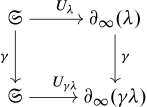
(Universal circle) A universal circle for is a circle with a faithful action and a monotone map called a structure map, for any leaf of such that
- (1)for any leaf and any the following diagram commutes:
- (2)if and are incomparable leaves, then the core of is contained in a single gap of and vice versa.
Two universal circles and are isomorphic if there is a equivariant homeomorphism such that for all
Proof of Theorem 1.1.
All the conditions of a universal circle in Definition 4.1 are obvious by properties of and the way we define except for condition (2). Suppose and are incomparable, then their shadows are disjoint. Otherwise, there is an orbit of the flow intersecting both leaves, contradicting their incomparability. Condition (2) is easily seen to be satisfied.
4.1. Calegari–Dunfield’s construction
In [7
D. Calegari and N. M. Dunfield, Laminations and groups of homeomorphisms of the circle. Invent. Math. 152 (2003), no. 1, 149–204 Zbl 1025.57018 MR 1965363
], Calegari–Dunfield describe an explicit construction of a universal circle for any taut foliation. We briefly review their construction below. For simplicity, we will stick to our instead of more general taut foliations.The bundle is a circle bundle over whose fiber at any leaf is the circle at infinity The topology of is defined as follows. For any transversal of embeds into and we identify with its embedding image in The unit tangent bundle of restricted to is the circle bundle and there is a natural map sending a tangent vector of a leaf to the ideal point it points toward. We require the map to be a homeomorphism. It is shown in [7
D. Calegari and N. M. Dunfield, Laminations and groups of homeomorphisms of the circle. Invent. Math. 152 (2003), no. 1, 149–204 Zbl 1025.57018 MR 1965363
] that this topology is well defined, that is, independent of the choice of Since is a taut foliation, there is an such that every leaf of is quasi-isometrically embedded in its neighborhood by [7
D. Calegari and N. M. Dunfield, Laminations and groups of homeomorphisms of the circle. Invent. Math. 152 (2003), no. 1, 149–204 Zbl 1025.57018 MR 1965363
, Lemma 2.4]. By the structure of depth-one foliations, there is a constant so that the neighborhood of is contained in a spiraling neighborhood. Fix to be Definition 4.2.
A marker for is an embedding
such that
- for any is a geodesic ray in a leaf of
- for any is a transversal with length bounded by
Any marker gives a section of where is the image of in such that for any leaf is the ideal endpoint of The image of under is called the end of
Note that our choice of is different from but no larger than the constant chosen in [7
D. Calegari and N. M. Dunfield, Laminations and groups of homeomorphisms of the circle. Invent. Math. 152 (2003), no. 1, 149–204 Zbl 1025.57018 MR 1965363
]. Shrinking the constant will not affect the main results in their paper. In general, different might give rise to different universal circles, but in our case, it can be seen that for small enough (i.e., smaller than above), the leftmost universal circles are all isomorphic.Lemma 4.3 ([7D. Calegari and N. M. Dunfield, Laminations and groups of homeomorphisms of the circle. Invent. Math. 152 (2003), no. 1, 149–204 Zbl 1025.57018 MR 1965363]).
Given two marker ends, either they are disjoint or their union is an embedded closed interval in transverse to fibers.
A point is called a marker endpoint if there is a marker so that the end of intersects at The following theorem was originally announced by Thurston in an unpublished manuscript [32
W. P. Thurston,
Three-manifolds, foliations and circles, II. Unfinished manuscript, 1998
], and the proof is carefully written down in [7D. Calegari and N. M. Dunfield, Laminations and groups of homeomorphisms of the circle. Invent. Math. 152 (2003), no. 1, 149–204 Zbl 1025.57018 MR 1965363
]. Heuristically, it says that the leaves of stay close in many directions.Theorem 4.4.
(Thurston’s leaf pocket theorem) For any leaf of the set of marker endpoints in is dense.
For any leaf of and any point there is a special section of called the leftmost section starting from built as follows.
In there is a neighborhood of homeomorphic to a closed interval, and is a cylinder. We adopt the convention that the flow is flowing upward, and we are facing the cylinder from the outside. Take a finite collection of marker ends in so that each fiber intersects at least one element in This is possible by Theorem 4.4. We build a path by starting from heading left horizontally in a fiber until we hit the first marker end in and following the marker end to move upward. After we reach the top of the marker end, we turn left again, staying in a fiber until we hit the next marker end in and follow the same rules to move on until we reach the top of We call this the leftmost-up rule, following [7
D. Calegari and N. M. Dunfield, Laminations and groups of homeomorphisms of the circle. Invent. Math. 152 (2003), no. 1, 149–204 Zbl 1025.57018 MR 1965363
]. We can also move downward from but in the rightmost-down way. This procedure gives us a staircase path in which is an approximation to (Figure 11).
Approximating the leftmost section on by starting from and going leftmost up.
To go from the staircase approximations to the leftmost section we define to be the (rightmost) supremum above and the (leftmost) infimum below among all possible To be precise, we view as For a leaf above we define
For below define
It was proved in [7
D. Calegari and N. M. Dunfield, Laminations and groups of homeomorphisms of the circle. Invent. Math. 152 (2003), no. 1, 149–204 Zbl 1025.57018 MR 1965363
] that the supremum and the infimum exist, and is indeed a continuous section of over We can define for all leaves comparable to following this procedure.Finally, we can branch out in by turning around to reach incomparable leaves where is not yet defined. More precisely, suppose is a leaf incomparable to There is a sequence of leaves
so that and are comparable and and are non-separated. To illustrate the idea, we assume is above (see Figure 12 for the case when ). In this case, there is a product region so that Let be the segment in and let be the image of in By the above construction, is already defined over and It is a consequence of Lemma 4.3 and Theorem 4.4 that has a well-defined endpoint at (see [7
D. Calegari and N. M. Dunfield, Laminations and groups of homeomorphisms of the circle. Invent. Math. 152 (2003), no. 1, 149–204 Zbl 1025.57018 MR 1965363
, Lemma 6.18]). We extend to continuously, and follow the rightmost-down rule to define it over the segment We continue along the sequence until we have defined Since the dual graph is a tree, there is a unique way to reach any incomparable from through such a sequence of In the end, we have a section that is well defined on the whole The process of extending is a process of branching out from and sweeping The values at leaves that are closer to are defined first, and the values at leaves farther away from are determined by the closer values. At each point of there is a direction of extension of that points toward the direction away from along which is defined.
Extending a leftmost section to incomparable leaves.
There is a unique leftmost section starting from any point in The set of leftmost sections is denoted by The images of two different leftmost sections might coalesce but can never cross each other. If is a line in the bundle is homeomorphic to a cylinder, and the leftmost sections restricted to give embedded lines on transverse to the fiber. For any three different leftmost sections, there is an embedded line in so that the restrictions of the sections to this line have a well-defined cyclic order, and the cyclic order is independent of the choice of the line [7
D. Calegari and N. M. Dunfield, Laminations and groups of homeomorphisms of the circle. Invent. Math. 152 (2003), no. 1, 149–204 Zbl 1025.57018 MR 1965363
, Lemma 6.25]. The completion of with respect to the cyclic order is homeomorphic to a circle, denoted by The fundamental group acts naturally on and the action extends to an action on For any there is a valuation map given byThe map can be extended to a monotone map
Theorem 4.5 ([7D. Calegari and N. M. Dunfield, Laminations and groups of homeomorphisms of the circle. Invent. Math. 152 (2003), no. 1, 149–204 Zbl 1025.57018 MR 1965363]).
The circle together with the action and the set of structure maps is a universal circle for
4.2. Markers contained in a product region
We first consider the ends of markers that are contained in a product region. The identification of with gives a canonical identification of as Here we implicitly use that for any homeomorphism between two infinite-type surfaces with standard hyperbolic structures, any lift to their universal covers extends continuously to a homeomorphism between their boundaries at infinity, and the extension is unique [10
J. Cantwell and L. Conlon, Hyperbolic geometry and homotopic homeomorphisms of surfaces. Geom. Dedicata 177 (2015), no. 1, 27–42 Zbl 1359.37097 MR 3370020
]. Denote the leaf by Again, each is identified with Lemma 4.6.
For any there is an so that is the end of a marker.
Proof.
We will use a tightening method described in [7
D. Calegari and N. M. Dunfield, Laminations and groups of homeomorphisms of the circle. Invent. Math. 152 (2003), no. 1, 149–204 Zbl 1025.57018 MR 1965363
, Section 5.3]. Take any point and consider the geodesic ray from to Since depth-one leaves in the same fibered region have asymptotic ends, for every small there is an such that any flowline of between and has length Moreover, the map from to any with induced by flowing to is bi-Lipschitz for some uniform Therefore, the flow image of in each such is a family of uniform quasi-geodesics with ideal endpoints We can then tighten to geodesics on We claim that the union of the for is a continuous one-ended band with bounded width. That is because any pair of and are bounded Hausdorff distance from each other, and so are their geodesic tightenings and By the continuity of the leafwise hyperbolic metric, this only happens when is a continuous family of geodesic rays. The union of has bounded width because the tightening process only shifts the rays by a bounded amount. Finally, we can take even smaller to obtain a genuine marker with width and with the end The next corollary follows immediately from the construction of leftmost sections on comparable leaves.
Corollary 4.7.
(Leftmost sections on a product region are vertical) Suppose is any leftmost section of If for some then for all
Proof.
By the construction of leftmost sections, one can see that any leftmost section has the following property: when extending upward, if meets the end of a marker at a point then has to contain the part of above The same is true if we are extending downward: if meets at a point it must also contain everything in below Since through any point in there is a vertical marker end in both directions, the leftmost section restricted to is forced to be vertical.
4.3. Markers intersecting a type-0 leaf
We now consider the ends of markers intersecting a type-0 leaf. Let be a type-0 leaf covering a compact leaf and assume for the rest of this section that is in the positive boundary of The case where is in the negative boundary of is similar.
As in the previous discussion, we identify every depth-one leaf in with and every type-1 leaf in with This gives us a homeomorphism between and Recall that in Section 3, we define a continuous map
for any Under the homeomorphism the map is the same map for any when viewed as a map from to We denote this map by
In is a half-open interval. Let be the set of markers in with one side lying in By Corollary 4.7 and Lemma 4.3, the end of such an intersects at a single point and intersects in a vertical segment
where is a constant depending on and is a point in depending on and independent of (Figure 13).
The end of a marker (in red) in
Define the set Intuitively, these are the directions on in which does not diverge from
Recall that the positive escaping set is the set of points whose orbit escapes in positive time. Let be the preimage of in There is a component of so that is a point of if and only if hits The hitting map defined by
is a homeomorphism since it is an open bijection. It is tautological that
where is the projection to as in Section 3.
Lemma 4.8.
Let be an oriented simple closed geodesic in with trivial holonomy on the side of and let be a lift of to Denote the forward endpoint at infinity of by Then there is a marker so that and
Proof.
Perform a homotopy of along into for a short distance so that the final image is a simple closed curve on a depth-one leaf in This is possible because has trivial holonomy on the side of The full homotopy image is an annulus, denoted by We lift to to get a two-ended infinite band in with one side being and the other side on for some Note that has bounded width because it is a lift of an annulus.
Fix a base point and let be the oriented ray in starting from toward We restrict the lifted homotopy to the ray and the restricted homotopy image is a one-ended infinite band (Figure 14). The band has finite width between and and we can make the width arbitrarily small by cutting the homotopy at for large enough When the ray has a well-defined endpoint at infinity because it is contained in a lift of a simple closed curve on a hyperbolic depth-one leaf. Similar to the proof of Lemma 4.6 and the tightening method in [7
D. Calegari and N. M. Dunfield, Laminations and groups of homeomorphisms of the circle. Invent. Math. 152 (2003), no. 1, 149–204 Zbl 1025.57018 MR 1965363
, Section 5.3], by taking even larger and pulling tight the intersection of and we get a marker Note that different from Lemma 4.6, here we do not have uniform bi-Lipschitz maps from to type-1 leaves in However, we still have that the rays are a family of uniform quasi-geodesics by the continuity of the leafwise metric, so the same tightening argument as in [7D. Calegari and N. M. Dunfield, Laminations and groups of homeomorphisms of the circle. Invent. Math. 152 (2003), no. 1, 149–204 Zbl 1025.57018 MR 1965363
, Section 5.3] still works. It is clear from the construction that The point is the endpoint of the rayBy (4.1), the projections of and to are identical, and both rays escape to infinity in the leaf. This implies and

An annulus without holonomy (shaded on the left) lifts to a band (shaded on the right) that gives a marker.
To state the next lemma, we need one more definition. A simple closed curve is called a juncture if is a connected positive juncture and covers a simple closed curve in under the covering map (note that is only a component of ).
Corollary 4.9.
Let be a juncture, and let be a lift of in that lies in Then both endpoints of are in
Proof.
Suppose covers a simple closed curve on Fix an orientation of which induces an orientation of The curve has trivial holonomy on the side of because is an juncture. For any we can view as an embedded line in There is a lift of given by Let be the forward endpoint of Applying Lemma 4.8 to the geodesic tightening of we obtain a marker But since is obtained by flowing to the proof of Lemma 4.8 implies that is exactly the forward endpoint of The same proof applies for the backward endpoint of proving the corollary.
We define the limit set of as the intersection where is defined to be the closure taken in
Lemma 4.10.
The closure in of is
Proof.
Suppose is a marker in The intersection of the image of with any is a ray After identifying with we claim that is contained in This is because the image of is close to By our choice of the neighborhood of in is contained in an spiraling neighborhood of and every orbit intersecting the spiraling neighborhood will hit So is contained in and the ideal endpoint of which is exactly by definition, will then be contained in This shows
By Corollary 4.9, it now suffices to show that the endpoints of lifts of any juncture in are dense inside We first recall some known facts and constructions. By [11
J. Cantwell, L. Conlon, and S. R. Fenley, Endperiodic automorphisms of surfaces and foliations. Ergodic Theory Dynam. Systems 41 (2021), no. 1, 66–212 Zbl 1464.57022 MR 4190052
], the geodesic tightenings of a system of positive junctures limit to the negative Handel–Miller geodesic lamination under negative iterations of and is independent of the choice of junctures. On the other hand, the intersection of with induces a singular foliation on We define as the restriction of to the complement of The complement of is saturated by leaves of and is a singular sublamination of by [23
M. P. Landry,
Y. N. Minsky,
and
S. J. Taylor,
Endperiodic maps via pseudo-Anosov flows.
2023,
arXiv:2304.10620v1,
to appear in Geom. Topol.
]. Let be the lift of to The singular lamination determines an abstract lamination on by a standard construction (Section 2). It follows from [23
M. P. Landry,
Y. N. Minsky,
and
S. J. Taylor,
Endperiodic maps via pseudo-Anosov flows.
2023,
arXiv:2304.10620v1,
to appear in Geom. Topol.
, Theorem 8.4] that as abstract laminations (the paper proves it for circular pseudo-Anosov flows, but the same method applies to any pseudo-Anosov flow without perfect fits).Now fix a juncture Suppose that is the boundary of a contracting neighborhood of a contracting end and is the smallest positive integer so that The above facts imply that the endpoints of can be approximated by endpoints of lifts of The limit set is nowhere dense by the next lemma (Lemma 4.11), so points in are approximated by endpoints of Also note that if is a juncture, so is Therefore, the endpoints of lifts of any juncture in are dense inside which completes the proof.
We give a proof of the following fact used in the proof of Lemma 4.10.
Lemma 4.11.
The limit set is nowhere dense in
Proof.
The subsurface is bounded by leaves of [23
M. P. Landry,
Y. N. Minsky,
and
S. J. Taylor,
Endperiodic maps via pseudo-Anosov flows.
2023,
arXiv:2304.10620v1,
to appear in Geom. Topol.
], each of which has distinct well-defined endpoints at infinity. In particular, is a proper subset of If contains a non-trivial interval we can find a hyperbolic element with a fixed point in Here we are using the fact that has bounded injectivity radius. But is either disjoint from or equal to since is embedded. So is contained in for any integer a contradiction. Lemma 4.12.
There is a subset of such that
- (1)the set is dense in ;
- (2)the set is dense in ;
- (3)for any , we have
Proof.
The subset can be taken to be the set of markers in that arise from Lemma 4.8. Item (3) is exactly the content of Lemma 4.8. Item (1) is true because the endpoints of the lifts of a simple closed curve are dense in The second part of the proof of Lemma 4.10 only used markers in so we have already proved item (2).
Lemma 4.13.
If is a point in such that is a closed interval with positive length, then
Proof.
Suppose there is a marker such that Let be the geodesic ray and let be the geodesic ray Let be the side of corresponding to Then the interior of is contained in for all Take a quasi-geodesic ray in such that has an endpoint in the interior of For example, using the notations in Proposition 3.1, for any we can take to be a ray in with one end at Since and both have endpoint they have bounded Hausdorff distance from each other on By the choice of in Definition 4.2, each in flows forward in bounded time to hit and the image on is exactly Therefore, has bounded Hausdorff distance from and as well. Since is smaller than a separation constant (Definition 4.2), and are also a bounded Hausdorff distance from each other in
Now fix a intersecting and for any define to be the time it takes for to flow backward to If we write for flowing along for time then satisfies This function is bounded on by the above. On the other hand, since we pick to have an endpoint in the interior of must go to as travels along to infinity. We will show that this is a contradiction. To see this, take sequences and with where is a constant, and with (and hence ) going to infinity. Then is bounded, while goes to By acting with deck transformations in we can find translates of that stay in a compact subset of Since the transformations preserve and are in the same type-1 leaf in Assume converges to and converges to and up to taking a subsequence, assume that converges to a finite positive number Then the flowline will never intersect the type-1 leaf containing which is a contradiction because every flowline intersecting will intersect every leaf in This proves that such a marker does not exist.
The following lemmas, Lemmas 4.14 and 4.15, together with Corollary 4.7, will give us the complete rules to build the leftmost section starting from a given point. Lemma 4.14 tells us how to extend the leftmost section from a product region to an adjacent type-0 leaf, and Lemma 4.15 tells us how to go from a type-0 leaf to an adjacent product region.
For any we use to denote the vertical section of given by
Lemma 4.14.
For any the vertical section extends continuously to by setting
Proof.
First of all, we remark that as noted in [7
D. Calegari and N. M. Dunfield, Laminations and groups of homeomorphisms of the circle. Invent. Math. 152 (2003), no. 1, 149–204 Zbl 1025.57018 MR 1965363
, Proof of Lemma 6.18], the closure of in is a closed interval transverse to the circle fibers, intersecting in exactly one point. This is a consequence of the density of markers, and it implies the section has a unique continuous extension to To determine the value of at we first consider the case where is in a gap of Let and be the leftmost and the rightmost endpoints of respectively. By Lemma 4.12, we have sequences and in with the following properties:
- the points limit to from the left and the points limit to from the right;
- we have
These properties imply that the points limit to from the left and the points limit to from the right by item (3) of Lemma 4.12 and Lemma 4.3. The two sequences of marker ends pin down the endpoint of to be (see the left-hand side of Figure 15).

When is not in any gap of the proof can be done similarly to above by replacing and all by the point
Lemma 4.15.
Let be a point in Suppose is any leaf of is any point in and is the leftmost section starting from If the direction of extension of at points from to that is, is closer to in than and then is the rightmost endpoint of Here we view a singleton as a closed interval of length zero.
Remark 4.16.
We remind the readers that here we are assuming to be in the positive boundary of as stated in the first paragraph of Section 4.3, so the direction of extension of is the backward flow direction. If is in the negative boundary of and the direction of extension of is the forward flow direction pointing from to the lemma remains true if we replace “the rightmost endpoint” by “the leftmost endpoint” with the same proof.
Proof.
We refer the readers to Figure 15 for an illustration of the situation. The value of on is determined by going down from and following the rightmost-down rule, described in Section 4.1. Since, by Corollary 4.7, can only go vertically down in its value in is the leftmost infimum of over all such that is in a small neighborhood of and is not on the left of (i.e., after identifying with an interval in ). By Lemma 4.12, there is a sequence of markers so that limits to from the right. By the monotonicity of and item (3) of Lemma 4.12, we have that limits to the rightmost endpoint of from the right. If is a single point, this implies that If is a closed interval, the existence of and Lemma 4.13 imply is the rightmost endpoint of
5. Building the homeomorphism
Suppose is a leaf of and is a point in Let denote which is either a closed interval or a singleton. If is a closed interval, let and be the leftmost and the rightmost endpoints of respectively. Note that by our convention, left means clockwise and right means counterclockwise. We say is a stable (resp. unstable) gap of if is a boundary leaf (resp. leaf) of Note that a closed interval of cannot be a stable gap of a leaf while being an unstable gap of another. Indeed, a leaf of and a leaf of cannot bound an ideal bigon. In fact, for without perfect fits, a stronger statement is true: any two rays in have distinct endpoints at infinity [13
S. Fenley, Ideal boundaries of pseudo-Anosov flows and uniform convergence groups with connections and applications to large scale geometry. Geom. Topol. 16 (2012), no. 1, 1–110 Zbl 1279.37026 MR 2872578
, Lemma 3.20]. We say a closed interval of is a stable (resp. an unstable) gap if it is a stable (resp. an unstable) gap of a leaf of Since is the completion of the set of leftmost sections, to define the homeomorphism it suffices to define on and show that it admits an extension. For any point in let be the leftmost section starting from The set of pointed leftmost sections is the set
We point out that this definition is not redundant, for it is possible to have with There is a natural forgetful map given by forgetting the starting point. We define a map as follows. For a pointed leftmost section consider If is a single point, define If is an unstable gap, define If is a stable gap, define
Theorem 1.2 follows from the following theorem.
Theorem 5.1.
The map descends to a map that extends continuously to a map from to which we will again denote by The extension is injective and preserves the cyclic order; hence it is a homeomorphism. Moreover, is equivariant, and for any and any we have In other words, is an isomorphism of universal circles between and
The rest of this section will be dedicated to proving Theorem 5.1.
Lemma 5.2.
Suppose is an element in Let be any leaf of and suppose Then
Proof.
By definition, we have is the leftmost section starting from where for some We assume that is a type-1 leaf for simplicity. The case when is type-0 is basically the same.
We first consider the case when and are comparable and Take a sequence of leaves
where is a type-0 leaf, is a type-1 leaf (note that here we set up the notations so that is of type mod 2) and The sequence represents the shortest path from to in after identifying a type-0 leaf with the dual vertex and a type-1 leaf with the vertex dual to the product region containing it. We record the value of along this sequence by and let We have a sequence of closed intervals (possibly with length zero) The goal is to show that for all we have In particular, this implies We will show this by tracking how the intervals vary along the sequence By Lemma 4.14, we have by Lemma 4.15, we have
Lemma 5.3.
If then is a stable gap. If then is an unstable gap and
Proof.
First, suppose The leaf is a side of containing in the interior of The fixed point in under corresponds to a periodic orbit in intersecting but not intersecting Since every orbit in is forward asymptotic to we see that is not contained in This means and is a stable gap.
Now suppose A similar argument to the above shows is an unstable gap. By Lemma 4.15 and Remark 4.16, if is a closed interval of positive length, there will be a boundary leaf of and a boundary leaf of different from and sharing the leftmost endpoint with But this cannot happen because when has no perfect fits, no pair of leaves in can share an endpoint. Therefore, is a single point, and it is the leftmost endpoint of by Lemma 4.15.
We continue the proof that for all It is obvious that by the definition of If is a single point or a stable gap of by Lemma 5.3 we have for all So we have
If is an unstable gap, then there are two cases. If for all we have then there is nothing to prove. If this is not the case, let be the first positive integer so that If then is a stable gap by Lemma 5.3, and we again have for all If then by definition and Lemma 5.3. We use Lemma 5.3 again to see that is a monotone increasing sequence of closed intervals. In any case, we have for all
The case when can be proved using a similar argument. Thus the lemma is proved for comparable to
Now suppose is not comparable to We again consider the shortest path from to in similar to above and track how changes along the path. To illustrate the idea, we consider the following example. Suppose the shortest path from to in is of length five:
where are type-1 leaves, are type-0 leaves, and they satisfy and Let We made a turn at from the positive flow direction to the negative direction. Our previous discussion shows that for Since and are incomparable, the core of is contained in a single unstable gap of The interval must be the gap containing by Lemmas 4.14 and 4.15 and the definition of In particular, we have Since is negatively adjacent to and a similar argument to the proof of Lemma 5.3 shows that is an unstable gap, and an unstable gap will only become larger as we track backward. Therefore, we have
In general, the path from to has a finite number of turns. If we track the interval along the path, at a turn from the positive direction to the negative direction, will become a larger unstable gap and can only grow even larger until the next turn happens. Similarly, if we turn from the negative direction to the positive direction, will become a larger stable gap and can only grow even larger until the next turn happens. Hence, will be non-decreasing after we make the first turn. But we have shown that is in before we made any turn in the first part of the proof. So the proof of Lemma 5.2 is completed.
Corollary 5.4.
Let be a pointed leftmost section. Then we have
Proof.
Lemma 5.2 already shows that so it suffices to prove that there is some with being a singleton. Suppose is at the infinity of the leaf If is a single point, it is trivial. If is a non-trivial closed interval, let be the side of facing and let be the periodic point in as in Proposition 3.1. The periodic orbit intersects some leaf comparable to If we take a path in from to and record the intervals as in the proof of Lemma 5.2, there must be some so that Otherwise, we have and so has a gap containing but that contradicts By Lemma 5.3, is a single point, so is the intersection The lemma is proved.
Corollary 5.5.
There is a map so that the following diagram commutes:
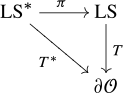
Proof.
For any pick a starting point for and define By Corollary 5.4, we have for any Therefore, the map is well defined.
Corollary 5.6.
The map preserves the cyclic order of elements in In particular, is injective.
Proof.
The cyclic order of leftmost sections is determined by the cyclic order of their values on embedded lines in the leaf space ([7
D. Calegari and N. M. Dunfield, Laminations and groups of homeomorphisms of the circle. Invent. Math. 152 (2003), no. 1, 149–204 Zbl 1025.57018 MR 1965363
, Lemma 6.25]; see also Section 4). Their images under must follow the same cyclic order by Lemma 5.2. Lemma 5.7.
The image of under is dense.
Proof.
It is clear that is equivariant, so is a invariant subset of The lemma follows from the minimality of the action on [20
S. R. Fenley, Geometry of foliations and flows I: almost transverse pseudo-Anosov flows and asymptotic behavior of foliations. J. Differential Geom. 81 (2009), no. 1, 1–89 Zbl 1160.57026 MR 2477891
]. Lemma 5.8.
The map extends continuously to a homeomorphism
Proof.
Proof of Theorem 5.1.
It suffices to show the “moreover” part about the map defined above. The equivariance is automatic from the way we define The structure maps are intertwined by because of Lemma 5.2.
It is also possible to define the universal circle from rightmost sections by considering the completion of rightmost sections (i.e., the sections of that go rightmost up and leftmost down). In general, there is no reason to expect However, we have the following corollary of Theorem 1.2.
Corollary 5.9.
Under the assumption of Theorem 1.2, the universal circles and are isomorphic.
Proof.
Using the same proof of Theorem 1.2, it can be shown that is isomorphic to hence isomorphic to
Corollary 5.9 suggests that one can view the sets of leftmost and rightmost sections as different dense subsets of the same circle. Indeed, the homeomorphisms from and to give embeddings of the sets of leftmost sections and rightmost sections into the both with dense image. Corollary 5.4 is true for both embeddings, so leftmost sections and rightmost sections never cross.
6. Invariant laminations
We conclude with a discussion of the invariant laminations on See Section 2 for a discussion about laminations on a circle.
Any separates into two components, the one containing the flow positive side of and the one containing the flow negative side of The leaf also separates into two parts, denoted by and with the same sign convention. Define a subset of by
The set is then defined as
It is proved in [5
D. Calegari, Promoting essential laminations. Invent. Math. 166 (2006), no. 3, 583–643 Zbl 1106.57014 MR 2257392
] that is indeed a pair of invariant laminations on We are now ready to prove Theorem 1.6. Recall that is the lamination on induced by
Proof of Theorem 1.6.
Take any type-0 leaf and consider the shadow Since is not a fiber, [19
S. R. Fenley, Surfaces transverse to pseudo-Anosov flows and virtual fibers in manifolds. Topology 38 (1999), no. 4, 823–859 Zbl 0926.57009 MR 1679801
, Proposition 4.6] shows that has leaves in both and Suppose that is a side of that is contained in a leaf of and consider the leftmost section starting from If is a leaf in we take a path in from to and track the closed interval as in the proof of Lemma 5.2. The interval is the stable gap of facing and the proof of Lemma 5.2 shows that is monotone increasing along the path. This means the shadow of is on the same side of as The side viewed as an element of is therefore in hence in By transitivity of every leaf of is dense in This implies that the image of is dense in because has no perfect fits. Since both and are invariant and closed, we have If is not empty, the difference must be a union of diagonals of complementary regions of Note that these diagonals cannot be approximated by leaves in so there must be such a diagonal in for some The corresponding complementary polygon comes from a singular leaf of and we denote the singularity in by
Suppose has endpoints and Then there is a sequence of leaves sides of and endpoints of so that converges to Up to taking a subsequence, we can assume that all are contained in leaves of or in leaves of If all are contained in leaves of then cannot be a boundary component of the convex hull of because will eventually cross by the absence of perfect fits. So all are contained in leaves of In particular, the singularity can be approximated by points in shadows of leaves in We will show that this is impossible, a contradiction.
If is in then there are points of on both sides of contradicting the assumption that Therefore, the orbit is disjoint from If is contained in it contradicts our assumption that by a similar reason. So is contained in Note that is not in otherwise a face of will be a side of and the face will be a leaf of as we showed above. This again contradicts the assumption that So orbits close enough to will stay in giving the desired contradiction.
Therefore, must be the same as For the same reason, we have finishing the proof of Theorem 1.6.
Acknowledgements
The author is grateful to his advisor, Yair Minsky, for being inspiring and supportive throughout this project. The author would like to thank Hyungryul Baik, Ellis Buckminster, Danny Calegari, Sergio Fenley, Michael Landry, Anna Parlak and Sam Taylor for helpful comments and conversations. The author thanks the referee for carefully reading the paper and for giving numerous insightful comments and suggestions.
Funding
The author is partially supported by NSF grant DMS-2005328.
References
- [1] I. Agol and C. C. Tsang, Dynamics of veering triangulations: infinitesimal components of their flow graphs and applications. Algebr. Geom. Topol. 24 (2024), no. 6, 3401–3453 Zbl 1552.57031 MR 4812222
- [2] T. Barbot, Caractérisation des flots d’Anosov en dimension 3 par leurs feuilletages faibles. Ergodic Theory Dynam. Systems 15 (1995), no. 2, 247–270 Zbl 0826.58025 MR 1332403
- [3] T. Barthelmé, S. Frankel, and K. Mann, Orbit equivalences of pseudo-Anosov flows. Invent. Math. 240 (2025), no. 3, 1119–1192 Zbl 08038253 MR 4902161
- [4] T. Barthelmé and K. Mann, Pseudo-Anosov flows: a plane approach. [v1] 2025, [v2] 2026, arXiv:2509.15375v2
- [5] D. Calegari, Promoting essential laminations. Invent. Math. 166 (2006), no. 3, 583–643 Zbl 1106.57014 MR 2257392
- [6] D. Calegari, Foliations and the geometry of 3-manifolds. Oxford Math. Monogr., Oxford University Press, Oxford, 2007, 363 pp. Zbl 1118.57002 MR 2327361
- [7] D. Calegari and N. M. Dunfield, Laminations and groups of homeomorphisms of the circle. Invent. Math. 152 (2003), no. 1, 149–204 Zbl 1025.57018 MR 1965363
- [8] A. Candel, Uniformization of surface laminations. Ann. Sci. Éc. Norm. Super. (4) 26 (1993), no. 4, 489–516 Zbl 0785.57009 MR 1235439
- [9] J. Cantwell and L. Conlon, Poincaré–Bendixson theory for leaves of codimension one. Trans. Amer. Math. Soc. 265 (1981), no. 1, 181–209 Zbl 0484.57015 MR 0607116
- [10] J. Cantwell and L. Conlon, Hyperbolic geometry and homotopic homeomorphisms of surfaces. Geom. Dedicata 177 (2015), no. 1, 27–42 Zbl 1359.37097 MR 3370020
- [11] J. Cantwell, L. Conlon, and S. R. Fenley, Endperiodic automorphisms of surfaces and foliations. Ergodic Theory Dynam. Systems 41 (2021), no. 1, 66–212 Zbl 1464.57022 MR 4190052
- [12] D. Cooper, D. D. Long, and A. W. Reid, Bundles and finite foliations. Invent. Math. 118 (1994), no. 1, 255–283 Zbl 0858.57015 MR 1292113
- [13] S. Fenley, Ideal boundaries of pseudo-Anosov flows and uniform convergence groups with connections and applications to large scale geometry. Geom. Topol. 16 (2012), no. 1, 1–110 Zbl 1279.37026 MR 2872578
- [14] S. Fenley and L. Mosher, Quasigeodesic flows in hyperbolic 3-manifolds. Topology 40 (2001), no. 3, 503–537 Zbl 0990.53040 MR 1838993
- [15] S. R. Fenley, Asymptotic properties of depth one foliations in hyperbolic manifolds. J. Differential Geom. 36 (1992), no. 2, 269–313 Zbl 0766.53018 MR 1180384
- [16] S. R. Fenley, Anosov flows in manifolds. Ann. of Math. (2) 139 (1994), no. 1, 79–115 Zbl 0796.58039 MR 1259365
- [17] S. R. Fenley, The structure of branching in Anosov flows of manifolds. Comment. Math. Helv. 73 (1998), no. 2, 259–297 Zbl 0999.37008 MR 1611703
- [18] S. R. Fenley, Foliations with good geometry. J. Amer. Math. Soc. 12 (1999), no. 3, 619–676 Zbl 0930.53024 MR 1674739
- [19] S. R. Fenley, Surfaces transverse to pseudo-Anosov flows and virtual fibers in manifolds. Topology 38 (1999), no. 4, 823–859 Zbl 0926.57009 MR 1679801
- [20] S. R. Fenley, Geometry of foliations and flows I: almost transverse pseudo-Anosov flows and asymptotic behavior of foliations. J. Differential Geom. 81 (2009), no. 1, 1–89 Zbl 1160.57026 MR 2477891
- [21] E. Field, H. Kim, C. Leininger, and M. Loving, End-periodic homeomorphisms and volumes of mapping tori. J. Topol. 16 (2023), no. 1, 57–105 Zbl 1567.57023 MR 4532490
- [22] D. Fried, Fibrations over with pseudo-Anosov monodromy. In Travaux de Thurston sur les surfaces, pp. 51–266, Astérisque 66–67, Société Mathématique de France, Paris, 1979 Zbl 0446.57023 MR 0568308
- [23] M. P. Landry, Y. N. Minsky, and S. J. Taylor, Endperiodic maps via pseudo-Anosov flows. 2023, arXiv:2304.10620v1, to appear in Geom. Topol.
- [24] M. P. Landry, Y. N. Minsky, and S. J. Taylor, Simultaneous universal circles. J. Topol. 19 (2026), no. 1, article no. e70054, 28 pp. Zbl 08143171 MR 5009301
- [25] M. P. Landry and C. C. Tsang, Endperiodic maps, splitting sequences, and branched surfaces. Geom. Topol. 29 (2025), no. 9, 4531–4663 Zbl 08152702 MR 5017754
- [26] M. P. Landry and C. C. Tsang, Pseudo-Anosov flows from sutured hierarchies. In preparation
- [27] L. Mosher, Dynamical systems and the homology norm of a manifold, I: efficient intersection of surfaces and flows. Duke Math. J. 65 (1992), no. 3, 449–500 Zbl 0754.58030 MR 1154179
- [28] L. Mosher, Laminations and flows transverse to finite depth foliations. Preprint, 1996
- [29] S. P. Novikov, The topology of foliations (in Russian). Tr. Moskov. Mat. Obs. 14 (1965), 248–278. English translation. Trans. Moscow Math. Soc. 14 (1965), 268–304 Zbl 0247.57006 MR 0200938
- [30] A. Parlak, Mutations and faces of the Thurston norm ball dynamically represented by multiple distinct flows. Geom. Topol. 29 (2025), no. 4, 2105–2173 Zbl 08084075 MR 4929474
- [31] W. P. Thurston, A norm for the homology of manifolds. Mem. Amer. Math. Soc. 59 (1986), no. 339, 99–130 Zbl 0585.57006 MR 0823443
- [32] W. P. Thurston, Three-manifolds, foliations and circles, II. Unfinished manuscript, 1998
Cite this article
Junzhi Huang, Depth-one foliations, pseudo-Anosov flows and universal circles. Groups Geom. Dyn. (2026), published online first
DOI 10.4171/GGD/964