Relative Calabi–Yau structures and perverse schobers on surfaces
Merlin Christ
Universität Bonn, Germany
Abstract
We give a treatment of relative Calabi–Yau structures on functors between linear stable categories, with any ring spectrum, generalizing previous treatments in the setting of dg categories. Using their gluing properties, we further construct relative Calabi–Yau structures on the global sections of perverse schobers, that is, categorified perverse sheaves, on surfaces with boundary. We treat examples coming from Fukaya categories and representation theory. In a related direction, we define the monodromy of a perverse schober parametrized by a ribbon graph on a framed surface and show that it forms a local system of stable categories.
1. Introduction
Let be a field. A linear triangulated category with finite-dimensional Homs is called Calabi–Yau if there exists an isomorphism of vector spaces
bifunctorial in To obtain a well-behaved notion of Calabi–Yau structure on a proper linear stable category one can ask for a trivialization of the Serre functor that is, the functor satisfying the following duality for linear derived Homs in :
The trivialization is called a weak right Calabi–Yau structure on Note that the natural transformations describe the dual Hochschild homology of The identification may thus additionally be required to be invariant, that is, to lie in the image of a dual cyclic homology class under the morphism This leads to the notion of a right Calabi–Yau structure on The importance of this invariance comes from the relation with topological field theories [12
K. Costello, Topological conformal field theories and Calabi–Yau categories. Adv. Math. 210 (2007), no. 1, 165–214 Zbl 1171.14038 MR 2298823
, 32J. Lurie, On the classification of topological field theories. In Current developments in mathematics, 2008, pp. 129–280, International Press, Somerville, MA, 2009 Zbl 1180.81122 MR 2555928
].There is a similar notion of left Calabi–Yau structure on a smooth linear stable category where instead of the Serre functor, one asks for a trivialization of the bimodule left dual of the evaluation bimodule. The endofunctor is sometimes called the inverse dualizing bimodule, as it is the inverse of the Serre functor if is smooth and proper.
In this paper, we will be concerned with generalizations of left and right Calabi–Yau structures to linear functors between linear stable categories, where is a base ring spectrum. Calabi–Yau structures on functors are also referred to as relative Calabi–Yau structures. This notion was suggested by Toën [43
B. Toën, Derived algebraic geometry. EMS Surv. Math. Sci. 1 (2014), no. 2, 153–240 Zbl 1314.14005 MR 3285853
] and fully worked out in the setting of dg categories by Brav–Dyckerhoff [2C. Brav and T. Dyckerhoff, Relative Calabi–Yau structures. Compos. Math. 155 (2019), no. 2, 372–412 Zbl 1436.18009 MR 3911626
]. The first half of this paper concerns a careful lift of this theory to the setting of linear stable categories.There are many natural examples of relative Calabi–Yau categories, the known ones usually come from Fukaya categories, representation theory, topology and algebraic geometry. Applications of relative Calabi–Yau structures include the constructions of shifted symplectic structures and Lagrangian structures on moduli spaces of objects [3
C. Brav and T. Dyckerhoff, Relative Calabi–Yau structures II: shifted Lagrangians in the moduli of objects. Selecta Math. (N.S.) 27 (2021), no. 4, article no. 63, 45 pp. Zbl 1486.14018 MR 4281260
], the construction of additive categorifications of cluster algebras with coefficients [8M. Christ, Cluster theory of topological Fukaya categories. [v1] 2022, [v2] 2024, arXiv:2209.06595v2
, 18C. Fraser, B. Keller, and Y. Wu, Relative cluster categories and Higgs categories with infinite-dimensional morphism spaces. 2023 arXiv:2307.12279v3
, 45Y. Wu, Relative cluster categories and Higgs categories. Adv. Math. 424 (2023), article no. 109040, 112 pp. Zbl 1545.13019 MR 4581969
], of Calabi–Yau exact categories/extriangulated categories from right Calabi–Yau functors [8M. Christ, Cluster theory of topological Fukaya categories. [v1] 2022, [v2] 2024, arXiv:2209.06595v2
] and of framed algebra structures on Hochschild cohomology [4C. Brav and N. Rozenblyum, The cyclic Deligne conjecture and Calabi–Yau structures. 2023 arXiv:2305.10323v1
], to name a few.Relative Calabi–Yau structures possess the remarkable feature that they can be glued together along suitable pushouts or pullbacks of categories to produce new relative or absolute Calabi–Yau structures. As emphasized by Brav–Dyckerhoff [2
C. Brav and T. Dyckerhoff, Relative Calabi–Yau structures. Compos. Math. 155 (2019), no. 2, 372–412 Zbl 1436.18009 MR 3911626
], Calabi–Yau structures should be considered as noncommutative orientations and their gluing property as a noncommutative version of the gluing property of oriented manifolds with boundary along boundary components.The gluing properties of relative Calabi–Yau structures can be used to construct relative Calabi–Yau structures on functors with target the topological Fukaya categories associated with framed marked surfaces [2
C. Brav and T. Dyckerhoff, Relative Calabi–Yau structures. Compos. Math. 155 (2019), no. 2, 372–412 Zbl 1436.18009 MR 3911626
]. These topological Fukaya categories can be seen as the global sections of perverse schobers on surfaces, that is, categorified perverse sheaves in the sense of [26M. Kapranov and V. Schechtman, Perverse schobers. [v1] 2014, [v2] 2015, arXiv:1411.2772v2
]. More generally, perverse schobers allow us to define Fukaya categories of surfaces ‘with coefficients’. Using the framework of [5M. Christ, Ginzburg algebras of triangulated surfaces and perverse schobers. Forum Math. Sigma 10 (2022), article no. e8, 72 pp. Zbl 1490.18017 MR 4377269
], we parametrize such perverse schobers by a ribbon graph homotopic to the surface. More specifically, such a parametrized perverse schober then amounts by definition to a certain constructible sheaf of stable categories on the ribbon graph, which is locally described by spherical adjunctions.In the second half of this paper, we discuss ways to construct relative Calabi–Yau structures on the global sections of more general perverse schobers on surfaces. The main results of this second half can be summarized as follows:
- We associate a local system of stable categories to a parametrized perverse schober on a framed marked surface encoding its monodromy on the surface away from its singularities. We also establish the independence of this local system on the chosen parametrizing ribbon graph. Further, we prove that parametrized perverse schobers without singularities are determined, up to equivalence, by their monodromy local systems.
- In the special case of perverse schobers without singularities, we prove the existence of a relative Calabi–Yau structure on its category of global sections, given the invariance of a local (negative) cyclic homology class under the monodromy action. This generalizes Brav–Dyckerhoff’s result [2C. Brav and T. Dyckerhoff, Relative Calabi–Yau structures. Compos. Math. 155 (2019), no. 2, 372–412 Zbl 1436.18009 MR 3911626] on relative Calabi–Yau structures on topological Fukaya categories of framed surfaces.
- We describe conditions which guarantee the existence of relative Calabi–Yau structures on the local and on the global sections of singular parametrized perverse schobers.
- We apply our results to construct relative Calabi–Yau structures on classes of examples, including Fukaya–Seidel categories, periodic topological Fukaya categories of marked surfaces, the derived categories of relative Ginzburg algebras associated with angulated surfaces, as well as variants of the latter which are linear over an arbitrary ring spectrum.
The remainder of the introduction is structured as follows. We begin in Section 1.1 by reviewing the notion of a relative Calabi–Yau structure over a base ring spectrum. We proceed in Section 1.2 with describing our results on relative Calabi–Yau structures on perverse schobers. In Section 1.3, we describe the implications of our results for Fukaya–Seidel categories and other Fukaya-type categories.
1.1. Relative Calabi–Yau structures
Let be the base ring spectrum. Our setting for the definition of relative Calabi–Yau structures is that of stable, presentable, dualizable, linear categories and dualizable (in particular colimit-preserving), linear functors between them. In the following, we sketch the definition of relative Calabi–Yau structures and describe the gluing properties. The definition makes use of the functoriality of linear Hochschild homology, as well as its action, which we obtain from the formalism of traces [23
M. Hoyois, S. Scherotzke, and N. Sibilla, Higher traces, noncommutative motives, and the categorified Chern character. Adv. Math. 309 (2017), 97–154 Zbl 1361.14014 MR 3607274
, 44B. Toën and G. Vezzosi, Caractères de Chern, traces équivariantes et géométrie algébrique dérivée. Selecta Math. (N.S.) 21 (2015), no. 2, 449–554 Zbl 1333.19006 MR 3338682
].Consider a dualizable linear functor between dualizable linear categories. To define the notion of a right Calabi–Yau structure on (also sometimes called a relative right Calabi–Yau structure on ), we assume that are proper as linear categories. The linear category being proper means that the evaluation functor admits an linear right adjoint, which can be identified with an endofunctor of If is compactly generated, the functor is a Serre functor on The natural transformations between and the identity functor are described by the dual Hochschild homology In a similar way, a class in the dual relative Hochschild homology of defines a map together with a null-homotopy of the composite map contained in the following diagram:
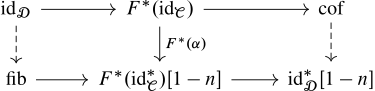
with horizontal fiber and cofiber sequences. This null-homotopy allows us to fill in the dashed arrows. We call a weak right Calabi–Yau structure on if the vertical maps in the above diagram are equivalences. A right Calabi–Yau structure on then further consists of a lift of to a relative dual cyclic homology class. If admits a right Calabi–Yau structure, we also say that is relative right Calabi–Yau. Non-relative right Calabi–Yau structures correspond to the case
The above definition is thus analogous to the definition of relative Calabi–Yau structures given in the setting of dg categories by Brav–Dyckerhoff [2
C. Brav and T. Dyckerhoff, Relative Calabi–Yau structures. Compos. Math. 155 (2019), no. 2, 372–412 Zbl 1436.18009 MR 3911626
]. We will show in Lemma 3.6 that a dg functor admits a weak Calabi–Yau structure if and only if the linear functor between the compactly generated derived categories admits a weak Calabi–Yau structure. The possibility to consider relative Calabi–Yau structures on dualizable linear categories thus makes the categorical setting slightly more general than the dg categorical setting. The definition of weak relative left and right Calabi–Yau structures for compactly generated categories linear over a commutative ring spectrum was also previously described in a model categorical framework in the unpublished Master’s thesis [29M. Leip, Relative Calabi–Yau structures over commutative ring spectra. Master’s thesis, Mathematisches Institut, Rheinische Friedrich-Wilhelms-Universität Bonn, Bonn, 2017
].We again summarize the above definition as follows: if is right Calabi–Yau, we have a trivialization of the shifted Serre functor. If instead is relative right Calabi–Yau, we have some natural transformation together with an identification of its cofiber with where is the right adjoint of To get a well-behaved theory, it is however important that this is not just any identification of the cofiber of with but rather that there is a specific such cofiber sequence coming from a relative dual Hochschild class.
Left Calabi–Yau structures for functors between smooth linear categories are defined similarly by replacing the right adjoint of the evaluation functor by the left adjoint, corresponding to an endofunctor and dual cyclic homology by negative cyclic homology.
Gluing Calabi–Yau structures. Relative Calabi–Yau structure can be glued together along pushouts or pullbacks of categories. There are also variants of this for categorical lax pushouts and pullbacks (see [9
M. Christ, T. Dyckerhoff, and T. Walde, Complexes of stable categories. [v1] 2023, [v2] 2024, arXiv:2301.02606v2
, Lem. 6.3.3]).For the gluing of left Calabi–Yau structures, consider a pushout diagram of smooth, dualizable linear categories and dualizable functors.
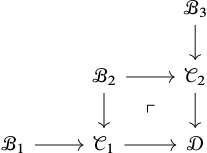
Theorem 1
(Theorem 3.15, [2
C. Brav and T. Dyckerhoff, Relative Calabi–Yau structures. Compos. Math. 155 (2019), no. 2, 372–412 Zbl 1436.18009 MR 3911626
] for a field). If the functors and carry linear left Calabi–Yau structures, which are compatible at then the functor inherits an linear left Calabi–Yau structure.For the gluing of right Calabi–Yau structures, we consider a pullback diagram of proper dualizable linear categories and dualizable functors as follows.
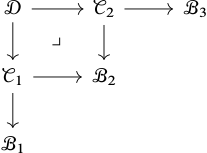
Theorem 2
(Theorem 3.16). If the functors and carry linear right Calabi–Yau structures, which are compatible at then the functor inherits an linear right Calabi–Yau structure.
We note that the analogue of Theorem 2 was not previously known for right Calabi–Yau structures on dg categories [2
C. Brav and T. Dyckerhoff, Relative Calabi–Yau structures. Compos. Math. 155 (2019), no. 2, 372–412 Zbl 1436.18009 MR 3911626
].1.2. Perverse schobers and relative Calabi–Yau structures
Perverse schobers are, in general, a conjectural categorification of perverse sheaves, proposed by Kapranov–Schechtman [26
M. Kapranov and V. Schechtman, Perverse schobers. [v1] 2014, [v2] 2015, arXiv:1411.2772v2
]. In this paper, we use the framework of perverse schobers parametrized by ribbon graphs of [5M. Christ, Ginzburg algebras of triangulated surfaces and perverse schobers. Forum Math. Sigma 10 (2022), article no. e8, 72 pp. Zbl 1490.18017 MR 4377269
]. This describes perverse schobers on marked surfaces with boundary in terms of constructible sheaves valued in stable categories defined on a spanning ribbon graph embedded in the surfaces. Concretely, a perverse schober parametrized by a graph is encoded as a functor Here denotes the category of stable categories, and the domain denotes the exit path category of whose objects are the vertices and edges of and whose morphisms describe the incidence between vertices and edges. The limit of this functor, denoted by is called the category of global sections of We remark that the usage of enhanced triangulated categories (such as the stable categories we employ in this paper) in our treatment of perverse schobers is essential, since there is no sensible theory of homotopy (co)limits of non-enhanced triangulated categories, which is needed for such a sheaf theory.
Monodromy of perverse schobers. A perverse sheaf on a topological surface restricts to a cochain complex of locally constant sheaves on the top-dimensional stratum, which is the complement of the discrete set of singularities. The cohomology sheaves of this cochain complex are trivial except in degree (in the typical convention), thus defining a local system of vector spaces. We discuss in Section 4.3, and sketch in the following, how to associate a similar local system of stable categories to parametrized perverse schobers.
If we only consider connected surfaces, then all generic, that is, non-singular, stalks of a given perverse sheaf are equivalent. The same is true for a parametrized perverse schober : the value of at any edge of is independent of the chosen edge, up to equivalence, and should be considered as the generic stalk. Denote the generic stalk by Locally at each vertex of a perverse schober is described by a spherical adjunction with called the category of vanishing cycles at If we call the vertex a singularity of
Let be the set of vertices of Given a perverse schober with a set of singularities we wish to associate a local system valued in on which we describe as a group homomorphism
to the group of equivalence classes of autoequivalences of the generic stalk
There is in general no canonical choice of such a local system. We can however canonically define a local system on the total space of the frame bundle The fiber of the frame bundle has the homotopy type of the circle the monodromy of the local system along the fiber is given Suppose now that we choose a framing of the surface meaning a section of its frame bundle. We can then pull back to a local system on and crucially, this local system extends to This defines the desired monodromy local system of We stress that this local system depends on the choice of framing
Note that in the special case that is periodic, that is, the local system on the frame bundle has trivial monodromy on the fiber. It thus already reduces to a local system on and no choice of framing is required as input.
Perverse schobers without singularities are fully determined by their monodromy.
Proposition 1
(Proposition 4.34). Let be a framing of Let be two parametrized perverse schobers without singularities with identical generic stalk Then there exists an equivalence if and only if the corresponding local systems
are equivalent.
The notion of a non-singular parametrized perverse schober is thus non-canonically equivalent to the notion of a local system of stable categories on the surface. Note that what we refer to as the global sections of the non-singular perverse schober is however very different from the global sections of a local system. The former type of global sections describes a generalized topological Fukaya category and categorifies the first cohomology of the surface relative to the complement in the boundary of the marked points.
Our results on the monodromy of perverse schobers relate to the problem of defining the topological Fukaya category of a marked surface over an arbitrary base category : without further assumptions on a choice of framing of the surface is required. Then there exists a perverse schober (unique up to equivalence) with generic stalk and trivial monodromy relative to the chosen framing. Its category of global sections describes the desired valued topological Fukaya category. In the case this categorical topological Fukaya category recovers the derived category of the dg categorical topological Fukaya category or equivalently of the categorical partially wrapped Fukaya category. If is periodic, then no choice of framing is required, and there is already a perverse schober with a well-defined trivial monodromy, whose global sections give the valued topological Fukaya category. In the setting of dg categories, this problem of constructing topological Fukaya categories (up to a contractible space of choices) was fully solved by Dyckerhoff–Kapranov [14
T. Dyckerhoff and M. Kapranov, Crossed simplicial groups and structured surfaces. In Stacks and categories in geometry, topology, and algebra, pp. 37–110, Contemp. Math. 643, American Mathematical Society, Providence, RI, 2015 Zbl 1373.18015 MR 3381470
, 15T. Dyckerhoff and M. Kapranov, Triangulated surfaces in triangulated categories. J. Eur. Math. Soc. (JEMS) 20 (2018), no. 6, 1473–1524 Zbl 1403.18011 MR 3801819
] using the formalism of Segal objects. Their construction in fact additionally supplies a choice of perverse schober with trivial monodromy for every choice of spanning ribbon graph. Their construction was extended to the case of the stable category of right modules over the periodic sphere spectrum by Lurie [33
J. Lurie,
Rotation invariance in algebraic K-theory.
Version of 2015, preprint, https://www.math.ias.edu/~lurie/papers/Waldhaus.pdf visited on 29 December 2025
].Local Calabi–Yau structures. Let be an linear parametrized perverse schober. Locally at any vertex of the graph with incident edges the perverse schober is given by a collection of functors One can show that these functors arise, up to suitable equivalence, from a single spherical adjunction via an explicit construction based on the relative Waldhausen construction (see Proposition 4.10). We say that the adjunction underlies at
Proposition 2
(Combine Propositions 4.10 and 5.2). Let be a parametrized perverse schober, with underlying spherical adjunction near a vertex of
- (1)If admits a right -Calabi–Yau structure, which restricts to a right -Calabi–Yau structure on , then the functor also admits a right -Calabi–Yau structure.
- (2)If admits a left -Calabi–Yau structure, which restricts to a left -Calabi–Yau structure of , then the right adjoint of the above functor also admits a left -Calabi–Yau structure.
We further prove a novel criterion for a spherical functor between compactly generated, proper linear categories, where is weakly right Calabi–Yau, to admit a weak right Calabi–Yau structure: this is the case if and only if its twist functor is equivalent to the shifted Serre functor (see Proposition 5.9).
Global Calabi–Yau structures. Given a parametrized perverse schober we can evaluate global sections at the external (i.e., boundary) edges of whose set is denoted by This yields a functor
The right adjoint of this functor is denoted by
Typically, a relative Calabi–Yau structure on the category of global sections arises in the smooth setting as a left Calabi–Yau structure on the functor and in the proper setting as right Calabi–Yau structure on the functor
Note that finite limits of proper dualizable linear categories in (or equivalently in the category of linear categories) are not necessarily again dualizable and proper. We can fix this issue by forming the limits in the category of dualizable linear categories (see Corollary 3.14). The arising notion of category of global sections is denoted by we call these the dualizable global sections. In the proper setting, we should thus ask for the restriction of to to be relative right Calabi–Yau.
When the global sections describe the partially wrapped Fukaya category of a surface, the difference between and can be explained as follows: the category describes the usual smooth partially wrapped Fukaya category of the marked surface. The proper full subcategory consists of those Lagrangians which do not end at the boundary components containing no marked points.
For perverse schobers without singularities, we prove the following.
Theorem 3
(Theorem 5.8). Let be a parametrized perverse schober without singularities valued in dualizable linear categories. Suppose that the generic stalk is smooth and admits a left Calabi–Yau structure
Suppose that the monodromy local system on preserves Then the functor
admits a left Calabi–Yau structure.
A similar statement holds for relative right Calabi–Yau structures on the dualizable global sections
Theorem 3 generalizes Brav–Dyckerhoff’s result [2
C. Brav and T. Dyckerhoff, Relative Calabi–Yau structures. Compos. Math. 155 (2019), no. 2, 372–412 Zbl 1436.18009 MR 3911626
] on relative Calabi–Yau structures on topological Fukaya categories of framed marked surfaces (corresponding to the case and a perverse schober with trivial monodromy relative to the chosen framing).There is no direct analogue of Theorem 3 for general perverse schobers with singularities. Essentially, this is because a perverse schober is not determined up to equivalence by the separate records of monodromy data and local singularity data (see Example 4.35). There is however an almost immediate consequence of the gluing property of relative Calabi–Yau structures for global sections of perverse schobers (see Theorem 5.7), which can be applied in practice by using the local Calabi–Yau structures from Proposition 2.
1.3. Examples: Fukaya categories and Fukaya-type categories
Fukaya–Seidel categories. Let be an exact symplectic manifold of dimension and a Lefschetz fibration with base the disc. Let be the regular fiber of and the proper Fukaya category of compact Lagrangians in The Fukaya–Seidel category is equivalent to the directed subcategory of on the vanishing cycles of the Lefschetz fibrations [37
P. Seidel, Fukaya categories and Picard–Lefschetz theory. Zur. Lect. Adv. Math., European Mathematical Soceity, Zürich, 2008, 326 pp. Zbl 1159.53001 MR 2441780
]. The corresponding derived Fukaya–Seidel category is a triangulated category and admits a canonical enhancement to a linear stable category The formalism of parametrized perverse schobers on the disc considered as a marked surface with a single marked point, realizes the derived Fukaya–Seidel category as the global sections of a perverse schober. The generic stalk of the schober is the derived Fukaya category of the fiber The singularities of the perverse schober lie at the singular values of the Lefschetz fibration; the corresponding spherical adjunctions arise from the spherical objects in given by the vanishing cycles. The ribbon graph parametrizing is chosen so that the singular values all lie at valent vertices. There is a further non-singular valent vertex with the number of vanishing cycles. The value of at is the directed category
Any spherical object in a weak Calabi–Yau category gives rise to a weak Calabi–Yau spherical functor (see Lemma 6.4). The gluing properties of right Calabi–Yau structures thus yield a weak relative right Calabi–Yau structure on This induces the known natural transformation [38
P. Seidel, Symplectic homology as Hochschild homology. In Algebraic geometry: Seattle 2005, Part 1, pp. 415–434, Proc. Sympos. Pure Math. 80, American Mathematical Society, Providence, RI, 2009 Zbl 1179.53085 MR 2483942
] from the Serre functor In Section 6.1, we will give a more detailed account of the above construction in the alternative framework of [20
S. Ganatra, J. Pardon, and V. Shende, Sectorial descent for wrapped Fukaya categories. J. Amer. Math. Soc. 37 (2024), no. 2, 499–635 Zbl 1546.53081 MR 4695507
] for the definition of Fukaya–Seidel categories. In this framework, we furthermore prove that the smooth and proper Fukaya–Seidel category admits not only a weak relative right Calabi–Yau structure but also a weak relative left Calabi–Yau structure.Theorem 4
- (i)The derived -category of the Fukaya–Seidel category arises as the -category of global sections of the perverse schober on the disc from Construction 6.3.
- (ii)The smooth and proper derived Fukaya–Seidel category admits both a weak relative left -Calabi–Yau structure and a weak relative right -Calabi–Yau structure.
The Fukaya–Seidel category is defined in [20
S. Ganatra, J. Pardon, and V. Shende, Sectorial descent for wrapped Fukaya categories. J. Amer. Math. Soc. 37 (2024), no. 2, 499–635 Zbl 1546.53081 MR 4695507
] as a partially wrapped Fukaya category with a stop in the fiber over Part (i) of Theorem 6.1 should readily generalize to the partially wrapped Fukaya categories arising from Lefschetz fibrations over an arbitrary marked surface. Up to technicalities, this follows from the cosheaf properties of such a partially wrapped Fukaya category shown in [20S. Ganatra, J. Pardon, and V. Shende, Sectorial descent for wrapped Fukaya categories. J. Amer. Math. Soc. 37 (2024), no. 2, 499–635 Zbl 1546.53081 MR 4695507
]. The statement about the relative left Calabi–Yau property of part (ii) of Theorem 6.1 may be generalized to this setting, given an understanding of the action of the monodromy of the Lefschetz fibration on the non-degenerate Hochschild class of the wrapped Fukaya category of the fiber.Periodic topological Fukaya categories. The author’s initial motivating example for treating relative Calabi–Yau structures over an arbitrary base was the construction of relative right Calabi–Yau structures on periodic topological Fukaya categories of marked surfaces. These can be considered as graded versions of the partially wrapped Fukaya categories. Their construction is the topic of Section 6.2. Relative right Calabi–Yau structure induces Calabi–Yau Frobenius exact structures (see [8
M. Christ, Cluster theory of topological Fukaya categories. [v1] 2022, [v2] 2024, arXiv:2209.06595v2
]), which in turn induce Calabi–Yau Frobenius extriangulated structures on the homotopy categories. In the case of periodic topological Fukaya categories, this exact/extriangulated structure allows for the additive categorification of cluster algebras with coefficients associated with surfaces (see [8M. Christ, Cluster theory of topological Fukaya categories. [v1] 2022, [v2] 2024, arXiv:2209.06595v2
]).As linear categories, with a field, these periodic categories are smooth but not proper, since the Ext-groups are non-zero in infinitely many degrees. This changes when we work with respect to a different base. For an integer, the derived category of periodic chain complexes is equivalent to the derived category of the dg algebra of graded Laurent polynomials, with generator in degree If is even, then is graded commutative and thus gives rise to an ring spectrum. If is odd, we can consider as a linear algebra object. Over the base or if is odd, the derived category is both smooth and proper and admits left and right Calabi–Yau structures.
Considering the periodic topological Fukaya category over the base or if is odd, Theorem 3 yields the desired relative Calabi–Yau structure on it.
Relative Ginzburg algebras over any base ring spectrum. The derived categories of relative Ginzburg algebras of angulated surfaces arise as the global sections of parametrized perverse schobers (see [5
M. Christ, Ginzburg algebras of triangulated surfaces and perverse schobers. Forum Math. Sigma 10 (2022), article no. e8, 72 pp. Zbl 1490.18017 MR 4377269
, 6M. Christ, Geometric models for the derived categories of Ginzburg algebras of n-angulated surfaces via local-to-global principles. [v1] 2021, [v4] 2023, arXiv:2107.10091v4
]). In Section 6.3, we construct relative left Calabi–Yau structures on these derived categories. In the case this result is a special case of results [45Y. Wu, Relative cluster categories and Higgs categories. Adv. Math. 424 (2023), article no. 109040, 112 pp. Zbl 1545.13019 MR 4581969
, 46W.-K. Yeung, Relative Calabi–Yau completions. [v1] 2016, [v3] 2022, arXiv:1612.06352v2
] on relative left Calabi–Yau structures on relative Ginzburg algebras of ice quivers with potentials or equivalently relative Calabi–Yau completions. In the case these categories can further be expected to describe the derived categories of the partially wrapped Fukaya categories of the 3-folds studied in [41I. Smith, Quiver algebras as Fukaya categories. Geom. Topol. 19 (2015), no. 5, 2557–2617 Zbl 1328.53109 MR 3416110
].The relevant perverse schobers are locally near each vertex described by the spherical adjunction where is the map from the singular simplicial set of the sphere to the point. The functor is left Calabi–Yau. Furthermore, the functor obtained by restricting to a functor is right Calabi–Yau.
We can replace by with an ring spectrum, to obtain an linear version of this adjunction. We expect that both the Calabi–Yau structures of and can be lifted to the linear setting, but we only prove that we have a weak right Calabi–Yau structure on Its existence is proven using the criterion for the existence of weak right Calabi–Yau structures on spherical functors of Proposition 5.9. Via gluing, the Calabi–Yau structure on yields weak relative right Calabi–Yau structures on the locally compact global sections of linear perverse schobers that generalize (finite) derived categories of relative Ginzburg algebras.
Besides the Calabi–Yau structures for this class of examples, many other classes of examples of linear relative Calabi–Yau structures also remain to be worked out.
1.4. Notation
We generally follow the notation and conventions of [31
J. Lurie, Higher topos theory. Ann. of Math. Stud. 170, Princeton University Press, Princeton, NJ, 2009, 925 pp. Zbl 1175.18001 MR 2522659
, 34
J. Lurie,
Higher algebra.
2017,
preprint, https://www.math.ias.edu/~lurie/papers/HA.pdf visited on 29 December 2025
]. In particular, we use the homological grading convention. Given an category and two objects we denote by the mapping space. We denote the completion of by and the subcategory of ()compact objects of by Given a functor we denote its left and right adjoints, if existent, by and respectively.2. Linear categories and Hochschild homology
In this section, we review background material on linear categories, with an ring spectrum, different notions of duals of bimodules, smooth and proper linear categories and linear traces and Hochschild homology. Much of this material appears in a similar form in [2
C. Brav and T. Dyckerhoff, Relative Calabi–Yau structures. Compos. Math. 155 (2019), no. 2, 372–412 Zbl 1436.18009 MR 3911626
, 3C. Brav and T. Dyckerhoff, Relative Calabi–Yau structures II: shifted Lagrangians in the moduli of objects. Selecta Math. (N.S.) 27 (2021), no. 4, article no. 63, 45 pp. Zbl 1486.14018 MR 4281260
, 23M. Hoyois, S. Scherotzke, and N. Sibilla, Higher traces, noncommutative motives, and the categorified Chern character. Adv. Math. 309 (2017), 97–154 Zbl 1361.14014 MR 3607274
, 34
J. Lurie,
Higher algebra.
2017,
preprint, https://www.math.ias.edu/~lurie/papers/HA.pdf visited on 29 December 2025
, 35
J. Lurie,
Spectral algebraic geometry.
2018,
preprint, https://www.math.ias.edu/~lurie/papers/SAG-rootfile.pdf visited on 29 December 2025
], though partly with less general proofs. The reader will find that most things work in the linear setting very similarly to those in the setting of dg categories.2.1. Linear categories
Let be the category of categories and the category of spaces. We denote by the subcategory of presentable categories and left adjoint functors and by the subcategory of presentable categories and right adjoint functors. The category admits a symmetric monoidal structure such that a commutative algebra object in amounts to a symmetric monoidal presentable category satisfying that its tensor product preserves colimits in both entries (see [34
J. Lurie,
Higher algebra.
2017,
preprint, https://www.math.ias.edu/~lurie/papers/HA.pdf visited on 29 December 2025
, § 4.8]). An example of a commutative algebra object in is the category of right module spectra over an ring spectrum Note that if is a commutative ring, then is equivalent as a symmetric monoidal category to the (unbounded) derived category (see [34
J. Lurie,
Higher algebra.
2017,
preprint, https://www.math.ias.edu/~lurie/papers/HA.pdf visited on 29 December 2025
, Thm. 7.1.2.13]).Definition 2.1.
Let be an ring spectrum. The category
of modules in over is called the category of linear categories.
As noted in [35
J. Lurie,
Spectral algebraic geometry.
2018,
preprint, https://www.math.ias.edu/~lurie/papers/SAG-rootfile.pdf visited on 29 December 2025
, § D.1.5], linear categories in the above sense are automatically stable. Given we denote the result of the action of an element on by Definition 2.2
([34
J. Lurie,
Higher algebra.
2017,
preprint, https://www.math.ias.edu/~lurie/papers/HA.pdf visited on 29 December 2025
, Def. 4.2.1.28]). Let be an ring spectrum. Let be an linear category, and let A morphism object is an module equipped with a map in such that for every object the following composite morphism is an equivalence of spaces:We thus have for all
Remark 2.3.
Morphism objects always exist, and the formation of morphism objects forms a functor
which preserves limits in both entries (see [34
J. Lurie,
Higher algebra.
2017,
preprint, https://www.math.ias.edu/~lurie/papers/HA.pdf visited on 29 December 2025
, Rem. 4.2.1.31]).The category inherits a symmetric monoidal structure, as the module category over a commutative algebra object. We will often make use of this monoidal product and denote it by The tensor product of arises as the geometric realization of the two-sided bar construction which is given informally by the formula where denotes the symmetric monoidal product of The symmetric monoidal category is closed. As observed in [23
M. Hoyois, S. Scherotzke, and N. Sibilla, Higher traces, noncommutative motives, and the categorified Chern character. Adv. Math. 309 (2017), 97–154 Zbl 1361.14014 MR 3607274
, § 4.1], using that is closed, the internal Hom in denoted can be obtained as the limit of a cosimplicial object obtained from replacing the tensor products in the two-sided bar resolution by the right adjoint internal Homs in We record the following functoriality of the internal Hom of Lemma 2.4.
There is a functor
satisfying
functorial in and We call the linear category of linear functors from to
Proof.
To construct the functor we follow [34
J. Lurie,
Higher algebra.
2017,
preprint, https://www.math.ias.edu/~lurie/papers/HA.pdf visited on 29 December 2025
, Rem. 4.2.1.31]. Consider the functorMoving the second copy of to the other side, we obtain a functor
whose image lies in the full subcategory of representable presheaves, since is a closed monoidal category. Composing with the inverse of the Yoneda embedding yields the functor By construction, we have
functorial in It follows that
functorial in and Composing again with the inverse of the Yoneda embedding shows (2.1), concluding the proof.
Lemma 2.5.
Let
- (1)The forgetful functor is exact and reflects finite limits and colimits.
- (2)The subcategory of of functors admitting an -linear right adjoint (i.e., of dualizable functors) is closed under finite limits and colimits.
Proof.
The forgetful functor factors through the internal Hom in and the functor is exact and reflects finite limits and colimits. Since and are stable categories, it thus suffices for part (1) to show that the full inclusion preserves finite colimits and loops. Colimits of colimit-preserving functors again preserve colimits since colimits commute with colimits.
2.2. Dualizable categories
We fix an ring spectrum Recall that an linear category is called dualizable if it admits a duality datum consisting of evaluation and coevaluation functors
and
satisfying the triangle identities.
Recall further that an category is called compactly generated if is equivalent to the completion of its subcategory of compact objects.
Definition 2.6.
We denote by the subcategory consisting of dualizable linear categories and dualizable functors, meaning linear functors whose right adjoint preserves colimits and is thus again linear.
We denote by the subcategory consisting of compactly generated categories and compact object-preserving functors.
An linear category is dualizable if and only if it is compactly assembled (see [35
J. Lurie,
Spectral algebraic geometry.
2018,
preprint, https://www.math.ias.edu/~lurie/papers/SAG-rootfile.pdf visited on 29 December 2025
, Thm. D.7.0.7]), which is equivalent to being a retract of a compactly generated, presentable and stable category in the category of stable, presentable categories (see [35
J. Lurie,
Spectral algebraic geometry.
2018,
preprint, https://www.math.ias.edu/~lurie/papers/SAG-rootfile.pdf visited on 29 December 2025
, Prop. D.7.3.1]).In particular, any compactly generated linear category is dualizable. In this case, the dual is given by the Ind-completion where denotes the subcategory of compact object and its opposite category. If is compactly generated, the evaluation functor restricts along
to the restriction of the morphism object functor (see [35
J. Lurie,
Spectral algebraic geometry.
2018,
preprint, https://www.math.ias.edu/~lurie/papers/SAG-rootfile.pdf visited on 29 December 2025
, Prop. D.7.2.3, Rem. D.7.7.6]). Under the assumption that is compactly generated, an linear functor is dualizable if and only if it preserves compact objects (see [31J. Lurie, Higher topos theory. Ann. of Math. Stud. 170, Princeton University Press, Princeton, NJ, 2009, 925 pp. Zbl 1175.18001 MR 2522659
, Prop. 5.5.7.2]). We thus have a fully faithful inclusion We remark that this inclusion preserves both limits and colimits, as follows from the results of [17A. I. Efimov, K-theory and localizing invariants of large categories. [v1] 2024, [v3] 2025, arXiv:2405.12169v3
].Remark 2.7.
The category admits (small) colimits, and these are preserved by the forgetful functor This follows from combining [17
A. I. Efimov, K-theory and localizing invariants of large categories. [v1] 2024, [v3] 2025, arXiv:2405.12169v3
, Prop. 1.65] and [34
J. Lurie,
Higher algebra.
2017,
preprint, https://www.math.ias.edu/~lurie/papers/HA.pdf visited on 29 December 2025
, Cor. 3.4.4.6].The category also admits (small) limits, described in [17
A. I. Efimov, K-theory and localizing invariants of large categories. [v1] 2024, [v3] 2025, arXiv:2405.12169v3
]. In the setting of compactly generated categories, limits can be very concretely described: on the level of the underlying categories, the limit of a diagram is computed by first restricting the values to compact objects, for all computing the limit of the resulting diagram in and then passing to the completion. This essentially follows from the fact that limits in the subcategory of compactly generated, stable categories and compact object-preserving functors are computed this way, since is equivalent to the category of idempotent complete stable categories.Definition 2.8.
Given a dualizable linear functor between dualizable linear categories with right adjoint we define the functor as the composite
Note that if are compactly generated, then
is obtained by taking the opposite functor of the restriction of to compact objects and then applying completion.
Definition 2.9.
Given a dualizable linear category we denote by
the linear Yoneda embedding. Its inverse is given by
Lemma 2.10.
Let be a dualizable linear functor between dualizable linear categories with right adjoint Then the following diagram commutes.
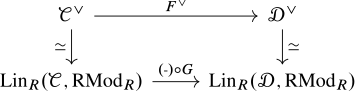
The functor is left adjoint to and the functor is hence dualizable.
Proof.
This readily follows from inspecting the definitions and using the triangle identities for the evaluation and coevaluation functors.
Lemma 2.11.
Let be a dualizable linear category. There exists an equivalence of linear functors :
Proof.
We note that and thus Composing with this equivalence, both functors in (2.2) yield showing their equivalence.
2.3. Duals of bimodules
We again fix a base ring spectrum Suppose we are given two linear ring spectra The category of bimodules is equivalent to the category of linear functors between the respective right module categories (see [34
J. Lurie,
Higher algebra.
2017,
preprint, https://www.math.ias.edu/~lurie/papers/HA.pdf visited on 29 December 2025
, Thms. 4.3.2.7 and 4.8.4.1]). In terms of functors, left and right duals of bimodules, if they exist, correspond to left and right adjoints of the corresponding functors. In the following, we will work with functors instead of bimodules.Let be a dualizable linear category. We are especially interested in the adjoints of functors or This corresponds as a special case to studying modules over the enveloping algebra of some linear ring spectrum We have the following equivalences.
Lemma 2.12.
The following statements hold:
- (1)The -linear functor , defined as the compositeis an equivalence with inverse given by
- (2)The -linear functor , defined as the compositeis an equivalence with inverse given by
Proof.
We begin by proving part (1). The equivalence of categories
with the linear Yoneda embedding, maps an endofunctor to the functor This shows that is essentially surjective. The triangle identity for and implies that It follows that is faithful, and in fact a split inclusion on Hom spaces. Using that all objects are of the form we find Using that and are exact, it follows that is also full, showing that is an equivalence. Since the inverse of is given by
For part (2), a similar argument as above applies, using that the equivalence of categories
maps a functor to
Notation 2.13.
We denote by the linear equivalence which permutes the factors.
We can use the equivalences and to define the dual of an linear endofunctor considered as a functor or
Definition 2.14.
Let be an linear endofunctor.
- (1)We call left dualizable if admits an linear left adjoint. In this case, we callthe left dual of
- (2)We call right dualizable if admits an linear right adjoint. In this case, we callthe right dual of
Proposition 2.15.
Let
- (1)is left dualizable if and only if admits a right adjoint, and in this case,
- (2)is right dualizable if and only if admits a left adjoint, and in this case,
Proof.
The lemma follows from Lemma 2.16 and the observation that for any dualizable linear functor we have
Lemma 2.16.
Let There are commutative diagrams
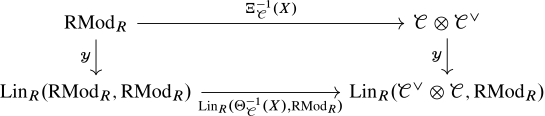
and
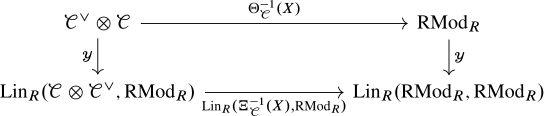
with the linear Yoneda embedding (see Definition 2.9).
Proof.
The evaluation functor
is, after reordering the factors of the tensor product, given by the tensor product of the evaluation functors of and Note that these two evaluation functors are themselves equivalent up to composition with The Yoneda embedding
is thus given by the functor
Using this, the commutativity directly follows from the triangle identities for the evaluation and coevaluation functors when inserting the descriptions of in Lemma 2.12.
Remark 2.17.
We denote by the stable subcategories of left dualizable functors. We similarly denote by the stable subcategory of right dualizable functors. Since passing to adjoints is functorial (see [31
J. Lurie, Higher topos theory. Ann. of Math. Stud. 170, Princeton University Press, Princeton, NJ, 2009, 925 pp. Zbl 1175.18001 MR 2522659
, Prop. 5.2.6.2]), there are exact functorsand
More concretely, we find that is given by the subcategory of compact objects. This follows from the observation that a compact object in
gives via the Yoneda embedding rise to an exact functor which also preserves filtered limits, and hence all limits, and thus admits a left adjoint by the adjoint functor theorem. If is compactly generated, then an endofunctor is right dualizable if and only if its image under in preserves compact objects, since in this case the right adjoint preserves colimits and is thus linear.
Lemma 2.18.
Let be a morphism in with linear right adjoint
- (1)There exists a commutative diagram.
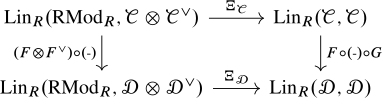 In particular, it follows that the -linear functorpreserves compact objects, meaning left dualizable functors.
 - (2)There exists a commutative diagram.
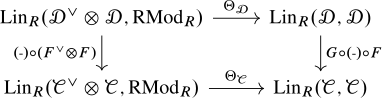 In particular, it follows that the -linear functorpreserves right dualizable functors.
Proof.
that
functorial in
2.4. Smooth and proper linear categories
We fix an ring spectrum and a dualizable linear category
Definition 2.19.
Let be as above.
- (1)The category is called smooth if is left dualizable. In this case, the left dual is also called the inverse dualizing bimodule.
- (2)The category is called proper if the functor is right dualizable.
Note that we do not require smooth or proper categories to be compactly generated. However, if is compactly generated, then being proper is equivalent to the assertion that for any two compact objects the linear morphism object is compact.
We denote
Definition 2.20.
Suppose that is compactly generated and proper. We call an linear endofunctor a Serre functor of if there exists a natural equivalence
Lemma 2.21.
Suppose that is compactly generated and proper, and let be two Serre functors of Then
Proof.
Since and are both Serre functors, there exist natural equivalences
Applying to this equivalence yields
It follows that on by (a corollary of) the Yoneda lemma (see, for instance, [11
D.-C. Cisinski, Higher categories and homotopical algebra. Cambridge Stud. Adv. Math. 180, Cambridge University Press, Cambridge, 2019, 430 pp. Zbl 1430.18001 MR 3931682
, Cor. 5.8.14]). Passing to completions shows Lemma 2.22.
The following statements hold:
- (1)If is proper and compactly generated, the right dual is a Serre functor of
- (2)If is smooth and proper, the functors and are inverse equivalences.
Remark 2.23.
Part (1) of Lemma 2.22 is stated without proof in [35
J. Lurie,
Spectral algebraic geometry.
2018,
preprint, https://www.math.ias.edu/~lurie/papers/SAG-rootfile.pdf visited on 29 December 2025
, Rem. 11.1.5.2].Proof of Lemma 2.22.
We begin by proving part (1). We denote by
the functor obtained by passing to completions from the restriction of to Let and consider the adjunction
Using that and the fully faithfulness of the linear Yoneda embedding of we find that the right adjoint is given by evaluation at that is,
Using the identification
we define the functor
with left adjoint
Informally, the left adjoint is given by
The right adjoint of the evaluation functor is equivalent to Using the description of the Yoneda embedding in (2.3), it follows that the right adjoint of the functor
is equivalent to
In total, we obtain that the right adjoint of
is given by Using the above adjunctions, the fully faithfulness of the linear Yoneda embedding and Lemma 2.11, we find the following equivalences in functorial in :
This shows that is indeed a Serre functor.
We proceed with proving part (2). We have
and passing to the right adjoint yields
We have
and by Proposition 2.15, we further obtain
Combining the above equivalences yields The identity arises from a similar argument by passing to the left adjoint of (2.4).
Definition 2.24.
Given a compactly generated linear category we denote by the full subcategory of objects satisfying that is compact for all We also refer to the objects of as finite.
The following lemma provides the analogue of part (1) of Lemma 2.22 for smooth, but not necessarily proper, linear categories.
Lemma 2.25.
Let be a compactly generated and smooth linear category. Then
functorial in and
In particular, this shows that if is an equivalence, then
Proof.
The exact inclusion gives rise to an linear functor The linear functor
preserves compact objects by the definition of and thus admits an linear right adjoint We define the linear functor as the composite
The functor admits a left adjoint, given by the composite
which describes the composite of with the linear functor
functorial in and By the above adjunction, we have
which combined with (2.5) yields the desired equivalence.
2.5. Traces
We fix an ring spectrum
Definition 2.26.
Let be a dualizable linear category. Let be an linear endomorphism. The trace of is defined as the linear endomorphism
In the following, we recall the construction of Hoyois–Scherotzke–Sibilla [23
M. Hoyois, S. Scherotzke, and N. Sibilla, Higher traces, noncommutative motives, and the categorified Chern character. Adv. Math. 309 (2017), 97–154 Zbl 1361.14014 MR 3607274
] of the equivariant categorical trace functor. This functor will also give rise to the Hochschild homology functor.As a model for categories, we use Barwick’s complete fold Segal spaces. We let be a symmetric monoidal category. We will primarily be interested in the case where is the category of linear stable and presentable categories (see [23
M. Hoyois, S. Scherotzke, and N. Sibilla, Higher traces, noncommutative motives, and the categorified Chern character. Adv. Math. 309 (2017), 97–154 Zbl 1361.14014 MR 3607274
, § 4.4]), where the notation is used. We have an associated complete (fold) Segal space (which models an category) of symmetric monoidal oplax transfors [25T. Johnson-Freyd and C. Scheimbauer, (Op)lax natural transformations, twisted quantum field theories, and “even higher” Morita categories. Adv. Math. 307 (2017), 147–223 Zbl 1375.18043 MR 3590516
]where denotes the free rigid1 category generated by (see also [23
By rigid, we mean that all objects are dualizable.
M. Hoyois, S. Scherotzke, and N. Sibilla, Higher traces, noncommutative motives, and the categorified Chern character. Adv. Math. 309 (2017), 97–154 Zbl 1361.14014 MR 3607274
, Def. 2.2]). The objects and morphisms in can be concretely described as follows:- Objects are given by pairs with dualizable and an endomorphism in
- A morphism corresponds to a right dualizable morphism in together with an oplax-commutative square
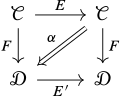 meaning a morphism in
We also consider the complete Segal space of endomorphisms of the monoidal unit of The trace is defined by [23
M. Hoyois, S. Scherotzke, and N. Sibilla, Higher traces, noncommutative motives, and the categorified Chern character. Adv. Math. 309 (2017), 97–154 Zbl 1361.14014 MR 3607274
, Defs. 2.9 and 2.11] as a symmetric monoidal functor between complete Segal spaceswhich is natural in Given a morphism in the morphism
in can be identified with the composition of the following natural transformations.
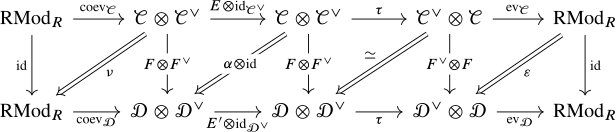
Using the triangle identities, the natural transformation above is defined as the composite of
and
where denotes the right adjoint of and the counit. The natural transformation is defined similarly. Further, is also equivalent to the composite
where denotes the unit and is the apparent morphism (see [3
C. Brav and T. Dyckerhoff, Relative Calabi–Yau structures II: shifted Lagrangians in the moduli of objects. Selecta Math. (N.S.) 27 (2021), no. 4, article no. 63, 45 pp. Zbl 1486.14018 MR 4281260
, Lem. 4.1]).Finally, we turn to the functoriality of the trace functor. For this, consider the complete Segal space which comes with a symmetric monoidal inclusion The objects of are given as pairs with dualizable and an equivalence. The self-action of the circle group induces an action on which in turn induces an action on the space of functors, natural in The trace can be exhibited as a homotopy fixed point of the action on (see [23
M. Hoyois, S. Scherotzke, and N. Sibilla, Higher traces, noncommutative motives, and the categorified Chern character. Adv. Math. 309 (2017), 97–154 Zbl 1361.14014 MR 3607274
, Thm. 2.14]). This invariance datum results in an action on the trace of any pair as well as an equivariant map for any morphism in Remark 2.27.
The datum of the invariance of the trace functor is natural in the symmetric monoidal category Thus, given a symmetric monoidal functor and a dualizable object we have an equivariant equivalence
We can specialize this to the symmetric monoidal functor from the terminal symmetric monoidal category, mapping the unique object of to the unit object of Since the action on the trace is necessarily trivial, this shows that the action on is also trivial. In particular, this holds for with and
2.6. Hochschild homology
We fix an ring spectrum Given a dualizable linear category its linear Hochschild homology is defined as the value of the trace at :
Note that is an linear functor and thus fully determined by its value When is the sphere spectrum, is also called topological Hochschild homology. When is a commutative ring, describes the usual linear Hochschild homology.
The dual Hochschild homology is defined as
The fixed points (limit over ) of the action on are denoted by We will refer to as the negative cyclic homology of as recovers the usual negative cyclic homology when is a commutative ring. The orbits (colimit over ) of the action on are denoted and we similarly call the cyclic homology. The dual cyclic homology is given by There are natural maps and
Notation 2.28.
Let be a morphism in We denote by
- (1)the evaluation at of We further define
- (2)the induced map. In the same way, we define
Let be a morphism in We denote by
- (3)the dual map obtained by precomposition with We further define
- (4)the induced map. In the same way, we define
The notation in (1) and (2) will usually be used when discussing left Calabi–Yau structures on whereas the notation in (3) and (4) will usually be used when discussing right Calabi–Yau structures on This is why we swap the roles of (the ‘Calabi–Yau boundary’) and (the relative Calabi–Yau category) as domain and target.
Lemma 2.29.
Let be a dualizable linear category, and let be linear.
- (1)If is smooth, then is canonically equivalent toIn particular, we have
- (2)If is proper, thenis canonically equivalent toIn particular, we have
Proof.
Suppose that is smooth. Then we have an adjunction
whose unit is given by precomposition with the unit of It follows that
If is proper, a similar argument applies.
Remark 2.30.
Suppose the dualizable linear category is smooth. If we make two different choices of left duals/adjoints
and two choices of units, there is a contractible space of equivalences compatible with the unit (see [11
D.-C. Cisinski, Higher categories and homotopical algebra. Cambridge Stud. Adv. Math. 180, Cambridge University Press, Cambridge, 2019, 430 pp. Zbl 1430.18001 MR 3931682
, Prop. 6.1.9]). Any such equivalence assembles with the equivalences from Lemma 2.29 into a commutative diagram as follows.
Construction 2.31.
Let be dualizable linear categories.
Case 1.
Suppose that are smooth.
Let be a morphism in and the linear right adjoint of We denote by
the functor from Lemma 2.18 and by the counit transformation of We define the unit as the image under of the natural transformation
composed with the equivalence
Case 2.
Suppose that are proper.
Let be a morphism in and the linear right adjoint of Consider the functor
from Lemma 2.18 and denote by the unit of Let denote the right adjoint of Applying to the counit defines a natural transformation
We use this to define the counit as the image under of the natural transformation
composed with the identification as stated in Lemma 2.18.
The following proposition describes the Hochschild homology functor in terms of the corresponding morphisms between bimodules.
Proposition 2.32
([3
C. Brav and T. Dyckerhoff, Relative Calabi–Yau structures II: shifted Lagrangians in the moduli of objects. Selecta Math. (N.S.) 27 (2021), no. 4, article no. 63, 45 pp. Zbl 1486.14018 MR 4281260
, Prop. 4.4]). Let be a map in with smooth. Consider a morphism corresponding via Lemma 2.29 to a natural transformation - (1)The morphism
(2.7) is equivalent to the composite - (2)Suppose that is smooth. Then the morphism ( 2.7 ) can be identified with
Proof.
The proof of part (1) can be found in [3
C. Brav and T. Dyckerhoff, Relative Calabi–Yau structures II: shifted Lagrangians in the moduli of objects. Selecta Math. (N.S.) 27 (2021), no. 4, article no. 63, 45 pp. Zbl 1486.14018 MR 4281260
, Prop. 4.4]; we also spell out its dual version in the proof of Proposition 2.33. Part (2) is stated in loc. cit.; we spell out the proof for the convenience of the reader. Using part (1), it suffices to show that the compositemaps to after evaluating the trace at and using the identification of Lemma 2.29.
The image under of the unit corresponds via the adjunction
to the morphism
which is by the triangle identity the same as
The map coming from the trace is given by
Applying the triangle identity of the adjunction we find that this agrees with the above.
Given we denote by the composite of and The analogue of Proposition 2.32 for the dual Hochschild homology is as follows.
Proposition 2.33.
Let be a map in with proper. Consider a morphism corresponding via Lemma 2.29 to a natural transformation
- (1)The morphism
(2.8) is equivalent to the composite - (2)Suppose that is proper. Then the morphism ( 2.8 ) can be identified with
Proof.
The proof of part (1) is dual to the proof of part (1) of Proposition 2.32. Using Lemma 2.29, the identity on gives rise to a morphism The statement now follows from the following commutative diagram.
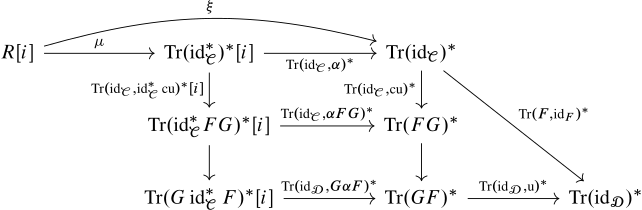
Note that the commutativity of the rightmost triangle follows from dualizing equation (2.6).
Lemma 2.34.
Let
- (1)Suppose that are smooth. Let be a map in which admits a left adjoint Then there exists a natural equivalence such that the composite ofwith this equivalence describes a unit of composed with
- (2)Suppose that are proper. Let be a map in which admits a left adjoint Then there exists a natural equivalence such that the composite ofwith this equivalence describes a counit of composed with
Proof.
The units of the adjunctions
and
are therefore equivalent. This gives rise to the following commutative diagram.

Consequently, the naturality of the unit and the counit gives rise to the following commutative diagram.

Postcomposing the upper diagram with and combining it with the lower diagram, we see that the definition of the natural transformation in Construction 2.31 is equivalent to the image under of the natural transformation
The desired description of now follows via the triangle identity for the adjunction
The following lemma shows that the natural transformations and can also be seen as the adjoints of the counit and unit of
Lemma 2.35.
The following statements hold:
- (1)Let be a morphism in with smooth. Denote the right adjoint of by The image under of the unit is left adjoint to the counit
- (2)Let be a morphism in with proper. Denote the right adjoint of by The image under of the counit is left adjoint to the unit
Proof.
We only prove part (1); part (2) can be proven similarly. Denote the right adjoint of by Upon passing to right adjoints, the natural transformation induces the following natural transformation:
Unraveling the definition of the above natural transformation, one sees that it is equivalent to the composite2
Hint: Given a natural transformation the induced natural transformation on the right adjoints is obtained as the composite
where the third natural transformation uses the counits of and This natural transformation fits into the following commutative diagram:

exhibiting it as the counit by further triangle identities.
3. Relative Calabi–Yau structures
The goal of this section is to introduce linear relative Calabi–Yau structures and describe essential features of their theory. We begin in Sections 3.1 and 3.2 with their definitions. After the short Section 3.3 on the behavior of Calabi–Yau structures under tensor products, we generalize the gluing properties of relative Calabi–Yau structures of [2
C. Brav and T. Dyckerhoff, Relative Calabi–Yau structures. Compos. Math. 155 (2019), no. 2, 372–412 Zbl 1436.18009 MR 3911626
] to the linear setting in Section 3.4. For the entire section, we fix an ring spectrum 3.1. Left Calabi–Yau structures
Let be a dualizable linear functor between dualizable and smooth linear categories. Part (2) of Proposition 2.32 shows that an linear relative Hochschild homology class amounts to a diagram in
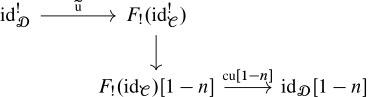
together with a choice of null-homotopy of the composite The null-homotopy allows us to extend the diagram to a diagram with horizontal fiber and cofiber sequences as follows.

We call the Hochschild homology class non-degenerate if all the vertical maps in diagram (3.1) are equivalences.
Definition 3.1.
Let be as above.
- (1)A weak left Calabi–Yau structure on the functor consists of a non-degenerate Hochschild homology class If we also say that carries a weak left Calabi–Yau structure.
- (2)A left Calabi–Yau structure on the functor is composed of a negative cyclic homology class the composition of which with defines a non-degenerate Hochschild homology class. If we also say that carries a left Calabi–Yau structure.
Weak left Calabi–Yau structures are also sometimes called bimodule Calabi–Yau structures.
Remark 3.2.
The notion of weak left Calabi–Yau structure on a functor only depends on the functor and the relative Hochschild class and not on any further choices made in its definition. This includes choices of adjoints and (co)units. For example, we make a choice of right adjoint of together with the counit; the space of such choices is however contractible. Inspecting the definition, one finds that making a different choice yields an equivalent diagram in (3.1) and thus the same condition of the Hochschild class being non-degenerate.
3.2. Right Calabi–Yau structures
Let be a dualizable linear functor between dualizable and proper linear categories. Part (2) of Proposition 2.33 shows that an linear dual relative Hochschild homology class amounts to a diagram in
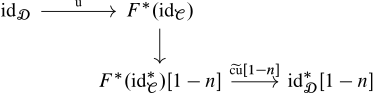
together with a choice of null-homotopy of the composite We extend the diagram to a diagram with horizontal fiber and cofiber sequences as follows.

As in the smooth case, we call the dual Hochschild homology class non-degenerate if all the vertical maps in the above diagram are equivalences.
Definition 3.3.
Let be as above.
- (1)A weak right Calabi–Yau structure on the functor consists of a non-degenerate dual Hochschild homology class If we also say that carries a weak right Calabi–Yau structure.
- (2)A right Calabi–Yau structure on the functor consists of a dual cyclic homology class whose composition with defines a non-degenerate dual Hochschild homology class. If we also say that carries a right Calabi–Yau structure.
Remark 3.4.
Assume that is compactly generated. A weak right Calabi–Yau structure on equivalently consists of an equivalence in
bifunctorial in
In good situations, a relative right Calabi–Yau structure on gives rise to a duality of a subfunctor of generalizing the equivalence (3.3) (see [8
M. Christ, Cluster theory of topological Fukaya categories. [v1] 2022, [v2] 2024, arXiv:2209.06595v2
]).Remark 3.5.
It is also possible to make sense of relative right Calabi–Yau structures on some non-proper linear categories, namely those arising as the derived category of a dg algebra whose homology is finite dimensional in each degree. We refer to the recent work [28
B. Keller and J. Liu, On Amiot’s conjecture. [v1] 2023, [v3] 2025, arXiv:2311.06538v3
] for this notion and the construction of many examples related to cluster categories.Finally, we comment on the relation with dg categorical left and right Calabi–Yau structures.
Recall that the passage to derived categories defines a functor with the category of linear dg categories.
Lemma 3.6.
Let be a dg functor. Then is a colimit-preserving functor between compactly generated linear categories.
- (1)Suppose that and are smooth. Then are smooth as well. Further, any weak left -Calabi–Yau structure of induces a weak left -Calabi–Yau structure of and vice versa.
- (2)Suppose that and are proper. Then are proper as well. Further, any weak right -Calabi–Yau structure of induces a weak right -Calabi–Yau structure of and vice versa.
Proof.
We may assume that and are cofibrant dg categories (with respect to the quasi-equivalence model structure). We first show that where the former tensor product is of dg categories and the latter in A similar argument shows that We can compute as the colimit of the sided bar construction, which is a diagram mapping to This diagram is cofibrant with respect to the Reedy model structure on meaning that all latching morphisms are cofibrations [22
P. S. Hirschhorn, Model categories and their localizations.. Math. Surveys Monogr. 99, American Mathematical Society, Providence, RI, 2003, 457 pp. Zbl 1017.55001 MR 1944041
, Def. 15.3.3]. Thus, the colimit of the sided bar construction computes its homotopy colimit (see also [22P. S. Hirschhorn, Model categories and their localizations.. Math. Surveys Monogr. 99, American Mathematical Society, Providence, RI, 2003, 457 pp. Zbl 1017.55001 MR 1944041
, Thm. 15.10.8]). The image under of the homotopy colimit can further be identified with the colimit of the categorical sided bar construction [34
J. Lurie,
Higher algebra.
2017,
preprint, https://www.math.ias.edu/~lurie/papers/HA.pdf visited on 29 December 2025
, Constr. 4.4.2.7], computing To the author’s knowledge, it has not been shown that there is a symmetric monoidal functor of categories lifting However, the above shows that the functor preserves the tensor product of two cofibrant dg categories and thus maps the evaluation and coevaluation bimodules to the evaluation and coevaluation functors. The functor thus (non-coherently) identifies the two traces, and hence (non-coherently) the functoriality of Hochschild homology. To identify the actions on the traces, a coherent identification of the traces would be necessary.
To obtain the statement from the lemma, all that remains to note is that the non-degeneracy conditions on relative (possibly dual) Hochschild classes of and coincide, which follows from Proposition 2.32 and [3
C. Brav and T. Dyckerhoff, Relative Calabi–Yau structures II: shifted Lagrangians in the moduli of objects. Selecta Math. (N.S.) 27 (2021), no. 4, article no. 63, 45 pp. Zbl 1486.14018 MR 4281260
, Prop. 4.4] in the smooth case and a similar argument in the proper case. 3.3. Behavior under tensor products
Lemma 3.7.
Let be dualizable linear categories. There is a canonical equivalence
Proof.
Using that and we find
We note that the equivalence in Lemma 3.7 is equivariant.
Remark 3.8.
If are smooth, then is also smooth, and we have Similarly, if are proper, then is proper and
In the smooth case, a pair of morphisms gives, under the identifications from Lemmas 2.29 and 3.7, rise to the morphism
A similar assertion holds in the proper case.
The following proposition shows that the tensor product of a Calabi–Yau functor with a Calabi–Yau category is again Calabi–Yau. A similar statement is proven in [3
C. Brav and T. Dyckerhoff, Relative Calabi–Yau structures II: shifted Lagrangians in the moduli of objects. Selecta Math. (N.S.) 27 (2021), no. 4, article no. 63, 45 pp. Zbl 1486.14018 MR 4281260
, Prop. 6.4].Proposition 3.9.
Let be dualizable linear categories.
- (1)Assume that are smooth. Let be a dualizable -linear functor, and let and be left Calabi–Yau-structures on and , respectively. The classdefines a left -Calabi–Yau structure on
- (2)Assume that are proper. Let be a dualizable -linear functor, and let and be right Calabi–Yau structures on and , respectively. The classdefines a right -Calabi–Yau structure on
Proof.
We only prove part (1); part (2) is analogous. The Hochschild homology class gives rise to the following diagram in up to equivalence.

The horizontal sequences in the above diagram are fiber and cofiber sequences as tensor products of such with or The vertical maps are equivalences as tensor products of equivalences, showing the non-degeneracy of the Hochschild homology class.
3.4. Gluing Calabi–Yau structures
In this section, we discuss a generalization of the gluing theorem for left Calabi–Yau structures on linear dg categories (see [2
C. Brav and T. Dyckerhoff, Relative Calabi–Yau structures. Compos. Math. 155 (2019), no. 2, 372–412 Zbl 1436.18009 MR 3911626
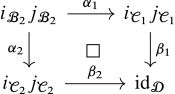
, Thm. 6.1]) to left and right Calabi–Yau structures on dualizable linear categories (see Theorems 3.15 and 3.16). The gluing theorems boil down to a simple description of objects in pullbacks/pushouts of stable, presentable categories in terms of their restrictions given in Lemma 3.11.Consider the simplicial set describing a span with objects and two non-degenerate simplices We fix a diagram with colimit satisfying that maps each morphism to a functor admitting an linear right adjoint. For we denote and can depict the colimit diagram of as follows.
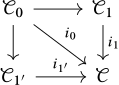
Above denotes the functor from the colimit cone. We further denote by the right adjoint, and the counit of for
The fact that counits compose to counits provides us with a commutative square
which can be depicted as follows.
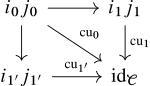
Proposition 3.10.
The square is biCartesian.
Proof.
Using that the forgetful functor reflects finite colimits (see Lemma 2.5) and that colimits in functor categories are computed pointwise (see [31
J. Lurie, Higher topos theory. Ann. of Math. Stud. 170, Princeton University Press, Princeton, NJ, 2009, 925 pp. Zbl 1175.18001 MR 2522659
, Cor. 5.1.2.3]), the statement reduces to Lemma 3.11. Lemma 3.11.
Let and consider the diagram
given by evaluating at Then describes a biCartesian square in
Proof.
We can identify the colimit of with the category of coCartesian sections of the Grothendieck construction of the diagram obtained from by passing to right adjoint functors, that is, the coCartesian fibration classified by (see
[36
J. Lurie,
Kerodon.
2024,
https://kerodon.net visited on 29 December 2025
, Prop. 05RX]). Denote by the category of all sections of and by the fully faithful inclusion with left adjoint For we denote by the evaluation functor at satisfying that The left adjoint of is denoted which satisfies An object corresponding to a coCartesian section of is of the form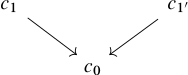
with By [31
J. Lurie, Higher topos theory. Ann. of Math. Stud. 170, Princeton University Press, Princeton, NJ, 2009, 925 pp. Zbl 1175.18001 MR 2522659
, Prop. 4.3.2.17], is given by the relative left Kan extension functor, and the objects are hence given as follows.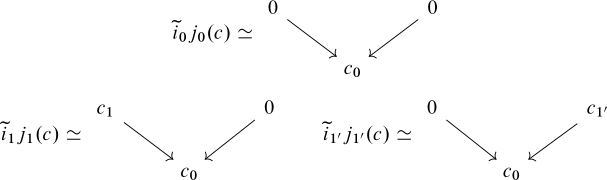
These assemble into a square in of the form
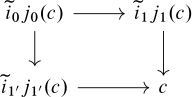
which restricts at to the constant diagram with value up to equivalence, and at to the fiber sequence of the map in Using that limits in the category of sections of the Grothendieck construction are computed componentwise in it follows that is a limit diagram in Using that is exact, we conclude that is a limit diagram as well.
Proposition 3.10 implies that linear smoothness is preserved under finite colimits along dualizable functors. A variant of this observation for linear categories appears in [40
V. Shende and A. Takeda, Calabi–Yau structures on topological Fukaya categories. Compos. Math. 161 (2025), no. 5, 1128–1214 Zbl 08086959 MR 4950556
, Lem. 8.21].Corollary 3.12.
Let be a finite simplicial set and a functor taking values in smooth linear categories. Then the colimit of in is also smooth.
Proof.
Any finite colimit can be computed in terms of pushouts and finite coproducts. Smoothness is clearly preserved under finite coproducts. It thus suffices to check that the pushout of a span of compactly generated, smooth linear categories along compact object-preserving functors is again smooth. This follows from combining the fact that the forgetful functor preserves colimits (see [17
A. I. Efimov, K-theory and localizing invariants of large categories. [v1] 2024, [v3] 2025, arXiv:2405.12169v3
, Prop. 1.65]), with Lemma 3.11, part (1) of Lemma 2.18 and the fact that pushouts of compact objects are again compact. We next discuss a dual version of Proposition 3.10 for limit diagrams of dualizable categories. Fix a cospan For we denote Let be a cone over with tip denoted We depict this cone as follows.
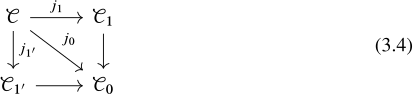
We denote by the right adjoint of for The units of these adjunctions assemble into the diagram depicted as follows.
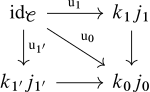
Proposition 3.13.
If is a limit cone in then is a biCartesian square.
Proof.
We show in the following that if the composition of with the forgetful functor defines a limit cone, then is a biCartesian square. Note that the pullback of in embeds fully faithfully into the pullback of in via an linear functor admitting an linear right adjoint (see [17
A. I. Efimov, K-theory and localizing invariants of large categories. [v1] 2024, [v3] 2025, arXiv:2405.12169v3
, Prop. 1.87]). Hence the square in arises from applying to the biCartesian square the exact functor which shows that is biCartesian.We thus suppose that expresses as the pullback of in Using Lemma 2.5 and that colimits in functor categories are computed pointwise (see [31
J. Lurie, Higher topos theory. Ann. of Math. Stud. 170, Princeton University Press, Princeton, NJ, 2009, 925 pp. Zbl 1175.18001 MR 2522659
, Cor. 5.1.2.3]), it suffices to show that for any the diagram is biCartesian in By passing to opposite categories (which exchanges left and right adjoints, as well as unit and counit maps), the argument from the proof of Lemma 3.11 directly applies to show that is biCartesian. Corollary 3.14.
Let be a finite simplicial set and a functor taking values in proper linear categories. Then the limit of in is also proper.
Proof.
The above discussion provides us with the tools needed for proving the gluing results for Calabi–Yau structures. We begin with the gluing of left Calabi–Yau structures. For this, fix a colimit diagram in valued in smooth categories of the following form.
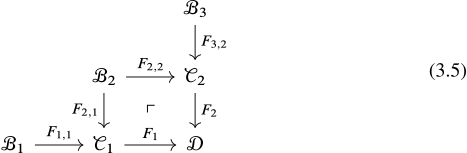
We form the following diagram in
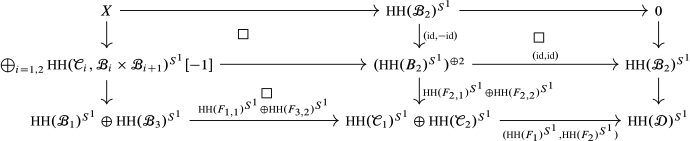
The outer square of the above diagram, though not necessarily biCartesian, induces a morphism A class corresponds to two classes whose restrictions to are not identical but differ exactly by a reversal of the sign, that is, composition with In this case, we say that the restrictions of the classes to are compatible.
Theorem 3.15.
Consider two classes with whose restrictions to are compatible, and let be the arising class. If and define left Calabi–Yau structures on the functors
then defines a left Calabi–Yau structure on the functor
Proof.
For denote by the functor from (3.5). Let be the right adjoint of Since the restriction of (3.5) to and is a pushout diagram, we find by Proposition 3.10 a biCartesian square in which is depicted as follows.
The sequence
is hence a fiber and cofiber sequence.
Using the pasting law for biCartesian squares, this gives rise to the following commutative diagram in where all squares are biCartesian and all objects are compact.
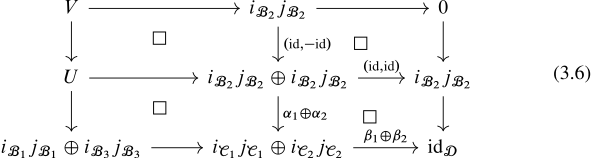
The image under of the counit is given by the unit (see Lemma 2.35). Applying the exact contravariant functor to (3.6) yields the following diagram, up to equivalence.
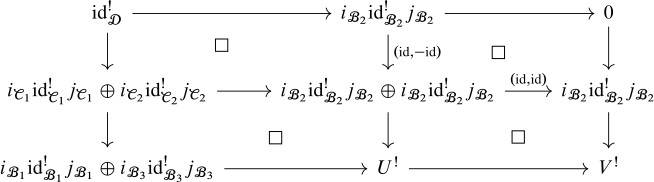
The classes define an equivalence between the lower left squares and upper right squares of the lower diagram and the th suspension of the upper diagram. These equivalences extend to an equivalence of the entire diagrams by using that the lower right and upper left squares are biCartesian. Restricting the equivalence to the outer biCartesian squares provides us with a diagram in

with horizontal fiber and cofiber sequences. This diagram arises from the class
thus showing that defines a left Calabi–Yau structure.
We next describe the gluing properties of right Calabi–Yau structures along pullbacks. For this, we consider a limit diagram in valued in proper linear categories of the following form.
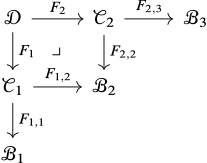
We form the following diagram in
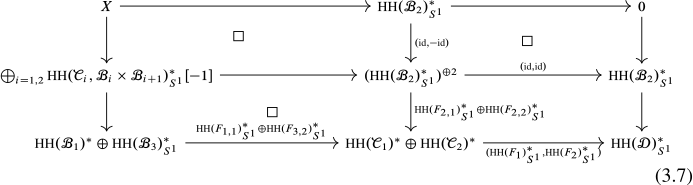
Similar to the smooth case, a class in consists of classes in with whose restrictions to differ by sign, and we again call such classes compatible.
Theorem 3.16.
Consider two classes with whose restrictions to are compatible, and let be the arising class. If and define right Calabi–Yau structures on the functors
then also defines a right Calabi–Yau structure on the functor
Proof.
Remark 3.17.
4. Perverse schobers on surfaces with boundary
4.1. Surfaces, ribbon graphs and line fields
Definition 4.1.
By a surface, we will mean a smooth, connected, oriented surface with non-empty boundary and interior We will also assume that is compact, unless stated otherwise. Note that if is compact, the boundary consists of a disjoint union of circles.
A marked surface consists of a surface and a non-empty finite set of marked points, lying on the boundary of We do not require that each connected component of contains at least one marked point.
Definition 4.2.
We define as follows:
- A graph consists of two finite sets of vertices and of halfedges (mostly simply denoted by ) together with an involution and a map
- Let be a graph. An edge of is defined to be an orbit of The set of edges is denoted by An edge is called internal if the orbit contains two elements and called external if the orbit contains a single element. An internal edge is called a loop at a vertex if it consists of two halfedges, both being mapped under to We denote the set of external edges of by
- A ribbon graph consists of a graph together with a choice of a cyclic order on the set of halfedges incident to each vertex
We will always assume graphs to be connected.
Definition 4.3.
Let be a graph. We define the exit path category of to be the nerve of the category with
- objects the vertices and edges of and
- a non-identity morphism of the form for every vertex and incident edge If is a loop at then there are two morphisms
The geometric realization of is defined as the geometric realization of
Remark 4.4.
A graph whose geometric realization is embedded into an oriented surface inherits a canonical ribbon graph structure by requiring the halfedges at any vertex to be ordered in the counterclockwise direction.
Definition 4.5.
Let be a marked surface. A spanning graph for consists of a graph together with an embedding satisfying that
- is a homotopy equivalence,
- maps to and
- the restriction gives a homotopy equivalence with the boundary components which do not contain marked points.
We consider a spanning graph of as endowed with the canonical ribbon graph structure arising from the embedding into
We now turn to line fields and framings on surfaces.
Definition 4.6.
Let be a possibly non-compact surface.
- (1)A line field on is a section of the projectivized tangent bundle
- (2)Assume that is equipped with a line field and let be a smooth, immersed loop. We denote by the winding number of with respect toFor the equivalence we use the convention that corresponds to a counterclockwise half-turn.
We let denote the principal bundle of frames (i.e., ordered bases) of the tangent bundle
- (3)A framing on is a section of
The winding number of an immersed loop can be obtained as follows: one chooses any homotopy in from the tangent vector to extends this homotopy to a homotopy of sections from to and then composes the two homotopies between and to obtain a loop in Informally, this counts the number of half-rotations of the tangent field along with respect to the line field.
Remark 4.7.
By projecting onto the first element of the ordered basis, we obtain a map of fiber bundles By composing with this map, any framing gives rise to a line field, all of whose winding numbers are even. Conversely, any line field with even winding numbers arises from a framing (see, for instance, [30
Y. Lekili and A. Polishchuk, Derived equivalences of gentle algebras via Fukaya categories. Math. Ann. 376 (2020), no. 1–2, 187–225 Zbl 1441.14062 MR 4055159
, Lem. 1.1.4]).The set of homotopy classes of line fields is an torsor (see [30
Y. Lekili and A. Polishchuk, Derived equivalences of gentle algebras via Fukaya categories. Math. Ann. 376 (2020), no. 1–2, 187–225 Zbl 1441.14062 MR 4055159
]).Finally, we describe how a choice of spanning ribbon graph induces a line field on the complement of its vertices.
Example 4.8.
Let be a marked surface with a spanning graph Then inherits a canonical (homotopy class of a) line field which we can depict locally near a vertex (of valency for concreteness) of as follows.
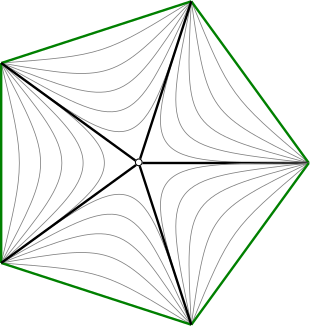
The winding number with respect to of an embedded loop wrapping clockwise around a vertex of valency is thus given by
Suppose that is a contraction between spanning graphs of contracting a set of edges of Then the corresponding line fields are closely related: the winding numbers of immersed loops not intersecting the edges in are not affected by the contraction.
4.2. Perverse schobers
In this section, we recall the definition of perverse schober parametrized by a ribbon graph. For more background on perverse schobers on surfaces, see [10
M. Christ, F. Haiden, and Y. Qiu, Perverse schobers, stability conditions and quadratic differentials. [v1] 2023, [v5] 2024, arXiv:2303.18249v5
, § 3], which refines the treatment in [5M. Christ, Ginzburg algebras of triangulated surfaces and perverse schobers. Forum Math. Sigma 10 (2022), article no. e8, 72 pp. Zbl 1490.18017 MR 4377269
, §§ 3 and 4].Given we denote by the ribbon graph with a single vertex and incident external edges. We call the spider.
Definition 4.9.
Let An linear perverse schober parametrized by the spider, or on the spider for short, consists of the following data:
- (1)If an linear spherical adjunctionthat is, an adjunction whose twist functor3and cotwist functor are equivalences. Such functors and are also called spherical functors (see [1There is a different much-used convention for the definition of the twist and cotwist functors in the literature (see, for instance, [1R. Anno and T. Logvinenko, Spherical DG-functors. J. Eur. Math. Soc. (JEMS) 19 (2017), no. 9, 2577–2656 Zbl 1374.14015 MR 3692883, 39P. Seidel and R. Thomas, Braid group actions on derived categories of coherent sheaves. Duke Math. J. 108 (2001), no. 1, 37–108 Zbl 1092.14025 MR 1831820]). This convention differs from the one considered in this paper in two ways: firstly, instead of forming the cone of the unit, the other convention considers the cocone of the unit and similarly the cone of the counit. Furthermore, the labels of the twist and cotwist are swapped.Let us illustrate our convention in the case of a spherical object: thinking of as the categorified vanishing cycles, this category is then given by The twist functor acts on as a shift functor. The cotwist is the arising autoequivalence of the category containing the spherical object.R. Anno and T. Logvinenko, Spherical DG-functors. J. Eur. Math. Soc. (JEMS) 19 (2017), no. 9, 2577–2656 Zbl 1374.14015 MR 3692883]). We also point out that such spherical functors automatically admit all left and right adjoints, given by compositions of and with powers of the (co)twist functors (see [16T. Dyckerhoff, M. Kapranov, V. Schechtman, and Y. Soibelman, Spherical adjunctions of stable categories and the relative S-construction. Math. Z. 307 (2024), no. 4, article no. 73, 59 pp. Zbl 1555.18036 MR 4771790]).
- (2)If a collection of linear adjunctionssatisfying that
- (a)is fully faithful, that is, via the counit,
- (b)is an equivalence of categories,
- (c)if
- (d)admits a right adjoint and
- (e)as full subcategories of
We will also consider a collection of functors as determining a perverse schober on the spider, or as a perverse schober on the spider for short, if there exist adjunctions which define a perverse schober on the spider. Such a collection of functors can be equivalently encoded as a functor
One can show that the datum of a perverse schober on the spider is for any equivalent to the datum of a perverse schober on the spider. This gives rise to an explicit model of perverse schobers on the spider, which we describe in the following. This construction is related to Dyckerhoff’s categorified Dold–Kan correspondence [13
T. Dyckerhoff, A categorified Dold–Kan correspondence. Selecta Math. (N.S.) 27 (2021), no. 2, article no. 14, 35 pp. Zbl 1468.18024 MR 4227866
] and the Waldhausen construction (see also the discussion in [5M. Christ, Ginzburg algebras of triangulated surfaces and perverse schobers. Forum Math. Sigma 10 (2022), article no. e8, 72 pp. Zbl 1490.18017 MR 4377269
]). Let be an linear spherical functor. We denote by the pullback in of the following diagram.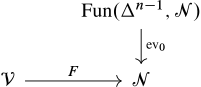
Explicitly, the category consists of diagram
where and the morphism lies in the Grothendieck construction of We define
as the projection functor to For we define recursively as the doubly left adjoint of which is the functor
given by a suspension of the composite of the projection functor to with the cofiber functor. We define as the doubly left adjoint of which maps an object (4.1) to the cofiber We further define for the functor as the right adjoint of We thus have a sequence of adjunctions
There is a further adjunction
where denotes the cotwist functor of the adjunction (see [5
M. Christ, Ginzburg algebras of triangulated surfaces and perverse schobers. Forum Math. Sigma 10 (2022), article no. e8, 72 pp. Zbl 1490.18017 MR 4377269
, Lem. 3.8]).Proposition 4.10
([5
M. Christ, Ginzburg algebras of triangulated surfaces and perverse schobers. Forum Math. Sigma 10 (2022), article no. e8, 72 pp. Zbl 1490.18017 MR 4377269
, 10M. Christ, F. Haiden, and Y. Qiu, Perverse schobers, stability conditions and quadratic differentials. [v1] 2023, [v5] 2024, arXiv:2303.18249v5
]). Let be a spherical functor. The collection of adjunctionsdefine an linear perverse schober on the spider, denoted Furthermore, for every linear perverse schober on the spider there exist such a spherical functor and an equivalence
We call any choice of such the spherical functor underlying
Let be a vertex of valency of a ribbon graph Let be the undercategory, which has objects, which can be identified with and its incident halfedges and non-identity morphisms going from to these halfedges. There is a functor which is fully faithful if has no loops incident to
Definition 4.11.
Let be a ribbon graph. A functor is called an linear parametrized perverse schober if for each vertex of the restriction of to determines a perverse schober parametrized by the spider in the sense of Definition 4.9.
We also call a functor or a parametrized perverse schober if its composite with is a parametrized perverse schober.
Remark 4.12.
A parametrized perverse schober assigns to each edge of an equivalent stable category, referred to as the generic stalk of and usually denoted by
Definition 4.13.
Let be an linear parametrized perverse schober. For a vertex of consider a choice of spherical functor underlying the restriction of to in the sense of Proposition 4.10. We call a singularity of if
Definition 4.14.
Let be an linear parametrized perverse schober.
- (1)We denote by the limit of in the category of linear categories. We call the category of global sections of
- (2)Suppose that takes values in compactly generated linear categories. We denote by the limit of in the category We call the category of locally compact global sections.
Remark 4.15.
Recall that agrees with the limit of in and can thus be identified with the category of coCartesian sections of the Grothendieck construction of that is, the coCartesian fibration classified by (see [36
J. Lurie,
Kerodon.
2024,
https://kerodon.net visited on 29 December 2025
, Prop. 05RX]).Similarly, the category of locally compact global sections can be identified with the completion of the limit in of the pointwise restriction of to the subcategories of compact objects. Hence a compact object consists of a pointwise compact coCartesian section of the Grothendieck construction.
Definition 4.16.
Given an linear parametrized perverse schober and an edge of we denote by the evaluation functor, which maps a coCartesian section of the Grothendieck construction to its value at
The functor is linear and preserves limits and colimits, which can be proven using the fact that limits and colimits in the functor category of sections of the Grothendieck construction are computed pointwise.
We will often consider the product of the evaluation functors at the external edges
By the categorical adjoint functor theorem, admits a right adjoint, which we denote by
The adjunction is spherical (see [9
M. Christ, T. Dyckerhoff, and T. Walde, Complexes of stable categories. [v1] 2023, [v2] 2024, arXiv:2301.02606v2
, Thm. 5.2.5] for a (sketch of) proof).Next, we briefly discuss how to relate perverse schober parametrized by different ribbon graphs. Given a ribbon graph and an edge of which is not a loop, we can contract to create a new ribbon graph The two vertices incident to are identified in the edge removed, but otherwise is the same as More generally, we say that a ribbon graph is a contraction of if can be obtained by contracting (automatically finitely many) edges of In this case, we write
Proposition 4.17
([6
M. Christ, Geometric models for the derived categories of Ginzburg algebras of n-angulated surfaces via local-to-global principles. [v1] 2021, [v4] 2023, arXiv:2107.10091v4
, Prop. 4.28]). Let be an linear parametrized perverse schober and a contraction which collapses no edge of which is incident to two singularities of Then there exists a canonical parametrized perverse schober together with an linear equivalence of categoriesWe note that if above takes values in then
holds as well.
We end this section by describing the relationship between global sections and locally compact global sections of perverse schobers in typical situations.
Lemma 4.18.
Let be a ribbon graph and be an linear parametrized perverse schober. Suppose that for every vertex of the spherical functor underlying near is conservative.
- (1)A global section is finite in the sense of Definition 2.24 if and only if is finite for all edges
- (2)Suppose the generic stalk is proper and that reflects compact objects for all vertices of Then the locally compact global sections of coincide with the -completion of the finite global sections, that is,
Proof.
We begin by proving part (1). For an edge denote the left adjoint of the evaluation functor by A straightforward computation shows that the assumption that is conservative for all vertices with incident edges is equivalent to the assertion that
is conservative. Thus, a global section of vanishes if and only if for all
Let be a collection of compact generators of the generic stalk of meaning that an object vanishes if and only if for all The collection of objects compactly generates as follows from the equivalence
Hence, the objects suffice to test the finiteness of global sections. A global section is thus finite if and only if is finite for all
We proceed with proving part (2). Let with for all The assertion that reflects compact objects for a vertex with incident edges is equivalent to the assertion that the functor reflects compact objects. It follows that is a pointwise compact coCartesian section of the Grothendieck construction, that is, it lies in
Remark 4.19.
Let be a spanning graph of a marked surface and let be a parametrized perverse schober with non-vanishing generic stalk. One can show that if and only if each boundary component of the marked surface contains at least one marked point.
4.3. Monodromy of perverse schobers
Let be a spanning graph of a marked surface and an linear parametrized perverse schober. We denote by the set of vertices of which are singularities of (see Definition 4.13). In analogy with perverse sheaves on which restrict to a local system of abelian groups or vector spaces on one may wish to associate a monodromy local system of linear categories to It turns out that there is indeed a reasonable notion of monodromy of a perverse schober, but it does not canonically assemble into a local system on Instead, to define the local system one needs to input a choice of framing of Applying we obtain the usual local system of abelian groups of the underlying perverse sheaf; the choice of framing does not affect this local system of abelian groups.
To define the monodromy local system, we will in the first step define an auxiliary local system of transports on From this, we will obtain a local system on the projectivized tangent bundle with monodromy on the circle fiber. We then pull back the local system to the frame bundle Any choice of framing then allows us to further pull back this local system to a local system on and this local system extends to as desired.
To obtain the transport along a loop, we compose local transports. We define these in Construction 4.21. For technical convenience, we will replace in the following the surface with spanning graph by the homotopic non-compact surface described in Remark 4.20.
Remark 4.20.
Let be a ribbon graph. To each vertex of of valency we associate a (non-compact) surface, denoted or also with an embedding of and its incident halfedges. We depict as follows (in green). The dotted lines correspond to open ends, whereas the solid lines indicate the boundary.
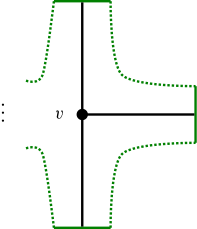
We define the thickening of to be the surface obtained by gluing the surfaces whenever two vertices are incident to the same edge at their boundary components corresponding to the edge. The surface comes with an embedding of which is also a homotopy equivalence. We define the subset as the union of the images of the boundaries for all vertices Note that each edge of intersects exactly one connected component of exactly once; we denote this component by
Construction 4.21.
Let the case is addressed at the end. The spider is embedded in we denote its central vertex by Consider an embedded curve satisfying that and that the boundary component of containing lies one step in the counterclockwise direction of the boundary component containing We can depict this setup as follows.
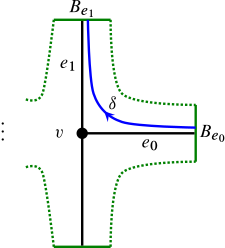
Given an linear parametrized perverse schober we define the transport of along as the linear equivalence
Reversing the orientation of yields a path going one step in the clockwise direction around and the transport of along is defined as
We thus have
Consider now an arbitrary curve satisfying that Then is homotopic relative to its endpoints either to a curve contained in the boundary in which case we set or there exists such that is homotopic relative to its endpoints to the composite of embedded paths as above, each wrapping one step counterclockwise if and one step clockwise if Thus, goes steps counterclockwise. We define the transport along as
If that is, is a loop wrapping once counterclockwise around it follows from adjunctions (4.2) and (4.3) that with the inverse cotwist of the spherical adjunction underlying at
We conclude with the case Consider a perverse schober parametrized by the spider, with vertex and edge that is, a spherical functor Let be a curve with If wraps times counterclockwise around we define the transport as
where denotes the cotwist functor of the adjunction
Example 4.22.
Consider an linear perverse schober on the spider for some with central vertex generic stalk and no singularity at Such a perverse schober categorifies a perverse sheaf without singularities (i.e., a local system) on the disc which automatically has trivial monodromy.
The perverse schober is up to equivalence described by the adjunctions
The transport functors along paths wrapping one step clockwise around from the th edge of to the th edge are given by
for as follows from adjunction (4.2). For the transport is given by
as follows from adjunction (4.3) using that the cotwist functor of the adjunction is given by The transport of an embedded full loop enclosing going in the clockwise direction is thus given by
Construction 4.23.
Let be a ribbon graph and consider a curve going from to for some We can write uniquely as the composite of a minimal number of curves with endpoints in such that each is contained in for some vertex Concretely, the paths near a given vertex are obtained as the components of the intersection of with
Let be an linear parametrized perverse schober. We define the transport of along as the linear equivalence
The following lemma collects some properties of the transport functors.
Lemma 4.24.
Let be an linear parametrized perverse schober.
- (1)Consider two curves with for If are homotopic in with the homotopy fixing endpoints, then
- (2)Let be curves with endpoints in and such that B Denote their composite by Then
(4.6) - (3)Let be a contraction of ribbon graphs contracting a set of edges, none connecting two singularities of Let be a curve with endpoints in not intersecting any edges in Choose a smooth map that realizes the contraction by contracting small neighborhoods of the edges in and that restricts on the complement of these neighborhoods to a diffeomorphism. Then is a curve in and
Proof.
Parts (1) and (2) are immediate from the definition of transport. For part (3), it suffices to consider the case that contracts a single edge since any contraction is a finite composition of such contractions. As and are identical away from a neighborhood of it suffices to show that the transports near of and coincide. Using the local model for from Proposition 4.10 and the local model for described in [6
M. Christ, Geometric models for the derived categories of Ginzburg algebras of n-angulated surfaces via local-to-global principles. [v1] 2021, [v4] 2023, arXiv:2107.10091v4
, Lem. 4.26], this is straightforward to verify. For the following, we fix a ribbon graph and we choose once and for all an edge Let be the intersection point.
Lemma 4.25.
Let be an linear parametrized perverse schober. The assignment on based loops at defines a group homomorphism
that is, a local system on with values in the group of equivalence classes of linear autoequivalences of
Proof.
The main issue with the local system from Lemma 4.25 is that it does not extend to where denotes the set of singularities of (see Example 4.22). This is in general not even true on
Suppose is an inverse image of under the bundle projection Consider the short exact sequence of groups
where (with corresponding to the counterclockwise half-turn). The line field from Example 4.8 defines a splitting
Definition 4.26.
Let be an linear parametrized perverse schober.
- (1)We define the local system on by the assignment
- (2)We define the local system on as the pullback of along the map
Remark 4.27.
Let be a vertex of of valency Near the local system can be described as follows. Since is diffeomorphic to a subset of there exist canonical splittings and which restrict to splittings
and
Let be an embedded loop mapping the base point to and wrapping one time clockwise around Then defines loops in and in each of which is constant in the second component. We have
By Example 4.22, if is not a singularity of then
Proposition 4.28.
Let be an linear parametrized perverse schober with singularities at and let be a framing on The pullback local system then extends to a local system
We call this local system the monodromy of with respect to the framing
Proof.
Consider the restriction Then the winding number of a clockwise embedded loop wrapping one time around a non-singular vertex is given by Comparing with (4.7), we see that the monodromy of along this loop is trivial. It follows that extends to the desired local system on
Remark 4.29.
The above constructions can be seen as implementing the following observation: the group acts on the category of local systems on The line field from Example 4.8 gives a base point of the torsor of homotopy classes of line fields. Thus, the line field arising from a framing acts on the local system to produce a new local system, given by Contrary to the local system extends to
Example 4.30.
Consider a perverse schober on the disc with one boundary marked point, parametrized by the spider with vertex Thus, consists of a spherical functor Let be the right adjoint of and the cotwist functor of Choosing any framing on and restricting it to the corresponding clockwise monodromy of around is given by Passing to Grothendieck groups, that is, applying we obtain a perverse sheaf on with (at most) one single singularity. We have
The automorphism of
describes the usual monodromy of this perverse sheaf.
Remark 4.31.
Let be an linear parametrized perverse schober and suppose that is periodic for some in the sense that Let be an inverse image of The fiberwise monodromy of that is, the action of is given by
Suppose first that that is, is periodic. Then the local system
factors through the quotient
and thus canonically defines a local system on (that even extends to ), without a choice of framing.
Now suppose that An spin structure on amounts to an fold connected covering of Pulling back along this covering yields a local system with trivial monodromy on the fiber over that hence restricts as in the case to a local system on
Remark 4.32.
Let be an linear parametrized perverse schober with singularities at Applying any additive invariant such as Hochschild homology, to the local system on yields a local system with trivial monodromy on the fiber, since By the same argument as in Remark 4.31, thus defines a local system on
The monodromy of a perverse schober is independent of the choice of ribbon graph in the appropriate sense.
Lemma 4.33.
Let be an linear parametrized perverse schober with singularities at Let be a contraction of ribbon graphs not contracting the edge and no edges connecting any two vertices in and choose a smooth map as in Lemma 4.24. Let be a framing on and let be the corresponding framing on There exists an equivalence between and the local system
Proof.
Next, we prove that a perverse schober without singularities is completely determined by its generic stalk and monodromy.
Proposition 4.34.
Let be two linear parametrized perverse schobers without singularities. Let be a framing of Assume that The following two are equivalent:
- (1)There exists an equivalence of parametrized perverse schobers
- (2)The monodromy local systems and are equivalent.
Proof.
It is clear that (1) implies (2). We next show that (2) implies (1). Denote by the generic stalk. Choose a contraction such that is not contracted and has only a single vertex. Part (3) of Lemma 4.24 implies that the local systems of transport of and are equivalent.
We choose a total order of the halfedges incident to the vertex of compatible with their given (counterclockwise) cyclic order. We denote the th halfedge by and its corresponding edge by We can replace and by equivalent parametrized perverse schobers, denoted and such that for and
and
where is some autoequivalence of The monodromy relative along a path starting at and going around a given loop of composed of halfedges of is given by if and by if We thus find We can additionally assume that by replacing by equivalent perverse schobers once more. We thus conclude as well. Performing this argument for all loops of shows that concluding the proof.
The next example illustrates that a perverse schober consists of more data than its singularity data and monodromy data.
Example 4.35.
Consider the following spanning graph of the gon.
Consider a parametrized perverse schober with two singularities at the vertices labeled and no singularity at the vertices labeled Let and be the underlying spherical adjunctions at the two vertices. These are determined only up to pre- and postcomposition with equivalences of categories. The perverse schober thus corresponds, up to equivalence, to a diagram
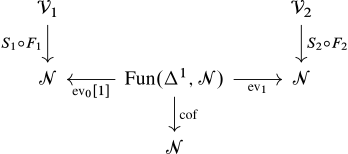
with autoequivalences of Note that with the spherical zero functor. Composing with the autoequivalence of replaces by and by Up to equivalence of perverse schobers, we may thus assume that In total, the equivalence class of the perverse schober is determined by the functors and up to natural equivalence of these functors and precomposition of with autoequivalences of
We equip the gon with any framing (it is unique up to homotopy) and denote its restriction to the complement of the two singular vertices by The monodromy of with respect to along a clockwise loop wrapping once around the left singularity is given by with the cotwist of which is the suspension of the cotwist functor of the adjunction The monodromy of the clockwise loop wrapping once around the right singularity is similarly given by the cotwist functor of the adjunction
Since the choice of affects the monodromy of only by conjugation with we find that, given the functors and the monodromy local system, one cannot in general recover the autoequivalence and thus also cannot recover the equivalence class of the perverse schober. One can make this failure explicit by choosing, for instance, the functor from Section 6.3 for where and is the functor from the proof of Theorem 6.9.
5. Calabi–Yau structures and perverse schobers
We begin with the local picture in Section 5.1 by constructing relative Calabi–Yau structures on the sections of perverse schobers parametrized by the spider. In Section 5.2, we discuss the construction of relative Calabi–Yau structures on the global sections of perverse schobers. Finally, in Section 5.3, we return to the case of perverse schobers parametrized by the spider, that is, spherical adjunctions, and give a novel and easy-to-verify criterion for the existence of a weak right Calabi–Yau structure.
5.1. Calabi–Yau structures locally
Consider a perverse schober on the spider Proposition 4.10 states that arises from a spherical adjunction in the sense that is given, up to equivalence, by the collection of adjunctions
We can combine these adjunctions into a single adjunction
As it turns out, this adjunction is spherical, and its twist functor describes the change in the perverse schober on the gon when rotating it by an angle of (see Proposition 5.1). Note that this is not a genuine symmetry; a full rotation does not return the perverse schober to itself, but instead changes it by the monodromy around the singularity, that is, the suspension of the cotwist functor of
Proposition 5.1
([5
M. Christ, Ginzburg algebras of triangulated surfaces and perverse schobers. Forum Math. Sigma 10 (2022), article no. e8, 72 pp. Zbl 1490.18017 MR 4377269
, Props. 3.8 and 3.11]). The adjunction is spherical. Let be its twist functor and the cotwist functor of the adjunction There exist equivalences of functorsThe goal of this section is to prove the following proposition, roughly stating that the functors can be equipped with Calabi–Yau structures, provided that are already equipped with relative Calabi–Yau structures. In this case, the Serre or inverse dualizing functors thus describe the effect of partial rotation of the gon.
To simplify the signs, we change and in the following proposition by composition with componentwise suspension functors.
Proposition 5.2.
Let be a spherical adjunction of dualizable linear categories and Consider the spherical adjunction
- (1)Suppose that are smooth and that there exists a class defining a left -Calabi–Yau structure on , which restricts to a left -Calabi–Yau structure on Then the functor admits a canonical left -Calabi–Yau structure, which restricts on to
- (2)Suppose that are proper and assume that there exists a class defining a right -Calabi–Yau structure on , which restricts to a right -Calabi–Yau structure on Then the functor admits a canonical right -Calabi–Yau structure, which restricts on to
Using the gluing properties of Calabi–Yau structures, we will reduce the proof of Proposition 5.2 to the case and This case is then first solved for which admits canonical left and right Calabi–Yau structures and then for arbitrary by tensoring (see Proposition 3.9).
Construction 5.3.
Let considered as an linear smooth and proper category. We construct two inverse equivalences via Kan extension.
Consider the category of diagrams in of the following form, where all squares are biCartesian, that is, both pushout and pullback squares.
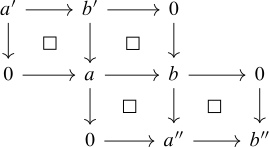
One can formally characterize the category as consisting of diagrams which are repeated Kan extensions of their restriction to The restriction functor to thus defines by [31
J. Lurie, Higher topos theory. Ann. of Math. Stud. 170, Princeton University Press, Princeton, NJ, 2009, 925 pp. Zbl 1175.18001 MR 2522659
, Prop. 4.3.2.15] a trivial fibration It hence admits an inverse, unique up to contractible space of choices. We denote by the restriction functor to and by the restriction functor to The functor is defined as the suspension of the composite functor
and the functor is defined as the looping of the composite functor
Remark 5.4.
An alternative description of the functor from Construction 5.3 is as follows. Let again We have functors together with a natural transformation as well as the further fully faithful functors given informally by and together with a natural transformation Composing these functors, we have an induced natural transformation whose cofiber describes an endofunctor of given by the assignment
This functor is equivalent to the endofunctor as follows from the universal property of the linear category as the lax limit of the functor considered as a indexed diagram in the category of linear categories.
Lemma 5.5.
Let The linear category is smooth and proper, and the functor from Construction 5.3 is a Serre functor of
Proof.
It is straightforward to check that is smooth and proper. Any object in is given as the cofiber of a map By the exactness of in the second entry, it follows that
Let be compact objects. Using that is an linear Serre functor, we find equivalences in
Lemma 5.6.
Let We let and denote the lifts4 of the apparent classes in and Note that and describe left and right Calabi–Yau structures on respectively.
Canonical lifts exist by Remark 2.27.
- (1)The -linear functoradmits a unique left -Calabi–Yau structure which restricts to the left -Calabi–Yau structure on
- (2)The -linear functoradmits a unique right -Calabi–Yau structure which restricts to the right -Calabi–Yau structure on
Proof.
furnishes us with a splitting Applying the adjunctions and we observe that and are the two projection maps and that are the two inclusion maps of the direct sum decomposition.
With the above, we have
where The formula for follows from
and
We let be the class The observation that implies that indeed restricts to on Furthermore, is clearly unique with this property.
Let be the Hochschild class underlying and the Hochschild class underlying To complete the proof, it remains to show that is non-degenerate. The class determines the diagram
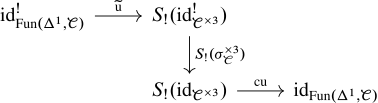
together with a null-homotopy of the composite functor Composing the first two morphisms in the above diagram, we obtain the sequence
The morphism is by Lemma 2.34 equivalent to the composite of the unit of the adjunction with By Lemmas 2.21, 2.22 and 5.5, there exists an equivalence between and the functor from Construction 5.3.
One can check that the functor is furthermore equivalent to the cotwist functor of the adjunction There thus exists a fiber and cofiber sequence
where is up to equivalence a unit of the adjunction composed with (see [16
T. Dyckerhoff, M. Kapranov, V. Schechtman, and Y. Soibelman, Spherical adjunctions of stable categories and the relative S-construction. Math. Z. 307 (2024), no. 4, article no. 73, 59 pp. Zbl 1555.18036 MR 4771790
] or [7M. Christ, Spherical monadic adjunctions of stable infinity categories. Int. Math. Res. Not. IMRN 2023 (2023), no. 15, 13153–13213 Zbl 1529.18013 MR 4621862
, Rem. 2.10]). The respective counit maps in (5.3) and (5.4) describe the same counit map. The respective unit maps are also equivalent, up to composition with an autoequivalence of To show that this autoequivalence may be chosen trivially, we inspect the module of all possible autoequivalences of We havewhere with the right adjoint of Since we have and thus
The functor splits as
where is the twist functor of the adjunction It acts via rotation, meaning that sends the th component of the direct sum to the th component of the direct sum for all and then acts with some suspensions on the three components. There are no non-zero natural transformations between and or It follows that the morphism
is an equivalence. We thus find that every possible autoequivalence of can be accommodated by choosing a different Hochschild class of We may hence conclude from the existence of cofiber sequence (5.4) that there exists some choice of Hochschild class which restricts to the class which turns (5.3) into a cofiber sequence. Since contains the identity as a direct summand, we find that is a conservative functor. The fact that induces an equivalence thus implies that is already an equivalence. It follows that must be an invertible element. Upon composing with its inverse in the ring cofiber sequence (5.3) clearly remains a cofiber sequence. This shows that already describes a left Calabi–Yau structure, concluding the proof.
Proof of Proposition 5.2.
We only prove part (2); the proof of part (1) is analogous. We suppose that is a spherical functor with a right Calabi–Yau structure restricting to a right Calabi–Yau structure on
We first assume that As shown in [5
M. Christ, Ginzburg algebras of triangulated surfaces and perverse schobers. Forum Math. Sigma 10 (2022), article no. e8, 72 pp. Zbl 1490.18017 MR 4377269
, Lem. 4.26], there is a pullback diagram in 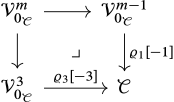
such that the functor factors for as
and for as
To show that admits the desired right Calabi–Yau structure, it thus suffices by Theorem 3.16 to show this in the case This case follows from combining Lemma 5.6 and Proposition 3.9.
Let now the above functor again be arbitrary. Again, by [5
M. Christ, Ginzburg algebras of triangulated surfaces and perverse schobers. Forum Math. Sigma 10 (2022), article no. e8, 72 pp. Zbl 1490.18017 MR 4377269
, Lem. 4.26], there exists a pullback diagram in 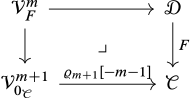
By Theorem 3.16, the above-constructed right Calabi–Yau structure on glues with the Calabi–Yau structure on to the desired right Calabi–Yau structure on
5.2. Calabi–Yau structures on global sections
We begin by recording a direct consequence of the gluing property of Calabi–Yau structures.
Theorem 5.7.
Let be a parametrized perverse schober.
- (i)Suppose that takes values in smooth -linear -categories. Suppose further that
- For each vertex of with incident halfedges and corresponding edges , the functorcarries a left -Calabi–Yau structureWe denote the restriction of along the functor by
- For each internal edge of with incident halfedges , we have
Then the -linear -category of global sections is smooth, and the functor from equation (4.4)admits a left -Calabi–Yau structure. - (ii)Suppose that takes values in proper -linear -categories. Suppose further that
- For each vertex of with incident halfedges and corresponding edges , the functorcarries a right -Calabi–Yau structureWe denote the restriction of along the functor by
- For each internal edge of with incident halfedges , we have
Then the evaluation functor at the external edgesadmits a right -Calabi–Yau structure.
Proof.
Given a parametrized perverse schober without singularities in the sense of Definition 4.13, also called a locally constant perverse schober, whose generic stalk admits a Calabi–Yau structure, Theorem 5.8 states that its global sections admit a Calabi–Yau structure if its monodromy with respect to any framing of the surface (see Section 4.3) acts trivially on the corresponding negative or dual cyclic homology class. Note that a direct variation on this result for arbitrary perverse schobers does not hold, as follows from a variant of Example 4.35. Theorem 5.8 generalizes the construction of relative Calabi–Yau structures on the topological Fukaya categories of framed surfaces of [2
C. Brav and T. Dyckerhoff, Relative Calabi–Yau structures. Compos. Math. 155 (2019), no. 2, 372–412 Zbl 1436.18009 MR 3911626
].Theorem 5.8.
Let be a parametrized perverse schober without singularities. Fix an edge of and let be the generic stalk of
- (i)Suppose that is smooth and admits a left -Calabi–Yau structureSuppose that the local system (see Remark 4.32 )preserves Then the functor
(5.5) admits a left -Calabi–Yau structure. - (ii)Suppose that is proper and admits a right -Calabi–Yau structureSuppose that the local systempreserves Then the functoradmits a right -Calabi–Yau structure.
Proof.
We only prove part (i); part (ii) is analogous. Using Proposition 4.17 and Lemma 4.33, we may assume that has a single vertex We choose a framing on Let be the valency of We choose a total order of the halfedges incident to Applying Proposition 5.2 to the spherical adjunction with the left Calabi–Yau structure on arising from yields a left Calabi–Yau structure on which restricts on to The diagram gives rise to a perverse schober on the spider assigning to the incidence of the th halfedge with the functor
Consider an internal edge of which is by assumption a loop. The loop consists of two halfedges which lie in positions and we orient so that it first traces along the th halfedge and then the th halfedge. We modify by composing the functor with the autoequivalence
We do this for each such internal edge and denote the arising perverse schober on the spider by We let be the parametrized perverse schober which restricts along to We have defined such that and have equivalent monodromy local systems. It follows from Proposition 4.34 that
5.3. Weak right Calabi–Yau structures on spherical functors
Consider a dualizable linear functor between proper linear categories with right adjoint If admits a weak right Calabi–Yau structure, the arising fiber and cofiber sequence
exhibits the shifted Serre functor as the twist functor of the adjunction If is smooth, then is an equivalence. To check that the adjunction is spherical, it thus suffices to show that the cotwist functor is also an equivalence or alternatively that the unit of the adjunction commutes with and that admits a right adjoint such that (see [7
M. Christ, Spherical monadic adjunctions of stable infinity categories. Int. Math. Res. Not. IMRN 2023 (2023), no. 15, 13153–13213 Zbl 1529.18013 MR 4621862
, Prop. 4.5]).Conversely, suppose that is a spherical adjunction, satisfying that the twist functor is equivalent to The unit and counit maps of spherical adjunctions exhibit a rather special behavior: in the fiber and cofiber sequence
the map is a counit map of the adjunction composed with up to composition with an autoequivalence By Lemma 2.34, this fiber and cofiber sequence looks very similar to diagram (3.2) appearing in the definition of a weak relative right Calabi–Yau structure on It is thus natural to ask whether already admits a weak right Calabi–Yau structure. In this section, we prove that can indeed be equipped with a weak right Calabi–Yau structure, under the assumption that is weak right Calabi–Yau and are compactly generated (see Proposition 5.9).
The proof is rather indirect and relies on first lifting the spherical adjunction to a perverse schober on the spider, which might be thought of as a kind of resolution, as it renders trivial certain commutativity problems of diagrams involved in checking the existence of the relative Calabi–Yau structure. We then use an explicit description of the Serre functor on the global sections of this perverse schober that is only available in the proper setting. We get back to the original spherical adjunction by gluing with the Calabi–Yau structure of the zero functor We leave it as an interesting problem to find an alternative argument which applies in the smooth setting.
Proposition 5.9.
Let be a spherical adjunction of compactly generated, proper linear categories. Let be the twist functor of If there exists an equivalence and a weak right Calabi–Yau structure on then admits a weak right Calabi–Yau structure.
Lemma 5.10.
Let be a spherical adjunction of compactly generated, proper linear categories. Let be the twist functor of Suppose that there is an equivalence and that admits a weak right Calabi–Yau structure. Consider the spherical adjunction (see Proposition 5.1)
The functor admits a weak right Calabi–Yau structure.
Proof.
We show in Lemma 5.11 that the Serre functor is equivalent to a suspension of the twist functor of The definition of thus gives us a fiber and cofiber sequence of endofunctors of :
By assumption, admits a weak right Calabi–Yau structure, corresponding to an equivalence This gives us an equivalence
Fiber and cofiber sequence (5.7) gives rise to a commutative diagram in

with horizontal fiber and cofiber sequences and vertical equivalences. The map is up to composition with an equivalence given by a counit map of the adjunction which can be seen as follows. By [16
T. Dyckerhoff, M. Kapranov, V. Schechtman, and Y. Soibelman, Spherical adjunctions of stable categories and the relative S-construction. Math. Z. 307 (2024), no. 4, article no. 73, 59 pp. Zbl 1555.18036 MR 4771790
, Cor. 2.5.16], there exists an equivalence By [7M. Christ, Spherical monadic adjunctions of stable infinity categories. Int. Math. Res. Not. IMRN 2023 (2023), no. 15, 13153–13213 Zbl 1529.18013 MR 4621862
, Lem. 2.10], the composite natural transformation evaluates at each object of to a counit map of so that is adjoint to a pointwise autoequivalence This implies that is already a counit composed with By Lemma 2.34, this shows that the natural transformation agrees with the counit from Construction 2.31, up to composition with an autoequivalence of As we show next, the adjunction has the special feature that the map
is an equivalence. We denote the inverse image of under this map by We have already seen this in the special case that and in the proof of Lemma 5.6. The argument here is very analogous: the functor splits as with the cotwist functor of which permutes the three factors of cyclically by one step and then acts on each component as suspension or the cotwist functor of We thus have and and
We adapt the choice of Calabi–Yau structure on by postcomposing with Note that is by construction equivalent to The existence of diagram (5.8) thus induces a relative dual Hochschild homology class which defines a weak right Calabi–Yau structure on We finally remark that restricts at to the class corresponding to
Lemma 5.11.
Proof.
In this proof, we will use the following simplified and abusive notation for elements of : given an element of that is, a diagram with the morphism lying in the Grothendieck construction of meaning that it encodes a morphism we simply write it as a tuple We similarly write elements of as pairs and elements of as pairs Given elements and we will also write for
The Serre functor of is the Serre functor of is given by and the Serre functor of is denoted by The functor is given by the tensor product of the Serre functors of and By Lemma 5.5 and Remark 5.4, is thus given by the assignment
A straightforward computation shows that the twist functor of is given by the assignment
This assignment is to be understood as in Remark 5.4, meaning the apparent functor corresponding to the above formulas constructed using the universal properties of the involved lax limits.
Consider the relative suspension functor of [16
T. Dyckerhoff, M. Kapranov, V. Schechtman, and Y. Soibelman, Spherical adjunctions of stable categories and the relative S-construction. Math. Z. 307 (2024), no. 4, article no. 73, 59 pp. Zbl 1555.18036 MR 4771790
, Def. 2.5.8], which is on objects given by mapping to The functor is an equivalence by the sphericalness of and [16T. Dyckerhoff, M. Kapranov, V. Schechtman, and Y. Soibelman, Spherical adjunctions of stable categories and the relative S-construction. Math. Z. 307 (2024), no. 4, article no. 73, 59 pp. Zbl 1555.18036 MR 4771790
, Cor. 2.5.10], and this implies thatbifunctorial in and
We thus have the following equivalences, bifunctorial in and :
This shows that is a Serre functor and thus equivalent to
Proof of Proposition 5.9.
Consider the functor from Lemma 5.10 which admits a weak right Calabi–Yau structure. Applying Theorem 3.16 to the pullback diagram in
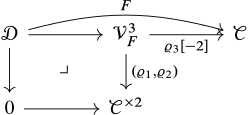
yields the desired weak right Calabi–Yau structure on
6. Examples
We begin in Section 6.1 by describing Fukaya–Seidel categories as the global sections of perverse schobers on the disc and using this to construct relative Calabi–Yau structures on these. In Section 6.2, we describe a special case of Theorem 5.8 concerning relative Calabi–Yau structures on periodic topological Fukaya categories of marked surfaces. Finally, we observe in Section 6.3 that the derived categories of relative Ginzburg algebras of angulated surfaces admit relative left Calabi–Yau structures and further exhibit in some cases weak right Calabi–Yau structures on the linear versions of the finite derived categories of these relative Ginzburg algebras, where is an arbitrary base ring spectrum.
6.1. Fukaya–Seidel categories
The cosheaves of partially wrapped Fukaya categories of [20
S. Ganatra, J. Pardon, and V. Shende, Sectorial descent for wrapped Fukaya categories. J. Amer. Math. Soc. 37 (2024), no. 2, 499–635 Zbl 1546.53081 MR 4695507
] give rise to perverse schobers. We will explain this in this section in the setting of Lefschetz fibrations over the disc. We remark that a related construction of Fukaya–Seidel categories using perverse schobers appears in [27M. Kapranov, Y. Soibelman, and L. Soukhanov, Perverse schobers and the algebra of the infrared. 2020 arXiv:2011.00845v1
].We work in the setup of partially wrapped Fukaya categories of [20
S. Ganatra, J. Pardon, and V. Shende, Sectorial descent for wrapped Fukaya categories. J. Amer. Math. Soc. 37 (2024), no. 2, 499–635 Zbl 1546.53081 MR 4695507
]. The original construction of Fukaya–Seidel categories in the different setup of [37P. Seidel, Fukaya categories and Picard–Lefschetz theory. Zur. Lect. Adv. Math., European Mathematical Soceity, Zürich, 2008, 326 pp. Zbl 1159.53001 MR 2441780
], as a directed category, can be treated in a similar way using perverse schobers.Let be the half-plane (considered as a Liouville sector). Let be a Lefschetz fibration (in the sense of [20
S. Ganatra, J. Pardon, and V. Shende, Sectorial descent for wrapped Fukaya categories. J. Amer. Math. Soc. 37 (2024), no. 2, 499–635 Zbl 1546.53081 MR 4695507
]), with a Liouville sector, with regular Weinstein fiber and core Let be the dimension of We assume that We further assume that the wrapped Fukaya category of the fiber is weakly left Calabi–Yau, which is shown under minor assumption on in [19S. Ganatra, Symplectic cohomology and duality for the wrapped Fukaya category. 2013 arXiv:1304.7312v1
].The wrapped Fukaya category is equivalent to the partially wrapped Fukaya category of the Liouville manifold arising from with a stop at This category is called the Fukaya–Seidel category of the Lefschetz fibration We will denote it by
From we obtain a linear stable category by first choosing a quasi-equivalent dg category to and then passing to its derived category.
As described in [20
S. Ganatra, J. Pardon, and V. Shende, Sectorial descent for wrapped Fukaya categories. J. Amer. Math. Soc. 37 (2024), no. 2, 499–635 Zbl 1546.53081 MR 4695507
, Exm. 1.31], the Fukaya–Seidel category arises as the homotopy colimit of a diagram of categories with values given by the categories and This diagram describes a perverse schober and is described in more detail in Construction 6.3. This allows us to obtain a weak relative left Calabi–Yau structure on Theorem 6.1.
Let be a Lefschetz fibration as above.
- (i)The derived -category of the Fukaya–Seidel category arises as the -category of global sections of the perverse schober on from Construction 6.3 with singularities at the singular values of and generic stalk
- (ii)Passing to derived -categories, the canonical functorknown as the cup/Orlov functor5agrees with the spherical boundary corestriction functor (see equation (4.4)). The functor admits a weak left -Calabi–Yau structure, exhibiting as weak relative left -Calabi–Yau.See [42Z. Sylvan, Orlov and Viterbo functors in partially wrapped Fukaya categories. 2019 arXiv:1908.02317v1]. The left adjoint is called the cap functor.
Remark 6.2.
The derived Fukaya–Seidel category is smooth being the colimit of smooth categories and proper as it is generated by the thimbles. There is a pushout diagram in of the following form (see [20
S. Ganatra, J. Pardon, and V. Shende, Sectorial descent for wrapped Fukaya categories. J. Amer. Math. Soc. 37 (2024), no. 2, 499–635 Zbl 1546.53081 MR 4695507
, Thm. 1.20]).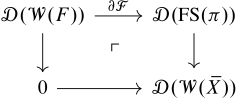
Thus, can be seen as a smooth and proper resolution of the smooth The Serre functor on is given by part (ii) of Theorem 6.1 by a shift of the cotwist functor of the spherical adjunction Note that spherical functors commute with their (co)twist functors (see [7
M. Christ, Spherical monadic adjunctions of stable infinity categories. Int. Math. Res. Not. IMRN 2023 (2023), no. 15, 13153–13213 Zbl 1529.18013 MR 4621862
, Lem. 2.2]). The Serre functor of thus stabilizes the stable subcategory generated by the image of Furthermore, by gluing with the Calabi–Yau functor via Theorem 3.15, we find that inherits a weak left Calabi–Yau structure, recovering the result of [19
S. Ganatra, Symplectic cohomology and duality for the wrapped Fukaya category. 2013 arXiv:1304.7312v1
].Construction 6.3.
Let be the number of singular values of the Lefschetz fibration Consider the following ribbon graph
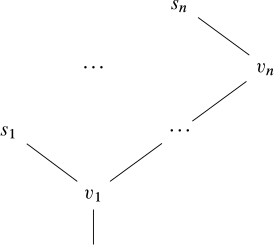
We can embed into making it into a spanning ribbon graph, such that each vertex lies at a singular value of and the external edge incident to ends on the unique boundary component of The embedding of into decomposes into sectors, lying near the vertices not containing any singular values, as well as half-planes containing the singular values The derived wrapped Fukaya categories of the inverse images of the half-planes are each equivalent to The Fukaya–Seidel category arises by [20
S. Ganatra, J. Pardon, and V. Shende, Sectorial descent for wrapped Fukaya categories. J. Amer. Math. Soc. 37 (2024), no. 2, 499–635 Zbl 1546.53081 MR 4695507
, Example 1.31] as the homotopy colimit of a diagram of categories, indexed by the opposite of the exit path category of This diagram assigns- to each edge of an category Morita equivalent to the wrapped Fukaya category of the fiber,
- to each vertex an category Morita equivalent to and
- to each vertex an category Morita equivalent to
Passing to derived categories and right adjoint functors yields a diagram which is readily verified to describe a perverse schober with singularities at The spherical adjunctions at the vertices arise from the spherical objects in given by the vanishing cycles of the Lefschetz fibration.
Note that we can contract the ribbon graph to the following ribbon graph
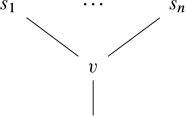
This allows us to understand the category of global sections of as a non-full subcategory of similar to the directed subcategory construction of [37
P. Seidel, Fukaya categories and Picard–Lefschetz theory. Zur. Lect. Adv. Math., European Mathematical Soceity, Zürich, 2008, 326 pp. Zbl 1159.53001 MR 2441780
]. From this perspective, the thimbles of the Lefschetz fibration amount to coCartesian sections of the parametrized perverse schober of the following form: for the th vanishing cycle, the corresponding thimble is given as follows: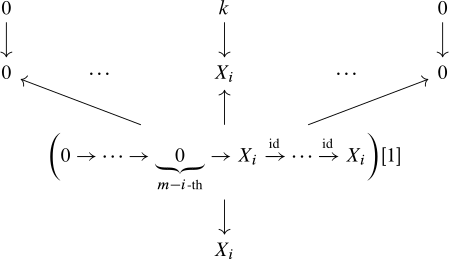
satisfying that the restriction of to the th internal edge is given by if and if
We next briefly discuss spherical objects and then show that these give rise to functors with Calabi–Yau structures.
We let be a commutative ring and a dualizable linear category. We fix an object whose endomorphism object is equivalent to the singular complex of the sphere for some meaning that
The object gives rise to a linear adjunction
By the assumption on the twist functor is equivalent to the fold loop functor and thus an equivalence. We call the object an spherical object if the cotwist functor is also an equivalence and adjunction (6.1) is thus a spherical adjunction. In this case, the right adjoint of is given by If is proper and compactly generated, with Serre functor the adjunction is spherical if and only if so that we specialize to the usual notion of a spherical object (see, for instance, [24
D. Huybrechts, Fourier–Mukai transforms in algebraic geometry. Oxford Math. Monogr. 307, Clarendon Press, Oxford, 2006 Zbl 1095.14002 MR 2244106
, Def. 8.1]): one implication of this can be proven using [7M. Christ, Spherical monadic adjunctions of stable infinity categories. Int. Math. Res. Not. IMRN 2023 (2023), no. 15, 13153–13213 Zbl 1529.18013 MR 4621862
, Prop. 4.5] and the fact that iterated adjoints between proper, compactly generated categories are obtained by compositions with powers of the Serre functors.Lemma 6.4.
Let and an spherical object in a dualizable linear category.
- (1)If is proper and admits a weak right -Calabi–Yau structure, then the functoradmits a compatible weak right -Calabi–Yau structure.
- (2)If is smooth and admits a weak left -Calabi–Yau structure, then the functoradmits a compatible weak left -Calabi–Yau structure.
Proof.
We only show part (1); part (2) can be shown analogously. Let be a weak right Calabi–Yau structure on The class gives rise to the following diagram.

Note that Since there are no natural transformations from to the above diagram is equivalent to the following diagram.

This diagram clearly admits a null-homotopy which defines a non-degenerate relative dual Hochschild class restricting to on thus exhibiting the desired weak right Calabi–Yau structure on the functor
Proof of Theorem 6.1.
We begin with showing part (i). By the cosheaf properties of partially wrapped Fukaya categories (see [20 into an categorical colimit. This follows from two observations. Firstly, by the universal property of the colimit, there is a comparison functor Secondly, both stable categories are generated by the thimbles, and on these, the above functor is a quasi-equivalence.
S. Ganatra, J. Pardon, and V. Shende, Sectorial descent for wrapped Fukaya categories. J. Amer. Math. Soc. 37 (2024), no. 2, 499–635 Zbl 1546.53081 MR 4695507
, Exm. 1.31]), we find that arises as the homotopy colimit of the diagram of categories indexed by described in Construction 6.3. It remains to show that the passage to the derived category turns the categorical homotopy colimit6We point out that in contrast to the category of dg categories, the category of categories does not admit a suitable model structure so that the notion of ‘homotopy colimit’ employed in [20
S. Ganatra, J. Pardon, and V. Shende, Sectorial descent for wrapped Fukaya categories. J. Amer. Math. Soc. 37 (2024), no. 2, 499–635 Zbl 1546.53081 MR 4695507
] is not understood in a model categorical sense. One can nevertheless expect that the passage to the derived categories always turns such homotopy colimits into categorical colimits.To obtain the weak left Calabi–Yau structure in part (ii), we combine Theorem 3.15, Lemma 6.4, as well as Proposition 5.2 applied to the spherical adjunction The existence of the weak right Calabi–Yau structure similarly follows using the observation that the limit of is equivalent to the limit of a diagram of proper subcategories in
6.2. Periodic topological Fukaya categories
Let be a field. We fix an integer and denote by the graded ring of Laurent polynomials in a formal variable in degree Note that if is even, then is graded commutative. A module amounts to an periodic linear chain complex. If is even, we thus refer to linear categories as periodic linear categories. In the following, we discuss how Theorem 5.8 specializes to periodic topological Fukaya categories.
If is even, we set Otherwise, we set As explained in [14
T. Dyckerhoff and M. Kapranov, Crossed simplicial groups and structured surfaces. In Stacks and categories in geometry, topology, and algebra, pp. 37–110, Contemp. Math. 643, American Mathematical Society, Providence, RI, 2015 Zbl 1373.18015 MR 3381470
], given an oriented marked surface if or more generally a marked spin surface, with spin structure denoted by one can associate a topological Fukaya of with values in the periodic stable category The analogue of its construction in [14T. Dyckerhoff and M. Kapranov, Crossed simplicial groups and structured surfaces. In Stacks and categories in geometry, topology, and algebra, pp. 37–110, Contemp. Math. 643, American Mathematical Society, Providence, RI, 2015 Zbl 1373.18015 MR 3381470
] in terms of the global sections of perverse schobers is as follows: there is a unique (up to equivalence) linear locally constant perverse schober on with generic stalk and whose monodromy local system with respect to in the sense of Remark 4.31, is trivial. We call its global sections the periodic topological Fukaya category of and denote it by The corresponding category of locally compact global sections of is by Lemma 4.18 equivalent to Theorem 6.5.
Let be a field with and as above.
- (1)The -linear topological Fukaya category valued in the derived -category of -periodic chain complexes admits a relative left -Calabi–Yau structure.
- (2)The -finite subcategory is proper and admits a relative right -Calabi–Yau structure. Further, if each boundary component of has at least one marked point, then S
Proof.
Lemma 6.6.
Let be a field with Let be odd. Then is smooth and proper as a linear category and further admits left and right Calabi–Yau structures.
Proof.
Denote The linear enveloping algebra of is given by the graded commutative dg algebra with generators in degrees and satisfying (graded commutativity), as well as As a right module, is equipped with the action and As a left module, is equipped with the action and We denote by the right module with the action and
We consider as a right module over itself. There is a retract of right modules
since the composite is given by multiplication by and thus invertible. There is a similar retract
and
It follows that is compact as a right module. The inverse dualizing functor is given by the tensor product with the left module One finds We thus have on linear homology, with being the image of The element corresponds to The left action of on is determined by and It follows that as left modules, since the shift by preserves the homology of over but flips the signs of the actions of and (since is odd). This shows that as desired. Composing with also yields
It remains to show that the (dual) Hochschild homology classes of these weak left and right Calabi–Yau structures lift to negative cyclic homology and dual cyclic homology, respectively. We show this by proving the triviality of the action on We have The action on the linear Hochschild homology is trivial by Remark 2.27 and the same thus holds for its image under
We are left with determining the action on the summand An action on a module is the same as a module structure, where with (see, for instance, [21
A. Hedenlund and J. Rognes, A multiplicative Tate spectral sequence for compact Lie group actions. Mem. Amer. Math. Soc. 294 (2024), no. 1468, 134 pp. Zbl 1541.55002 MR 4719082
, Prop. 3.3] for the latter equivalence). Since the action of and thus of on is trivial for degree reasons, concluding the proof. Remark 6.7.
There is a periodic version of the sphere spectrum, and topological Fukaya categories with coefficients in the modules over this ring spectrum have been considered in [33
J. Lurie,
Rotation invariance in algebraic K-theory.
Version of 2015, preprint, https://www.math.ias.edu/~lurie/papers/Waldhaus.pdf visited on 29 December 2025
]. Interestingly, the periodic sphere spectrum is not an ring spectrum but only an ring spectrum so that Theorem 6.5 cannot be directly lifted to this setting.6.3. Relative Ginzburg algebras of surfaces
Fix a base ring spectrum and let Let be a marked surface, equipped with an valent spanning ribbon graph It is dual to a so-called ideal angulation, roughly meaning a decomposition of into gons with vertices at the marked points of There is an associated perverse schober (see [6
M. Christ, Geometric models for the derived categories of Ginzburg algebras of n-angulated surfaces via local-to-global principles. [v1] 2021, [v4] 2023, arXiv:2107.10091v4
]). If is discrete, that is, a commutative ring, the category of global sections is equivalent to the derived category of a relative Ginzburg algebra (see [6M. Christ, Geometric models for the derived categories of Ginzburg algebras of n-angulated surfaces via local-to-global principles. [v1] 2021, [v4] 2023, arXiv:2107.10091v4
]). The generic stalk of is given by the category of valued local systems on the sphere. At every vertex of the spherical adjunction underlying the perverse schober is given by the adjunctionarising from the pullback functor along the inclusion of the boundary of the ball.
As shown in [7
M. Christ, Spherical monadic adjunctions of stable infinity categories. Int. Math. Res. Not. IMRN 2023 (2023), no. 15, 13153–13213 Zbl 1529.18013 MR 4621862
], there is an equivalence of linear categorieswhere denotes the free linear algebra generated by Under this equivalence, the functor is identified with the pullback functor along the morphism determined by mapping to Note that if is a field, then is the graded polynomial algebra with generator in degree
If is a field, it is shown in [2
C. Brav and T. Dyckerhoff, Relative Calabi–Yau structures. Compos. Math. 155 (2019), no. 2, 372–412 Zbl 1436.18009 MR 3911626
, Thm. 5.7] that the functor admits a relative left CY structure, which further restricts to a left Calabi–Yau structure on The next theorem states that Theorem 5.7 applies to give a relative Calabi–Yau structure on the global sections of if either is odd or the spanning graph is orientable in the following sense.Definition 6.8.
Let be even. We call the valent spanning graph of orientable if there exist choices of orientations of the edges of such that the directions of the halfedges at any vertex of alternate in their cyclic order.
Theorem 6.9.
Let be an valent spanning graph of a marked surface and the derived category of the corresponding relative Ginzburg algebra If is odd or orientable, then the functor
admits a linear left Calabi–Yau structure.
Proof.
For the construction of each vertex of is equipped with a choice of total order of its incident halfedges, whose corresponding edges we denote by The functor
is either given by or with the autoequivalence of given by pullback along
Inspecting Proposition 5.2, using and ignoring the equivalence for the moment, we see that the signs alternate cyclically of the classes describing the left Calabi–Yau structures of arising from restricting the relative left Calabi–Yau structure of If is odd, the map reverses the sign of the class, whereas if is even, fixes the class.
We suppose that is even and choose an orientation of Choose further for each vertex of an incident halfedge; if it points outward from we equip with the relative Calabi–Yau structure from Proposition 5.2, and if points inward, we equip with the same relative Calabi–Yau structure, except for reversing the sign of the relative dual cyclic homology class. With these choices, Theorem 5.7 applies.
It remains to consider the case that is odd. For all vertices we equip with the relative Calabi–Yau structure from Proposition 5.2. Consider the two vertices incident to an edge in position in the total order of halfedges at and in the th position in the total order of halfedges at The equivalence appears in one of the functors if and only if the difference of the two positions in the total orders of the two halfedges of is even. We thus see that the induced Calabi–Yau structures on are compatible for any edge so that Theorem 5.7 again applies.
We next note a variant of Theorem 6.9 on the existence of a weak right Calabi–Yau structure on the proper linear category with even and an arbitrary ring spectrum.
Theorem 6.10.
Suppose that is even and orientable. Then the functor
admits an linear weak right Calabi–Yau structure.
Proof.
The adjunction restricts to the adjunction of proper linear categories:
We note that
Lemma 6.11.
For any the linear category admits a weak right Calabi–Yau structure and the functor admits a compatible weak right Calabi–Yau structure.
Proof.
The adjunction is spherical with twist functor (see [7
M. Christ, Spherical monadic adjunctions of stable infinity categories. Int. Math. Res. Not. IMRN 2023 (2023), no. 15, 13153–13213 Zbl 1529.18013 MR 4621862
]); the same thus holds for By Proposition 5.9, the functor thus admits a weak right Calabi–Yau structure if admits a weak right Calabi–Yau structure.Applying to the following pushout diagram of spaces
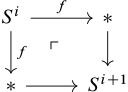
and completing, we obtain the pullback diagram of compactly generated linear categories.

Acknowledgements
The present paper is based on and refines results from the author’s Ph.D. thesis, advised by Tobias Dyckerhoff. I thank him for helpful discussions and feedback. I thank Gustavo Jasso for pointing out a gap in the proof of Lemma 2.4 in a previous version of the article. I further thank Chris Brav, Fabian Haiden and Bernhard Keller for helpful discussions.
Funding
The author acknowledges support from the Deutsche Forschungsgemeinschaft under Germany’s Excellence Strategy – EXC 2121 ‘Quantum Universe’ – 390833306. This project has received funding from the European Union’s Horizon 2020 research and innovation programme under the Marie Sklodowska-Curie grant agreement no. 101034255. The author is a member of the Hausdorff Center for Mathematics at the University of Bonn (DFG GZ 2047/1, project ID 390685813).
Footnotes
- 1By rigid, we mean that all objects are dualizable.
- 2Hint: Given a natural transformation the induced natural transformation on the right adjoints is obtained as the composite
- 3There is a different much-used convention for the definition of the twist and cotwist functors in the literature (see, for instance, [1R. Anno and T. Logvinenko, Spherical DG-functors. J. Eur. Math. Soc. (JEMS) 19 (2017), no. 9, 2577–2656 Zbl 1374.14015 MR 3692883, 39P. Seidel and R. Thomas, Braid group actions on derived categories of coherent sheaves. Duke Math. J. 108 (2001), no. 1, 37–108 Zbl 1092.14025 MR 1831820]). This convention differs from the one considered in this paper in two ways: firstly, instead of forming the cone of the unit, the other convention considers the cocone of the unit and similarly the cone of the counit. Furthermore, the labels of the twist and cotwist are swapped.Let us illustrate our convention in the case of a spherical object: thinking of as the categorified vanishing cycles, this category is then given by The twist functor acts on as a shift functor. The cotwist is the arising autoequivalence of the category containing the spherical object.
- 4Canonical lifts exist by Remark 2.27.
- 5See [42Z. Sylvan, Orlov and Viterbo functors in partially wrapped Fukaya categories. 2019 arXiv:1908.02317v1]. The left adjoint is called the cap functor.
- 6We point out that in contrast to the category of dg categories, the category of categories does not admit a suitable model structure so that the notion of ‘homotopy colimit’ employed in [20S. Ganatra, J. Pardon, and V. Shende, Sectorial descent for wrapped Fukaya categories. J. Amer. Math. Soc. 37 (2024), no. 2, 499–635 Zbl 1546.53081 MR 4695507] is not understood in a model categorical sense. One can nevertheless expect that the passage to the derived categories always turns such homotopy colimits into categorical colimits.
References
- [1] R. Anno and T. Logvinenko, Spherical DG-functors. J. Eur. Math. Soc. (JEMS) 19 (2017), no. 9, 2577–2656 Zbl 1374.14015 MR 3692883
- [2] C. Brav and T. Dyckerhoff, Relative Calabi–Yau structures. Compos. Math. 155 (2019), no. 2, 372–412 Zbl 1436.18009 MR 3911626
- [3] C. Brav and T. Dyckerhoff, Relative Calabi–Yau structures II: shifted Lagrangians in the moduli of objects. Selecta Math. (N.S.) 27 (2021), no. 4, article no. 63, 45 pp. Zbl 1486.14018 MR 4281260
- [4] C. Brav and N. Rozenblyum, The cyclic Deligne conjecture and Calabi–Yau structures. 2023 arXiv:2305.10323v1
- [5] M. Christ, Ginzburg algebras of triangulated surfaces and perverse schobers. Forum Math. Sigma 10 (2022), article no. e8, 72 pp. Zbl 1490.18017 MR 4377269
- [6] M. Christ, Geometric models for the derived categories of Ginzburg algebras of n-angulated surfaces via local-to-global principles. [v1] 2021, [v4] 2023, arXiv:2107.10091v4
- [7] M. Christ, Spherical monadic adjunctions of stable infinity categories. Int. Math. Res. Not. IMRN 2023 (2023), no. 15, 13153–13213 Zbl 1529.18013 MR 4621862
- [8] M. Christ, Cluster theory of topological Fukaya categories. [v1] 2022, [v2] 2024, arXiv:2209.06595v2
- [9] M. Christ, T. Dyckerhoff, and T. Walde, Complexes of stable categories. [v1] 2023, [v2] 2024, arXiv:2301.02606v2
- [10] M. Christ, F. Haiden, and Y. Qiu, Perverse schobers, stability conditions and quadratic differentials. [v1] 2023, [v5] 2024, arXiv:2303.18249v5
- [11] D.-C. Cisinski, Higher categories and homotopical algebra. Cambridge Stud. Adv. Math. 180, Cambridge University Press, Cambridge, 2019, 430 pp. Zbl 1430.18001 MR 3931682
- [12] K. Costello, Topological conformal field theories and Calabi–Yau categories. Adv. Math. 210 (2007), no. 1, 165–214 Zbl 1171.14038 MR 2298823
- [13] T. Dyckerhoff, A categorified Dold–Kan correspondence. Selecta Math. (N.S.) 27 (2021), no. 2, article no. 14, 35 pp. Zbl 1468.18024 MR 4227866
- [14] T. Dyckerhoff and M. Kapranov, Crossed simplicial groups and structured surfaces. In Stacks and categories in geometry, topology, and algebra, pp. 37–110, Contemp. Math. 643, American Mathematical Society, Providence, RI, 2015 Zbl 1373.18015 MR 3381470
- [15] T. Dyckerhoff and M. Kapranov, Triangulated surfaces in triangulated categories. J. Eur. Math. Soc. (JEMS) 20 (2018), no. 6, 1473–1524 Zbl 1403.18011 MR 3801819
- [16] T. Dyckerhoff, M. Kapranov, V. Schechtman, and Y. Soibelman, Spherical adjunctions of stable categories and the relative S-construction. Math. Z. 307 (2024), no. 4, article no. 73, 59 pp. Zbl 1555.18036 MR 4771790
- [17] A. I. Efimov, K-theory and localizing invariants of large categories. [v1] 2024, [v3] 2025, arXiv:2405.12169v3
- [18] C. Fraser, B. Keller, and Y. Wu, Relative cluster categories and Higgs categories with infinite-dimensional morphism spaces. 2023 arXiv:2307.12279v3
- [19] S. Ganatra, Symplectic cohomology and duality for the wrapped Fukaya category. 2013 arXiv:1304.7312v1
- [20] S. Ganatra, J. Pardon, and V. Shende, Sectorial descent for wrapped Fukaya categories. J. Amer. Math. Soc. 37 (2024), no. 2, 499–635 Zbl 1546.53081 MR 4695507
- [21] A. Hedenlund and J. Rognes, A multiplicative Tate spectral sequence for compact Lie group actions. Mem. Amer. Math. Soc. 294 (2024), no. 1468, 134 pp. Zbl 1541.55002 MR 4719082
- [22] P. S. Hirschhorn, Model categories and their localizations.. Math. Surveys Monogr. 99, American Mathematical Society, Providence, RI, 2003, 457 pp. Zbl 1017.55001 MR 1944041
- [23] M. Hoyois, S. Scherotzke, and N. Sibilla, Higher traces, noncommutative motives, and the categorified Chern character. Adv. Math. 309 (2017), 97–154 Zbl 1361.14014 MR 3607274
- [24] D. Huybrechts, Fourier–Mukai transforms in algebraic geometry. Oxford Math. Monogr. 307, Clarendon Press, Oxford, 2006 Zbl 1095.14002 MR 2244106
- [25] T. Johnson-Freyd and C. Scheimbauer, (Op)lax natural transformations, twisted quantum field theories, and “even higher” Morita categories. Adv. Math. 307 (2017), 147–223 Zbl 1375.18043 MR 3590516
- [26] M. Kapranov and V. Schechtman, Perverse schobers. [v1] 2014, [v2] 2015, arXiv:1411.2772v2
- [27] M. Kapranov, Y. Soibelman, and L. Soukhanov, Perverse schobers and the algebra of the infrared. 2020 arXiv:2011.00845v1
- [28] B. Keller and J. Liu, On Amiot’s conjecture. [v1] 2023, [v3] 2025, arXiv:2311.06538v3
- [29] M. Leip, Relative Calabi–Yau structures over commutative ring spectra. Master’s thesis, Mathematisches Institut, Rheinische Friedrich-Wilhelms-Universität Bonn, Bonn, 2017
- [30] Y. Lekili and A. Polishchuk, Derived equivalences of gentle algebras via Fukaya categories. Math. Ann. 376 (2020), no. 1–2, 187–225 Zbl 1441.14062 MR 4055159
- [31] J. Lurie, Higher topos theory. Ann. of Math. Stud. 170, Princeton University Press, Princeton, NJ, 2009, 925 pp. Zbl 1175.18001 MR 2522659
- [32] J. Lurie, On the classification of topological field theories. In Current developments in mathematics, 2008, pp. 129–280, International Press, Somerville, MA, 2009 Zbl 1180.81122 MR 2555928
- [33] J. Lurie, Rotation invariance in algebraic K-theory. Version of 2015, preprint, https://www.math.ias.edu/~lurie/papers/Waldhaus.pdf visited on 29 December 2025
- [34] J. Lurie, Higher algebra. 2017, preprint, https://www.math.ias.edu/~lurie/papers/HA.pdf visited on 29 December 2025
- [35] J. Lurie, Spectral algebraic geometry. 2018, preprint, https://www.math.ias.edu/~lurie/papers/SAG-rootfile.pdf visited on 29 December 2025
- [36] J. Lurie, Kerodon. 2024, https://kerodon.net visited on 29 December 2025
- [37] P. Seidel, Fukaya categories and Picard–Lefschetz theory. Zur. Lect. Adv. Math., European Mathematical Soceity, Zürich, 2008, 326 pp. Zbl 1159.53001 MR 2441780
- [38] P. Seidel, Symplectic homology as Hochschild homology. In Algebraic geometry: Seattle 2005, Part 1, pp. 415–434, Proc. Sympos. Pure Math. 80, American Mathematical Society, Providence, RI, 2009 Zbl 1179.53085 MR 2483942
- [39] P. Seidel and R. Thomas, Braid group actions on derived categories of coherent sheaves. Duke Math. J. 108 (2001), no. 1, 37–108 Zbl 1092.14025 MR 1831820
- [40] V. Shende and A. Takeda, Calabi–Yau structures on topological Fukaya categories. Compos. Math. 161 (2025), no. 5, 1128–1214 Zbl 08086959 MR 4950556
- [41] I. Smith, Quiver algebras as Fukaya categories. Geom. Topol. 19 (2015), no. 5, 2557–2617 Zbl 1328.53109 MR 3416110
- [42] Z. Sylvan, Orlov and Viterbo functors in partially wrapped Fukaya categories. 2019 arXiv:1908.02317v1
- [43] B. Toën, Derived algebraic geometry. EMS Surv. Math. Sci. 1 (2014), no. 2, 153–240 Zbl 1314.14005 MR 3285853
- [44] B. Toën and G. Vezzosi, Caractères de Chern, traces équivariantes et géométrie algébrique dérivée. Selecta Math. (N.S.) 21 (2015), no. 2, 449–554 Zbl 1333.19006 MR 3338682
- [45] Y. Wu, Relative cluster categories and Higgs categories. Adv. Math. 424 (2023), article no. 109040, 112 pp. Zbl 1545.13019 MR 4581969
- [46] W.-K. Yeung, Relative Calabi–Yau completions. [v1] 2016, [v3] 2022, arXiv:1612.06352v2
Cite this article
Merlin Christ, Relative Calabi–Yau structures and perverse schobers on surfaces. J. Noncommut. Geom. 20 (2026), no. 3, pp. 871–951
DOI 10.4171/JNCG/663