On the isoperimetric functions of a class of Artin groups
Arye Juhász
Technion – Israel Institute of Technology, Haifa, Israel
Abstract
We find a polynomial () isoperimetric function for Artin groups, the defining graph of which contains no edges labelled by This in particular shows that even Artin groups have solvable word problem. We use small cancellation theory of relative extended presentations.
1. Introduction
Let ( – the natural numbers), and let be a simple graph without loops, with vertex set and edge set Label the edges by natural numbers via a labelling function Denote where the edge connects to (), and let if and are not connected by an edge. For every such labelled graph corresponds a group presentation
such that
denote by
if is even and
if is odd.
The group presented by is denoted by and is called the Artin group defined by .
Examples 1.
- (1)for everyThen is the free group on
- (2)for everyThen is the free abelian group on
- (3)for everyThen is called right-angled Artin group.
- (4)for everyThen is called an even Artin group.
- (5)for everyThen is said to be of large type.
To each Artin group there corresponds a Coxeter group obtained by adding the relators An Artin group is said to be of spherical type if is a finite group. The graphs of the spherical type Artin groups are classically known. An Artin group is said to be of FC type if it belongs to the smallest class of Artin groups which are closed under amalgamation along standard parabolic subgroups and contain all the spherical type Artin groups. Standard parabolic subgroups are the subgroups which are generated by subsets of
We recall isoperimetric functions. Let be a group presented by Let be the free group freely generated by cyclically reduced (i.e., contains neither nor ). Then represents if and only if
A function is an isoperimetric function for the presentation if for every word which represents of the group in (1.2) satisfies Here denotes the length of in
The isoperimetric functions are known for spherical type, FC type, large type, right-angled Artin groups and some other classes of Artin groups. See [1
R. Charney, Artin groups of finite type are biautomatic. Math. Ann. 292 (1992), no. 1, 671–683 Zbl 0736.57001 MR 1157320
, 4D. F. Holt and S. Rees, Artin groups of large type are shortlex automatic with regular geodesics. Proc. Lond. Math. Soc. (3) 104 (2012), no. 3, 486–512 Zbl 1275.20034 MR 2900234
, 5J. Huang and D. Osajda, Helly meets Garside and Artin. Invent. Math. 225 (2021), no. 2, 395–426 Zbl 1482.20023 MR 4285138
].Main Theorem. Let be an Artin group, If for every then is an isoperimetric function for
We believe that “” can be replaced by “”.
Corollary.
Let be an Artin group. If for every then has solvable word problem. In particular, even Artin groups have solvable word problem.
The corollary has been established recently also in [9
R. Blasco-Garcéa, M. Cumplido, and R. Morris-Wright, The word problem is solvable for 3-free Artin groups in quadratic time. [v1] 2022, [v4] 2025, arXiv:2204.03523v4
], using a completely different method.Our basic method is small cancellation theory of extended (relative) presentations via van Kampen and Howie diagrams (see [6
A. Juhasz, On the isoperimetric functions of a class of Artin groups. 2025 arXiv:2507.16770v1
, Lemma 1.2.2, Remark 1.2.3]). (Recall that a van Kampen diagram over is a connected, simply connected labelled planar complex, labelled by elements of such that the labels of the boundary of the cells are elements of We say that the corresponding cell (region) realises the element of )The original version of this article appeared in [6
A. Juhasz, On the isoperimetric functions of a class of Artin groups. 2025 arXiv:2507.16770v1
] and has been approved by the referee. The present article is a shortened version of it.Outline of the proof of the Main Theorem. In order to find an isoperimetric function for the presentation we have to find an upper bound on the number in (1.2) in terms of the length of for every representing in the group defined by By the basic theorem of van Kampen diagrams, for every cyclically reduced representing there is a van Kampen diagram with boundary label such that the number of regions in is at most See [10
R. C. Lyndon and P. E. Schupp, Combinatorial group theory. Classics in Math., Ergeb. Math. Grenzgeb. 89, Springer, Berlin, 1977, 339 pp. Zbl 0368.20023 MR 0577064
, Chapter V]. So our problem can be considered as a counting problem in van Kampen diagrams, and this is our approach. We use the following simple basic principles, together with the well-known result in Proposition 1. Thus let be a finite set. In order to count the elements of we subdivide into subsets such that we know and know the maximal possible number of elements in Then has at most elements. In our case, Proposition 1 provides the first approximation to the numbers and in terms of the length of Proposition 1.
Let be a reduced van Kampen diagram over Let be a boundary label of cyclically reduced. Assume satisfies conditions and Suppose that each piece has length Then each of the following holds:
- (a)For each region of , we have
- (b)The number of regions in is at most
Hence if our diagram would be a and diagram, then by part (b) of the proposition, the number of regions in would be bounded by Being this not the case, we first modify our approach. The core idea is not to try to estimate the number of all the regions via a result like Proposition 1 but to use that result for the estimation of a part of the regions only, namely, the number of regions of having boundary cycle of length at least and then relate the number of remaining regions, to
In this direction, we have the following.
Theorem 1.
Let be a van Kampen diagram, given by (1.1). Assume
Then there is a van Kampen diagram with the same boundary label as such that
For the proof, see [6
A. Juhasz, On the isoperimetric functions of a class of Artin groups. 2025 arXiv:2507.16770v1
, pp. 5–11,105].Now, we relate the number of regions in to the number of regions in First, let us state a definition.
Definition 1
(Bands). Let and let ( is not excluded). Say that and are neighbours if contains a subpath with label (We consider as a neighbour of itself, ) The transitive closure of “neighbourhood” is an equivalence relation. For with denote by the equivalence class of Let be the subdiagram of generated by Call the band generated by . Denote by the collection of all the bands in Clearly,
We make the observation that every band either starts on the boundary of a region in or on the boundary of The same is true for the ends of bands. Hence we can estimate the number of bands in terms of the number of regions from Next, we show that the number of regions in a band is bounded by the number of bands. Relying on Theorem 1, this easily implies that is bounded by See [6
A. Juhasz, On the isoperimetric functions of a class of Artin groups. 2025 arXiv:2507.16770v1
, pp. 10–12].The proof of the Main Theorem is reduced to the proofs of Theorems A–C and some results on the way to their proofs. In the rest of the work, we concentrate on their proofs. We assume that is given by (1.3).
See Definition 2.1.4 for
Theorem A.
Let be a van Kampen diagram over with cyclically reduced boundary label If then satisfies the small cancellation conditions and for every
Theorem B.
Let be a van Kampen diagram over with cyclically reduced boundary label If then for every region in realising a relation and and in
The main theorem obtained from the proof of Theorem 1 and the main result is Theorem C, which is a variant of Greendlinger’s lemma.
Theorem C
(Greendlinger’s lemma). Let be an Artin group given by (1.3). Let (see Definition 2.1.4) be a connected, simply connected minimal diagram over with cyclically reduced boundary label in
Let be reduced as written. Then there is a van Kampen diagram with boundary cycle such that decomposes into labelled with and one of the following holds:
- (a)There is a boundary region with connected, , for or , where Moreover, , where is the complement of on
- (b)There are boundary regions with connected, , for or for
- (c)There is a region with connected, , and there is a region with connected, , for or for
Overview of the present work. The goals of the work are
- (1)to estimate the number of regions in
- (2)to estimate the number of regions in
The idea behind (1) is to count the number of regions in (for notations, see [6
A. Juhasz, On the isoperimetric functions of a class of Artin groups. 2025 arXiv:2507.16770v1
, the three constructions on pp. 6, 7, 11]) where due to Theorem A, conditions and are satisfied, hence we may do this, and then to show that the number of regions in and is the same, via a natural mapping of diagrams which sends a region in to a uniquely defined region in For see [6A. Juhasz, On the isoperimetric functions of a class of Artin groups. 2025 arXiv:2507.16770v1
, pp. 79–81]. One of the problems is that is obtained from by shrinking edges and identifying vertices; hence in principle, may shrink to an edge or a vertex. Thus our task is to show that (and ) does not cause deformation and collapse of regions. One of the classical methods to avoid deformations in diagrams is by Greendlinger’s lemma. It roughly says that a diagram with at least two regions has at least two Greendlinger regions, the boundary of which contains a big portion of the relators. See [6A. Juhasz, On the isoperimetric functions of a class of Artin groups. 2025 arXiv:2507.16770v1
, Definition 1.3.1]. In general terms, it shows that if there is a kind of deformation in certain subdiagrams, then certain events are simultaneously unavoidable and forbidden, which of course is absurd. Hence no deformation occurs. For example, consider a reduced diagram in which every region has boundary label cyclically reduced, not proper power, Suppose that the boundary of a region is not simple closed. (This is the deformation which we would like to avoid.) Then there is a loop in the boundary of the region which surrounds a disc the boundary of which is labelled by a subword of the cyclic word Suppose that in we have Greendlinger’s lemma. Then has a boundary region with connected such that Hence and necessarily have a common (unavoidable) piece of length at least But such a word is forbidden, because due to not being a proper power, this would mean that cancels violating that the diagram is reduced. (Though we do not use this example, we use its underlying idea. See the proofs of Propositions 2.1.7 and 2.1.8 in [6A. Juhasz, On the isoperimetric functions of a class of Artin groups. 2025 arXiv:2507.16770v1
].) Coming back to the context of our work, notice that by Theorem C, every bigonal diagram that is, has a generalised Greendlinger region on one of the sides of the bigon. Since does satisfy and hence it has Greendlinger regions. The natural candidates for Greendlinger’s regions in are the images (by ) of the Greendlinger regions of The problem is that while Greendlinger regions are boundary regions, our candidates in need not be. So we need a technique to “move” inner regions to the boundary. More precisely, to show that there is a diagram with the same boundary label as in which the candidates are boundary regions. We do this by observing that since the generators of the second homotopy group of the defining complex are prisms, we can replace one half of the prism by its complement by a rotation of the prism. In this has the effect of moving a region which occurs both in and in the prism. See [6A. Juhasz, On the isoperimetric functions of a class of Artin groups. 2025 arXiv:2507.16770v1
, Section 3]. The involvement of the second homotopy group requires the introduction of extended presentations.Finally, we have to count To this end, it is enough to show that two bands cannot intersect more than once (see Section 4). Essentially, we prove this simultaneously with the other main proposition (see Section 4).
The ideas developed here lead to further results for Artin groups dealt with in the present work. Recall that a parabolic subgroup of an Artin group is a conjugate of a standard parabolic subgroup. In [7
A. Juhász,
Fusion in Artin groups II. In preparation
], we show that the intersection of parabolic subgroups is parabolic. Also, we describe fusion in In particular, we show that in even Artin groups, every standard parabolic subgroup controls fusion in (i.e., if two elements of are conjugate in then they are already conjugate in ).Together with further ideas, we show in [8
A. Juhász,
On locally reducible Artin groups. In preparation
] that locally reducible Artin groups (i.e., no (2.3.3), (2.3.4) and (2.3.5) type standard parabolics occur) have polynomial isoperimetric functions.The work is organised as follows:
2. The diagrams and
2.1. The diagrams and
Let be a simply connected diagram over given by (1.3), and let Denote by the set of all the regions of the boundaries of which are labelled only by letters from (). Denote by the set of all the regions of the boundaries of which have labels from and also from Thus We subdivide further by
where is the set of regions in with boundary length at least and is the set of regions in with boundary length We have for
For the definition of the diagrams and we introduce equivalence relations “”, “” and “” on and respectively.
Definition 2.1.1
(of ). Let and be regions in Say that they are friends if the following hold:
- (i)contains an edge.
- (ii)
Let be the transitive closure of friendness. It is easy to see that is an equivalence relation on Denote by the equivalence class of
Definition 2.1.2
(of ). Let and be regions in Say that they are friends if contains an edge. Let be the transitive closure of friendness. Then is an equivalence relation on Denote by the equivalence class of
Definition 2.1.3
(of ). Let and be regions in Say that and are friends if consists of an edge with label Let be the transitive closure of friendness. Then is an equivalence relation. For denote by the equivalence class of in
Definition 2.1.4
(The class of diagrams). The following statements hold:
- (a)Let be a cyclically reduced word which represents in Assume that in Here is the graph obtained from by removing all edges not labelled by Denote by the set of all the van Kampen diagrams with boundary label By [10R. C. Lyndon and P. E. Schupp, Combinatorial group theory. Classics in Math., Ergeb. Math. Grenzgeb. 89, Springer, Berlin, 1977, 339 pp. Zbl 0368.20023 MR 0577064, Chapter V], Let denote the set of all the diagrams in for which is minimal possible. Clearly, Let be the set of the diagrams in which contain minimal number of equivalence classes of regions in Clearly, Finally, let be the set of the diagrams in with adequate bands. Say that is minimal if and is minimal possible. It follows that if is minimal, then Hence
- (b)Definition 2.1.1 makes sense without the requirement that and are in namely, if and contains an edge. We shall call the corresponding equivalence relation “equivalence”. For define Then is connected. If then define Notice that is well defined. Also, denote by for this case. Denote the diagram obtained by
Definition 2.1.5
(Adequate). Let be a connected, simply connected diagram over Say that is adequate, if for every is homeomorphic to the open unit disc, is simple such that the boundary label is not and is cyclically reduced.
Definition 2.1.6
(). Let be a van Kampen diagram over and let If is homeomorphic to the open unit disc, for every then we may consider as a set of regions such that their totality generates a diagram which we denote by Thus We have Also,
Proposition 2.1.7.
Let Then is adequate for every Moreover, if and are regions of not both bands, then implies that is connected.
Proposition 2.1.8.
Let Then is adequate. Moreover, if then is connected.
Remark 2.1.9.
Let When passing from to by shrinking edges labelled by elements of to a point and shrinking bands to edges, it may happen that the interior of the obtained region in becomes disconnected. Since is adequate, we can replace by a disc (and we shall do so), the boundary of which is labelled by
We prove Propositions 2.1.7 and 2.1.8 by simultaneous induction on the size of See [6
A. Juhasz, On the isoperimetric functions of a class of Artin groups. 2025 arXiv:2507.16770v1
, Sections 2.2–2.4].3. Extended presentations, moves and banded diagrams
3.1. Identities among relations
We recall identities among relations from [2
D. J. Collins and J. Huebschmann, Spherical diagrams and identities among relations. Math. Ann. 261 (1982), no. 2, 155–183 Zbl 0477.20019 MR 0675732
, p. 157]. Let be a complex. Let be a basepoint for (some designated vertex of ). A sequence over at is where is a path in consisting of a concatenation being a region (face) of and a path from to where is the basepoint of We call an identity sequence if the concatenation is freely equivalent to the trivial path at Given a presentation following [10
R. C. Lyndon and P. E. Schupp, Combinatorial group theory. Classics in Math., Ergeb. Math. Grenzgeb. 89, Springer, Berlin, 1977, 339 pp. Zbl 0368.20023 MR 0577064
], we construct a bouquet of tailed circles with basepoint Let be a sequence over at tails. Label by and label by a word in via a labelling function After carrying out all free cancellations in we get an diagram over the boundary label of which is the cyclically reduced word for in If then is a connected and simply connected planar diagram (van Kampen diagram), and if in then is the union of a finite number of spines and tessellated spheres () by the In this case, we call a spherical diagram. We call a singular sphere or just a sphere if it consists of a single sphere. When the are labelled with and in then we call the sequence an identity sequence over and call it a simple identity sequence, if the corresponding spherical diagram is a simple sphere.
Definition 3.1.1
(Extended presentations). Let be a finite presentation of a group and let be a set of simple identity sequences over The corresponding extended presentation is the triple This notion was introduced in [3
R. A. Fenn, Techniques of geometric topology. London Math. Soc. Lecture Note Ser. 57, Cambridge University Press, Cambridge, 1983, 280 pp. Zbl 0517.57001 MR 0787801
] by Roger Fenn. Now let be an Artin group given by in (1.3). The identities among relations we choose are obtained from the generated standard parabolic subgroups with defining subgraphs with the vertex set and the edge set with labels and The corresponding tessellated simple spheres are prisms with two regions of degree (upper and lower) labelled with which we call the big regions, and a band of length in which the regions are labelled by and in an alternating manner. See Figure 1 for 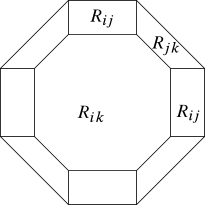
A big region realising in a half sphere for
We introduce one of our main tools, moves.
Let and let be a simple closed curve on Then subdivides into two simply connected subdiagrams, and with connected interiors, where is the submap of all regions to the right of and is the submap of all the regions to the left of Clearly, and
Let be the set of all the connected, simply connected submaps of with connected interior, and let be the function which for every closed curve on sends to and to and leaves unaltered.
Let be a van Kampen diagram over and let be a simply connected subdiagram of with connected interior and simple boundary cycle Suppose that can be embedded into for some (uniquely defined) and as an diagram with image in with simple closed such that is mapped onto Then
Definition 3.1.2
(moves). Let be a simple identity among relations realised by a uniquely defined sphere Let and be as defined above for some An move at is a surgery in by which we cut out and fill in instead by Since this is well defined.
Below we consider some examples which illustrate the way moves are used.
Example 3.1.3.
Let where
Here Let Then represents in Figure 2 shows the corresponding van Kampen diagrams.
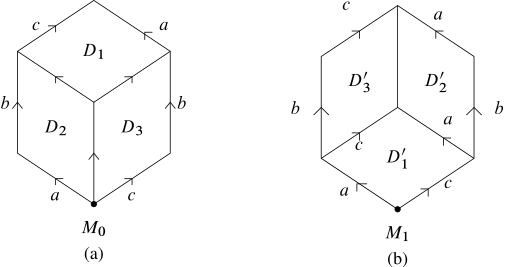
Application of an move on
Example 3.1.4.
This changes the positions of the regions realising and and may reduce the number of regions. See Figure 3.
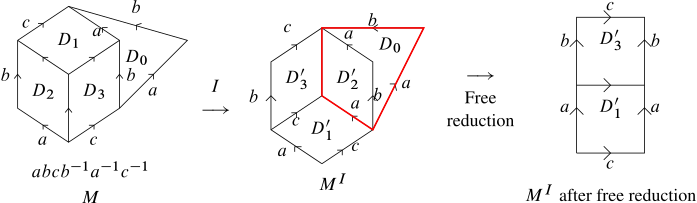
An move followed by a free reduction which reduces the number of regions.
3.2. Banded subdiagrams and transfer of regions
In this subsection, we assume and assumption
Lemma 3.2.1.
Let and let be an move or extended move. Then
Proof.
We have to show that increases neither nor Suppose that replaces the simply connected subdiagram with connected interior by a diagram
We use notation of Definition 3.1.1. If then clearly cannot alter and If then contains exactly one big region and also contains exactly one big region which is a copy of Since the result follows.
Definition 3.2.2
(Banded subdiagrams). Let be a band in with sides and and let be a boundary path of a simply connected subdiagram with connected interior.
Definition 3.2.3
(Transfer of regions from ). Let be a connected, simply connected diagram over with connected interior, and let be a connected, simply connected subdiagram over with connected interior. Let be a boundary region of with connected, and let be such that Observe that embeds into the prism where is an annulus with regions from (a closed band) and is a region with and (We identify and with their images in ) Notice that and have the same poles and hence is a band. Replace with (which have the same boundaries) and denote the resulting diagram by where is the move which replaced with Thus is replaced by Hence
In this situation, we say that transferred from . See Figure 4 (b) and 4 (c). If every region can be transferred from we say that is transferable. The removal of naturally extends to transfer of regions from (See Figure 4 (b′) and 4 (c′).)
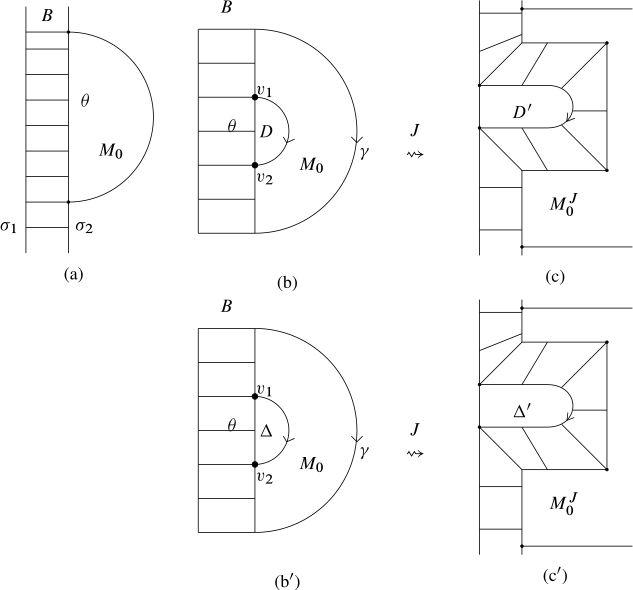
(a)–(c): Transfer of the region via an adjacent band by the application of the move. (b′) and (c′): Transfer of the modified region via an adjacent band by the application of the move.
Notice that if instead of we have a band-bundle, then can be transferred by a sequence of moves beyond the band-bundle, without destroying the bundle structure. See Figure 5 (a) and 5 (b) for and Figure 5 (a′) and 5 (b′) for
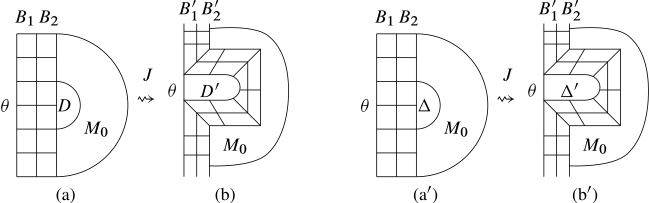
(a) and (b): Transfer of the region via a band-bundle by the application of the move (a′) and (b′): Transfer of the modified region via a band-bundle by the application of the move
We are interested in a special type of banded subdiagrams (2-banded subdiagrams) which we consider in the next subsection.
Definition 3.2.4
(2-Banded subdiagram). Let be a cyclically reduced word in which represents in Let and let be a connected, simply connected subdiagram of with connected interior. Say that is banded if
- (1)there is an band and a band in ( is not excluded),
- (2)there are connected and simply connected subdiagrams and in and paths and such that
- (i)and where are sides of respectively, are connected, and are poles of and and are poles of
- (ii)
- (3)then is cyclically reduced.
Call closed banded if Let be a cyclically reduced word in which represents in Denote by the collection of all the banded subdiagrams of with boundary label
We shall show that under certain conditions, there is a boundary region of which we can transfer from We wish to repeat the process of transferring until either no regions remain in or has a special structure. The next proposition shows that moves preserve these “certain conditions”, hence we can repeat transferring regions as long as there are regions in or does not have the special structure. Here is the result of applying on a sequence of moves.
Definition 3.2.5
(Standard moves). Say that an move is standard if is a maximal piece in the sense that in Figure 5 (b) cannot be extended as a common boundary of and
Proposition 3.2.6.
Let be a cyclically reduced word in which represents in and let Let be a subdiagram of with cyclically reduced boundary label and suppose that (Thus is banded.) Let notation be as in [6
A. Juhasz, On the isoperimetric functions of a class of Artin groups. 2025 arXiv:2507.16770v1
, Figure 33 (c)].Assume that contains a boundary region or such that or respectively, are connected and or or such that or Let be the standard move on or respectively, where or according as or respectively, which transfers or respectively, from Then See the proof of Proposition 3.2.6 in [6
A. Juhasz, On the isoperimetric functions of a class of Artin groups. 2025 arXiv:2507.16770v1
].4. Lifting to and the proofs of the main results
The idea behind showing that satisfies conditions and is to use it in Obviously, we cannot lift conditions and from to however, we can lift a version of Greendlinger’s lemma. This is the content of Theorem C. The first step towards such a lifting is to establish the basic connection between and We consider as a map and consider its skeleton. Following the definition of we consider as a quotient of Then we extend this from the skeleton to the whole map and show that Since satisfies conditions and this allows us to estimate
4.1. Preliminary results
4.1.1. The mappings and
Let be a connected, simply connected diagram, and Consider the diagram (defined in Section 2.1). Assume first that it has connected interior. Denote by the skeleton of Define an equivalence relation “” on the vertices of to be the transitive closure of the relation “” defined as follows: vertices and satisfy if either or there is an edge labelled by a letter from (edge) with and Here denotes the initial vertex of and denotes the terminal vertex of Edges and satisfy if Then by the definition of is isomorphic to
Let be the collection of all the edges of which are labelled by and define accordingly.
Denote the projection mapping of which realises by Then sends a vertex in to the vertex which we denote by If then is an edge which we denote by If then is a loop with which we remove. We can do this because there is no interrelation between a loop and an edge (or loop). So we define and where and We define by its set theoretical definition as follows.
Let be a vertex in a vertex of
- (a)Define
- (b)If is an edge in then is the unique edge such that (Notice that is necessarily in )
If is not connected, then consider each connected component individually.
Consider now Assume first that it has connected interior. Define an equivalence relation “” on to be the transitive closure of the relation “” defined as follows:
- (1)Vertices and of satisfy if and only if
- (2)Edges and satisfy if and only if and
It follows from the definition of that is isomorphic to
Denote by the projection from onto which realises Then we have
- (1)if then a uniquely defined vertex in
- (2)if then a uniquely defined edge in
We define as follows:
- (1)If then where is the unique vertex in with
- (2)If then where
Finally, define by Then It follows by checking Euler characteristics that is planar. We have the following.
Lemma 4.1.2.
The following statements hold:
- (1)Let , and let be the -skeleton of the -band which contains Then In particular,
- (2)Let Then
- (3)Let Then In particular,
- (4)Let Then
- (5)and for every edge
Proof.
Immediate by the definitions of and
Proposition 4.1.3.
Let notation and assumptions be as above. Then
Proof.
See [6
A. Juhasz, On the isoperimetric functions of a class of Artin groups. 2025 arXiv:2507.16770v1
, pp. 82–83]. 4.2. The subdiagrams and
Let and assume is connected. In general, this does not imply that has connected interior. In the rest of the work, we aim to prove Theorems A–C. It is enough to prove these theorems for every connected component of Hence without loss of generality, we may work under the assumption that has connected interior, and we shall do so. Thus for the rest of the work, we shall assume that has connected interior, unless said otherwise.
Definition 4.2.1
(). Suppose and let Assume vertices, edges. Define define and define Thus and Define It follows from the definition of that where are bands emanating from and are connected unions of regions from
Thus and are connected subdiagrams of Due to Proposition 2.1.7, and are connected, and it is easy to see that and are connected.
We are interested in for the special case when has valency in
Lemma 4.2.2.
Let Assume that decomposes by vertices and Let and be boundary regions of and in Assume that is a vertex with valency in Let and let Thus where and are the boundary paths of and with common endpoint Then each of the following holds:
- (a)is connected and simply connected with cyclically reduced boundary label such that each connected component of has cyclically reduced boundary labels Moreover,
- (b)is connected and simply connected with connected interior and cyclically reduced boundary label .
- (c), where are vertices, are sides of -bands and and
Proof of Lemma 4.2.2.
See the proof of Lemma 5.2.2 in [6
A. Juhasz, On the isoperimetric functions of a class of Artin groups. 2025 arXiv:2507.16770v1
]. 4.3. Definitions and assumptions
Generalised Greendlinger regions. In our earlier work [6
A. Juhasz, On the isoperimetric functions of a class of Artin groups. 2025 arXiv:2507.16770v1
, Section 1.3], we introduced (classical) Greendlinger regions. In the rest of the work, we shall need more general notions of Greendlinger regions. Recall from [6A. Juhasz, On the isoperimetric functions of a class of Artin groups. 2025 arXiv:2507.16770v1
, Section 1.3] and that is a connected, simply connected map with connected interior which contains at least two regions.If and boundary paths, we shall call bigonal with sides and . We define and and as follows.
Definitions 4.3.1.
Let be a bigonal map with sides and Define
- (i)is defined accordingly. Furthermore, define where is defined only if In this case, if and if In case we choose
- (ii)Let be an diagram, given by (1.1). Assume andDefineHere, is the complement of on Define accordingly.
- (iii)DefineDefine accordingly.
- (iv)Define
- (v)Define as follows:if one of the following holds:
- (1)
- (2)
- (3)and there is a region in and a sequence of moves such that is connected and
- (4)and
In all other cases, - (vi)Let Define
Assumptions 4.3.2.
Theorem 4.3.3
(Theorem S). Let and assume that decomposes by where and are boundary paths and and are boundary vertices. Let and let Assume in parts (a), (b) and (c). Then there is a sequence of moves such that and each of the following holds:
- (a)If is an edge of then there is a band which has a pole on and the other pole on In particular, is connected.
- (b)If and are bands emanating from with adjacent poles on then is connected. Moreover, let be the bands that emanate from Then is connected, where and have adjacent poles on
- (c)Let where are the connected components.
- (i)are simple closed curves and decompose by where and .
- (ii)Up to diamond moves, is cyclically reduced and and either or is transferable via See Figure 6.
- (iii)For every .
- (d)Let Then the following hold:
- (i)If then
- (ii)If and for and then
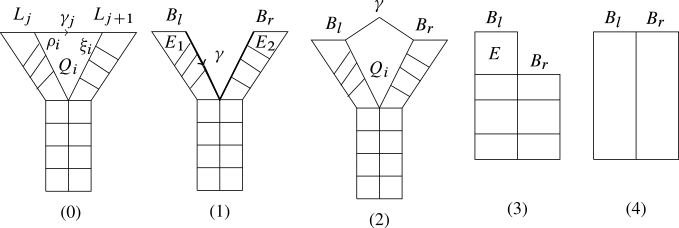
The possible configurations of the adjacent bands in emanating from
Remarks
(Pushing up ).
- (1)It follows from part (c) that if then is a homogeneous band-bundle, hence we can push up by a sequence of moves to such that obtaining the classical result on Greendlinger regions.
- (2)The same results hold if we use in place of
Theorem 4.3.4
(Theorem L). Let and vertices, and boundary paths of Assume and let Let and let Let and let Let
- (a)If , then and
- (b)If , then and
Theorem 4.3.5
(Theorem T). Let and let be a simply connected, connected subdiagram of with at least one region. Assume that is closed banded in by bands and If has cyclically reduced label and then is transferable. In particular, there is a sequence of moves such that is connected and is a band-bundle. Moreover, and .
In each of these theorems, and and vertices. The induction hypothesis claims that if is a proper subdiagram of with cyclically reduced boundary label such that then the corresponding result holds for We shall denote these hypotheses by and respectively. So we assume in the sequel that
4.4. The proof of Theorem A
Lemma 4.4.1.
Let be a cyclically reduced word in in and in Let be a van Kampen diagram over given by (1.1). Assume that and all bands are adequate. Let and be regions in with Assume that there are bands and connecting adjacent edges of with adjacent edges of and are vertices such that and Then In particular, if then the poles of and cannot be adjacent both on and on
Proof.
See the proof of Lemma 5.4.1 in [6
A. Juhasz, On the isoperimetric functions of a class of Artin groups. 2025 arXiv:2507.16770v1
]. Lemma 4.4.2.
Let and assume Let Then
- (a)has no inner vertices with valency
- (b)satisfies condition
Proof.
See the proof of Lemma 5.4.2 in [6
A. Juhasz, On the isoperimetric functions of a class of Artin groups. 2025 arXiv:2507.16770v1
]. 4.4.3. Proof of Theorem A
If does not satisfy condition then due to Lemma 4.4.2, contains an inner vertex with valency Let and be the regions of which contain on their boundary. Let and let It is not difficult to show by arguments similar to those used in the proof of Lemma 4.2.2 that is connected and simply connected, and and are sides of bands and is either a point or a path with label Consider Since while if is not a point, then is labelled with the only occurrences of letters in which do not commute with are the non-trivial labels of In particular,
We claim that if and are not points, then Suppose not. By [6
A. Juhasz, On the isoperimetric functions of a class of Artin groups. 2025 arXiv:2507.16770v1
, Lemma 1.1.c], there are at least two disjoint occurrences of and two disjoint occurrences of in hence has at least four such occurrences violating (*). Hence Denote It is easy to see that is cyclically reduced and In particular, Theorem B applies to (). Hence if is a region of with then due to (*). Since hence Hence is abelian. Consequently, if is not a point, then from each edge of there emanates a band in which has one of its poles on and the other on Observe that and have adjacent poles on and on But this violates Lemma 4.4.1. Hence all are points. But then since three is odd, the three changes of orientations of the poles of force This violates [6A. Juhasz, On the isoperimetric functions of a class of Artin groups. 2025 arXiv:2507.16770v1
, Lemma 1.1 (a)]. Hence It follows from Lemma 4.4.2 (b) that satisfies conditions and ∎4.5. Preparatory results for the proofs of Theorems S, L, T and B
Lemma 4.5.1.
Let be a connected, simply connected diagram with connected interior. Suppose and where and are vertices.
Let and consider Assume Let and define Assume Theorem S holds for Then for or and
Proof.
See the proof of Lemma 5.5.1 in [6
A. Juhasz, On the isoperimetric functions of a class of Artin groups. 2025 arXiv:2507.16770v1
]. Lemma 4.5.2.
Let with boundary cycle where and are vertices. Assume that and let Let and let Let and let Assume is connected. Then in each of the following cases, and :
- (a)
- (b), and there is an -band emanating from and ending on
Moreover, in case (a),
Proof.
See the proof of Lemma 5.5.2 in [6
A. Juhasz, On the isoperimetric functions of a class of Artin groups. 2025 arXiv:2507.16770v1
]. Remark.
Lemma 4.5.2 remains true if we replace by
Lemma 4.5.3.
Let be a connected, simply connected diagram over F with connected interior. Let and vertices and and boundary paths. Let and assume that and If and Theorem S holds for then each of the following holds:
- (a)
- (b)
Proof.
See [6
A. Juhasz, On the isoperimetric functions of a class of Artin groups. 2025 arXiv:2507.16770v1
, pp. 98–99]. Lemma 4.5.4.
Let notation and assumptions be as in Lemma 4.2.2. Let Let and (Thus and is a boundary cycle of ) If then is abelian.
Proof.
See the proof of Lemma 5.5.4 in [6
A. Juhasz, On the isoperimetric functions of a class of Artin groups. 2025 arXiv:2507.16770v1
]. Corollary.
Let notation and assumptions be as in the lemma. If then
Proof.
4.6. Proof of Theorem S
- (a)Let be a subpath of and vertices, It follows from the definition of that there are bands and emanating from and respectively, and ending on Let be the side of which has as an endpoint, and let be the side of which has as an endpoint. Then and Let and be the endpoints of and respectively, on and let be the subpath of which starts at and ends at Then as and Also, is cyclically reduced, since Let be the bounded component of Assume first that is a simple closed path. Hence is connected. It follows from [6A. Juhasz, On the isoperimetric functions of a class of Artin groups. 2025 arXiv:2507.16770v1, Lemma 2.2.1] that Hence Theorem A applies to and it follows from the proof of Lemma 4.5.4 that if is not abelian, then one of the four cases mentioned in the proof of Lemma 5.5.4 in [6A. Juhasz, On the isoperimetric functions of a class of Artin groups. 2025 arXiv:2507.16770v1] occurs. From this point on, we follow the proof of Lemma 4.5.4, with (here) instead of showing that each case leads to a contradiction, hence is abelian, more precisely, in the first case, by Lemma 4.5.1, in the second case, by Lemma 4.5.3, in the third case, by Lemma 4.5.2 and in the fourth case, by Theorem L. Therefore, if then from every there emanates an band which ends on since (Notice that it cannot end on ) If is not connected, then a similar argument applies to each component.
- (b)Let and be bands emanating from and ending on Assume that their poles on are adjacent. Let and be the sides of and respectively, with a point. We claim that is connected. Suppose not and consider Let be a bounded connected component of it. Then Let Then applying diamond moves at the endpoints of if needed, we may assume that is cyclically reduced. It follows from [6A. Juhasz, On the isoperimetric functions of a class of Artin groups. 2025 arXiv:2507.16770v1, Lemma 2.2.1] that Hence Theorem T applies to (). Hence by a sequence of moves, is transferable beyond and such that contains no regions. Doing so independently for every connected component by we get that is connected, whereConsider now Let be its bounded connected components.Assume and is connected. Assume that for some occurs between and such that Suppose that we would like to transfer a region from via In principle, it is possible that a previous step of transferring regions occurred between and and was transferred to Hence now we transfer it back, and by this we create a loop in the process. The point is that because is connected, we may regard as a single band, and this enables us to transfer further beyond out of and, by this, to “empty” (by moves ) each so to get and simultaneously connected. From this, it is clear how to prove for general
- (c)(i) This is clear from the construction of and the definition of(ii) and (iii) It follows from [6A. Juhasz, On the isoperimetric functions of a class of Artin groups. 2025 arXiv:2507.16770v1, Lemma 2.2.1] that It remains to show that either with or is transferable. Thus Theorem C is applicable to implying that (Recall that ) Consequently, if is not abelian, then contains a transferable region. Hence by applying a finite number of moves, we can transfer all the regions with beyond and/or and remaining either with an abelian diagram or with a diagram with where is obtained from by the appropriate move. Applying [6A. Juhasz, On the isoperimetric functions of a class of Artin groups. 2025 arXiv:2507.16770v1, Lemma 4.1.2], the result follows. Finally, since either every region in is transferable via or But Hence
- (d)We follow notation of part (c).(i) By assumption, Hence Consider Let be the bands which emanate from and end on Consider If with then we can transfer beyond and via a suitable sequence of moves such that in configurations (1), (2), (3) and (4) as in [6A. Juhasz, On the isoperimetric functions of a class of Artin groups. 2025 arXiv:2507.16770v1, Figure 41] occur. In configuration (1), in configurations (2) and (3), and in configuration (4), Similar arguments apply to Notice that if and are in configurations (1), (2) or (3), then This is part (2) in the definition of Hence we have to show that if then which contradictsLet be in configuration and in configuration and If then either or or both. Assume is in configuration (4) and in configuration Then is a homogeneous band-bundle. See [6A. Juhasz, On the isoperimetric functions of a class of Artin groups. 2025 arXiv:2507.16770v1] for the definition. Let be the maximal band-bundle that contains Then we claim that Thus suppose and consider If then we transfer via by a sequence of moves such that Hence is in configurations (1), (2) or (3), since implies that Observe that we can push up by a sequence of moves along and This is part (3) in the definition of So it remains to deal with the case when both and are in configuration (4). Let be the maximal band-bundle which contains Then If then is a band-bundle, and by pushing up via we get But then by part (4) of the definition of Finally, if then either or and we fulfil part (3) of the definition of showing that If one of the consists of a single region with then and the above arguments apply to this case.(ii) The case when is dealt with similarly.∎
4.7. Proof of Theorem L
- (a)If then by Lemma 4.5.1, Assume By Theorem S part (d), it is enough to show that By [6A. Juhasz, On the isoperimetric functions of a class of Artin groups. 2025 arXiv:2507.16770v1, Lemma 1.3.2], If then by Lemma 4.5.2 (a), If then by [6A. Juhasz, On the isoperimetric functions of a class of Artin groups. 2025 arXiv:2507.16770v1, Lemma 1.3.4], has an endpoint with valency Let If then is an abelian, by Lemma 4.5.4, hence there is an band-bundle emanating from and ending at (We follow the notation of Lemma 4.5.4.) Consequently, by Lemma 4.5.2 (b), as required. Since the rest follow.
- (b)Let and consider By [6A. Juhasz, On the isoperimetric functions of a class of Artin groups. 2025 arXiv:2507.16770v1, Proposition 1.5.2], is connected, and where is the complement of on Consequently, See Definition 4.3.1 (iii). Therefore, the result follows from Theorem S part (d). The rest follows from the fact that hence and due to the alternating nature (in and ) of the boundary label of ∎
4.8. Proof of Theorem T
By induction on Let and let Then and boundary vertices. We start with all the transferable regions from by applying successively a sequence of moves. Let be the resulting diagram. Assume If then we can replace by and make the same argument. Hence we may assume that where is a boundary label of which we may assume to be cyclically reduced. Since we removed only regions of and this cannot increase and Theorem C applies to and implies that or where Consequently, there is a region with or a submap which can be transferred from See Remarks following Theorem S. Let the resulting diagram obtained from be denoted by Notice that Then we may continue transferring from all the regions with ending up either with a diagram without regions proving the theorem or with an abelian diagram. In this case, [6
A. Juhasz, On the isoperimetric functions of a class of Artin groups. 2025 arXiv:2507.16770v1
, Lemma 4.1.2] completes the proof.∎4.9. Proofs of Theorems B and C
Proof of Theorem B.
We start with the proof of Theorem B.
Case
Then hence Hence if then Now, by [6
A. Juhasz, On the isoperimetric functions of a class of Artin groups. 2025 arXiv:2507.16770v1
, Lemma 1.1.1 (c)], Hence and as required.Case
Let and consider Recall that for every region in and where Without loss of generality, we may assume that has connected interior. Hence due to Theorem A and [6
A. Juhasz, On the isoperimetric functions of a class of Artin groups. 2025 arXiv:2507.16770v1
, Lemma 1.3.2], either or In the first case, the result is clear. Assume, therefore, that We show thatFrom this, the result follows. We show this for The proof is the same for Recall the notation of Lemma 4.5.2. By (3) in the proof of Lemma 4.5.2, Hence by Theorem A and due to [6
A. Juhasz, On the isoperimetric functions of a class of Artin groups. 2025 arXiv:2507.16770v1
, Lemma 1.3.2], the individual contribution of to is at least However, due to possible consolidation of labels of adjacent the actual contribution of to is at least Observe thatConsequently, due to (4.2),
Now, that is,
Hence if then as required. If then due to [6
A. Juhasz, On the isoperimetric functions of a class of Artin groups. 2025 arXiv:2507.16770v1
, Lemma 1.3.2], hence Finally, if then by [6A. Juhasz, On the isoperimetric functions of a class of Artin groups. 2025 arXiv:2507.16770v1
, Lemma 1.3.2], hence that is, due to (4.3), as required. Proof of Theorem C.
We have to show that either or Let and consider By [6
A. Juhasz, On the isoperimetric functions of a class of Artin groups. 2025 arXiv:2507.16770v1
, Lemma 1.3.2], either or If then by the Pigeon Hole Principle (P.H.P), either or Assume Then hence by Theorem L, as required. If then by [6A. Juhasz, On the isoperimetric functions of a class of Artin groups. 2025 arXiv:2507.16770v1
, Lemma 1.3.2], Hence, again, by Theorem L, Finally, if then by Lemma 4.5.3, Acknowledgements
I am very grateful to the referee for his important remarks on a previous version of the work, in particular for pointing out several omissions.
References
- [1] R. Charney, Artin groups of finite type are biautomatic. Math. Ann. 292 (1992), no. 1, 671–683 Zbl 0736.57001 MR 1157320
- [2] D. J. Collins and J. Huebschmann, Spherical diagrams and identities among relations. Math. Ann. 261 (1982), no. 2, 155–183 Zbl 0477.20019 MR 0675732
- [3] R. A. Fenn, Techniques of geometric topology. London Math. Soc. Lecture Note Ser. 57, Cambridge University Press, Cambridge, 1983, 280 pp. Zbl 0517.57001 MR 0787801
- [4] D. F. Holt and S. Rees, Artin groups of large type are shortlex automatic with regular geodesics. Proc. Lond. Math. Soc. (3) 104 (2012), no. 3, 486–512 Zbl 1275.20034 MR 2900234
- [5] J. Huang and D. Osajda, Helly meets Garside and Artin. Invent. Math. 225 (2021), no. 2, 395–426 Zbl 1482.20023 MR 4285138
- [6] A. Juhasz, On the isoperimetric functions of a class of Artin groups. 2025 arXiv:2507.16770v1
- [7] A. Juhász, Fusion in Artin groups II. In preparation
- [8] A. Juhász, On locally reducible Artin groups. In preparation
- [9] R. Blasco-Garcéa, M. Cumplido, and R. Morris-Wright, The word problem is solvable for 3-free Artin groups in quadratic time. [v1] 2022, [v4] 2025, arXiv:2204.03523v4
- [10] R. C. Lyndon and P. E. Schupp, Combinatorial group theory. Classics in Math., Ergeb. Math. Grenzgeb. 89, Springer, Berlin, 1977, 339 pp. Zbl 0368.20023 MR 0577064
Cite this article
Arye Juhász, On the isoperimetric functions of a class of Artin groups. Groups Geom. Dyn. 20 (2026), no. 3, pp. 771–796
DOI 10.4171/GGD/950