Crystalline representations and -adic Hodge theory for non-commutative algebraic varieties
Keiho Matsumoto
Osaka University, Osaka-Fu, Japan
Abstract
In this paper, we study adic Hodge theory for non-commutative algebraic varieties. Firstly, we propose a conjecture that for a complete discretely valued nonarchimedean extension of with perfect residue field and an linear idempotent-complete, small smooth proper stable category, there exists a coefficient isomorphism preserving additional structures between the local theory on the generic fiber of and the topological periodic cyclic homology on the special fiber. This conjecture can be regarded as a non-commutative analog of the crystalline comparison theorem. We then proceed to prove the following results: the topological negative cyclic homology admits a Breuil–Kisin module structure, and the non-commutative analog of Bhatt–Morrow–Scholze’s comparison theorems holds. Additionally, we demonstrate that the module obtained from the topological negative cyclic homology is a lattice of a crystalline representation. Finally, we show that when the generic fiber of admits a geometric realization in the sense of Orlov, the non-commutative analog of the crystalline comparison theorem proposed by the author holds.
1. Introduction
The aim of this paper is to study adic Hodge theory for non-commutative algebraic varieties. Specifically, we propose a conjecture and prove several results related to the relationship between local theory and topological periodic homology in this non-commutative setting.
Notation 1.1.
Fix a prime Let be a complete discretely valued nonarchimedean extension of with perfect residue field Here, is the ring of integers of and is a uniformizer. We write to denote the completion of endowed with its unique absolute value extending the given absolute value on let be the Witt ring of and let be the fraction field of Let be the maximal ideal of For a spectrum let be the Bousfield localization of complex theory at prime
Cohomology theories such as de Rham cohomology Hodge cohomology adic cohomology and crystalline cohomology are important tools in the study of algebraic geometry and arithmetic geometry. On the other hand, homological invariants such as (topological) periodic homology, (topological) cyclic homology and theory play an important role in the study of algebra, Lie algebra and non-commutative geometry. There are deep and subtle links between cohomology invariants and homological invariants. One of the most well-known examples is the Atiyah–Hirzebruch spectral sequence. For a finite-dimensional CW-complex Atiyah–Hirzebruch [4
M. F. Atiyah and F. Hirzebruch, Vector bundles and homogeneous spaces. In Proc. Sympos. Pure Math., Vol. III, pp. 7–38, American Mathematical Society, Providence, RI, 1961 Zbl 0108.17705 MR 0139181
] prove that there is a spectral sequenceThe Thomason spectral sequence is an arithmetic-geometrical analog of the Atiyah–Hirzebruch spectral sequence. For a smooth variety over a field of characteristic Thomason [36
R. W. Thomason,
Erratum: “Algebraic K-theory and etale cohomology”
[Ann. Sci. Éc. Norm. Super. (4) 18 (1985), no. 3, 437–552 Zbl 0596.14012 MR 0826102]
Ann. Sci. Éc. Norm. Super. (4)
22
(1989),
no. 4,
675–677
Zbl 0714.14006 MR 1026753
] shows that there exists a spectral sequenceand this spectral sequence degenerates after tensoring Besides, Hesselholt [21
L. Hesselholt, On the p-typical curves in Quillen’s K-theory. Acta Math. 177 (1996), no. 1, 1–53 Zbl 0892.19003 MR 1417085
] shows a close relation between adic cohomology theory and topological cyclic homology.Bondal–Kapranov [10
A. I. Bondal and M. M. Kapranov, Enhanced triangulated categories (in Russian). Mat. Sb. 181 (1990), no. 1, 669–683. English translation. Math. USSR-Sb. 70 (1991), no. 1, 93–107 Zbl 0729.18008 MR 1055981
], Orlov [34D. Orlov, Smooth and proper noncommutative schemes and gluing of DG categories. Adv. Math. 302 (2016), 59–105 Zbl 1368.14031 MR 3545926
] and Kontsevich [27
M. Kontsevich,
Noncommutative motives. Talk at the conference on Pierre Deligne’s 61st birthday
] introduce non-commutative algebraic geometry in which a dg-category (or a stable category) is studied as a non-commutative space. Nowadays, non-commutative algebraic geometry plays an important role in research on mirror symmetry, mathematical physics and algebraic geometry. Besides, homological invariants are, in general, well defined for dg-categories and stable categories. It has been known that some comparison theorems between cohomology groups can be formulated naturally for dg-categories and stable categories: instead of cohomology theories, one can consider homological invariants. For a smooth proper dg-category over Kaledin [25D. Kaledin, Non-commutative Hodge-to-de Rham degeneration via the method of Deligne-Illusie. Pure Appl. Math. Q. 4 (2008), no. 3, 785–875 Zbl 1189.14013 MR 2435845
] proves that there is an isomorphism which has been conjectured by Kontsevich–Soibelman [28M. Kontsevich and Y. Soibelman, Notes on algebras, categories and non-commutative geometry. In Homological mirror symmetry, pp. 53–219, Lecture Notes in Phys. 757, Springer, Berlin, 2009 Zbl 1202.81120 MR 2596638
] and can be regarded as a non-commutative Hodge decomposition via Connes [12A. Connes, Cohomologie cyclique et foncteurs Extn. C. R. Acad. Sci. Paris Sér. I Math. 296 (1983), no. 23, 953–958 Zbl 0534.18009 MR 0777584
], Feigin–Tsygan [18B. L. Feigin and B. L. Tsygan, Cohomology of Lie algebras of generalized Jacobi matrices (in Russian). Funktsional. Anal. i Prilozhen. 17 (1983), no. 2, 86–87. English translation. Funct. Anal. Appl. 17 (1983), no. 2, 153–155 Zbl 0544.17011 MR 0705056
] and Hochschild–Kostant–Rosenberg [24G. Hochschild, B. Kostant, and A. Rosenberg, Differential forms on regular affine algebras. Trans. Amer. Math. Soc. 102 (1962), 383–408 Zbl 0102.27701 MR 0142598
]. Besides, Blanc [9A. Blanc, Topological K-theory of complex noncommutative spaces. Compos. Math. 152 (2016), no. 3, 489–555 Zbl 1343.14003 MR 3477639
] conjectured that there is an equivalence which can be regarded as the non-commutative de Rham comparison theorem, and in some cases, the equivalence is proved by A. A. Khan [26A. A. Khan, The lattice property for perfect complexes on singular stacks. 2023 arXiv:2308.01617v1
]. For a smooth proper stable category over Scholze proves that there is an isomorphism of modules (it has been unpublished yet), and Petrov–Vologodsky obtain the same result for any stable category [35A. Petrov and V. Vologodsky, On the periodic topological cyclic homology of DG categories in characteristic p. [v1] 2019, [v2] 2023, arXiv:1912.03246v2
].In the study of adic cohomology theories, crystalline comparison theory [16
G. Faltings, Crystalline cohomology and p-adic Galois-representations. In Algebraic analysis, geometry, and number theory (Baltimore, MD, 1988), pp. 5–80, Johns Hopkins University Press, Baltimore, MD, 1989 Zbl 0805.14008 MR 1463696
] states that for a smooth proper variety over the adic étale cohomology is isomorphic to and the isomorphism is compatible with action, Frobenius endomorphism and filtration. We study a non-commutative version of the crystalline comparison theorem. For a commutative ring we will refer to linear idempotent-complete, small stable categories simply as linear categories. For an linear category acts continuously on module and there is a Frobenius operator (see [2B. Antieau, A. Mathew, and T. Nikolaus, On the Blumberg–Mandell Künneth theorem for TP. Selecta Math. (N.S.) 24 (2018), no. 5, 4555–4576 Zbl 1410.14017 MR 3874698
]). Inspired by Petrov and Vologodsky’s work on non-commutative crystalline cohomology theory [35A. Petrov and V. Vologodsky, On the periodic topological cyclic homology of DG categories in characteristic p. [v1] 2019, [v2] 2023, arXiv:1912.03246v2
], and the study of motivic filtration of the local theory [36
R. W. Thomason,
Erratum: “Algebraic K-theory and etale cohomology”
[Ann. Sci. Éc. Norm. Super. (4) 18 (1985), no. 3, 437–552 Zbl 0596.14012 MR 0826102]
Ann. Sci. Éc. Norm. Super. (4)
22
(1989),
no. 4,
675–677
Zbl 0714.14006 MR 1026753
] and the topological periodic homology [8B. Bhatt, M. Morrow, and P. Scholze, Topological Hochschild homology and integral p-adic Hodge theory. Publ. Math. Inst. Hautes Études Sci. 129 (2019), no. 1, 199–310 Zbl 1478.14039 MR 3949030
], we predict the following conjecture.Conjecture 1.2 (Non-commutative version of crystalline comparison theorem [16G. Faltings, Crystalline cohomology and p-adic Galois-representations. In Algebraic analysis, geometry, and number theory (Baltimore, MD, 1988), pp. 5–80, Johns Hopkins University Press, Baltimore, MD, 1989 Zbl 0805.14008 MR 1463696, 37T. Tsuji, p-Adic étale cohomology and crystalline cohomology in the semi-stable reduction case. Invent. Math. 137 (1999), no. 2, 233–411 Zbl 0945.14008 MR 1705837]).
Let be a smooth proper linear category. Then there is an isomorphism of module
which is compatible with action and Frobenius endomorphism. In particular, the adic representation is crystalline.
Remark 1.3.
Assume Then the isomorphism of modules
has been proved independently by Scholze (unpublished) and by Petrov–Vologodsky [35
A. Petrov and V. Vologodsky, On the periodic topological cyclic homology of DG categories in characteristic p. [v1] 2019, [v2] 2023, arXiv:1912.03246v2
] for For all primes and for smooth proper dg-categories, this result has since been established by Devalapurkar–Raksit [13S. K. Devalapurkar and A. Raksit, THH(Z) and the image of J. 2025 arXiv:2505.02218v1
] and Mao [32Z. Mao, Equivariant aspects of de-completing cyclic homology. [v1] 2024, [v3] 2025, arXiv:2410.05994v3
]. Consequently, the non-commutative Hodge–de Rham filtration on induces a natural filtration on It is further expected that for a general complete DVR of mixed characteristic, the base changeinherits a filtration arising from the non-commutative Hodge–de Rham filtration on Moreover, we expect the isomorphism in Conjecture 1.2 to be compatible with these filtrations.
For a smooth proper variety over by [36
R. W. Thomason,
Erratum: “Algebraic K-theory and etale cohomology”
[Ann. Sci. Éc. Norm. Super. (4) 18 (1985), no. 3, 437–552 Zbl 0596.14012 MR 0826102]
Ann. Sci. Éc. Norm. Super. (4)
22
(1989),
no. 4,
675–677
Zbl 0714.14006 MR 1026753
] one has a equivariant isomorphism and similarly by [7B. Bhatt, M. Morrow, and P. Scholze, Integral p-adic Hodge theory. Publ. Math. Inst. Hautes Études Sci. 128 (2018), no. 1, 219–397 Zbl 1446.14011 MR 3905467
] one has an isomorphism of isocrystals, thus the conjecture holds for via crystalline comparison theorem [37T. Tsuji, p-Adic étale cohomology and crystalline cohomology in the semi-stable reduction case. Invent. Math. 137 (1999), no. 2, 233–411 Zbl 0945.14008 MR 1705837
]. In this paper, we approach this conjecture via theoretical version of Bhatt–Morrow–Scholze’s comparison theorem [8B. Bhatt, M. Morrow, and P. Scholze, Topological Hochschild homology and integral p-adic Hodge theory. Publ. Math. Inst. Hautes Études Sci. 129 (2019), no. 1, 199–310 Zbl 1478.14039 MR 3949030
]. We will use the language of stable categories, following Lurie [31
J. Lurie,
Spectral algebraic geometry. Last update: Feb 2018, Preprint
].Definition 1.4.
For an ring we let denote the category of linear categories, where the morphisms are exact functors.
Definition 1.5.
For an ring we let denote the category of smooth proper linear categories, where the morphisms are exact functors.
Definition 1.6
(See also [34
D. Orlov, Smooth and proper noncommutative schemes and gluing of DG categories. Adv. Math. 302 (2016), 59–105 Zbl 1368.14031 MR 3545926
, Section 4.1]). For an ring an linear category admits a geometric realization if there is a derived scheme over such that the truncation is separated scheme of finite type over and there is a fully faithful admissible inclusion of linear categories (see [1B. Antieau and E. Elmanto, Descent for semiorthogonal decompositions. Adv. Math. 380 (2021), article no. 107600, 37 pp. Zbl 1467.14049 MR 4205113
, Definition 3.1]).In many cases, a stable category is known to admit a geometric realization. For example, the derived Fukaya category of a symplectic manifold is known or expected to admit a geometric realization from the study of mirror symmetry. Besides, Lunts–Bergh–Schnürer [5
D. Bergh, V. A. Lunts, and O. M. Schnürer, Geometricity for derived categories of algebraic stacks. Selecta Math. (N.S.) 22 (2016), no. 4, 2535–2568 Zbl 1360.14058 MR 3573964
] proved that the stable infinity category of perfect complexes on a smooth proper Deligne–Mumford admits a geometric realization.Remark 1.7.
Assume is an algebraically closed field of characteristic In [34
D. Orlov, Smooth and proper noncommutative schemes and gluing of DG categories. Adv. Math. 302 (2016), 59–105 Zbl 1368.14031 MR 3545926
, Question 4.4], Orlov asked if there exist linear idempotent-complete, small smooth proper stable categories which do not admit a geometric realization. This is still an important open problem.Remark 1.8.
If a smooth proper linear category admits a geometric realization the dual also admits a geometric realization
First, we fix a sequence of elements inductively such that and Given this sequence, let be the corresponding element in the tilt, and let be its Teichmüller lift. Let and let be the usual map whose kernel is generated by Eisenstein polynomial of Let be the linear map that sends to We write We write Let be a Frobenius endomorphism which is Frobenius on and sends to We prove a non-commutative version of Bhatt–Morrow–Scholze’s Breuil–Kisin cohomology theory [8
B. Bhatt, M. Morrow, and P. Scholze, Topological Hochschild homology and integral p-adic Hodge theory. Publ. Math. Inst. Hautes Études Sci. 129 (2019), no. 1, 199–310 Zbl 1478.14039 MR 3949030
].Theorem 1.9
(Theorem 2.17, non-commutative version of [8
B. Bhatt, M. Morrow, and P. Scholze, Topological Hochschild homology and integral p-adic Hodge theory. Publ. Math. Inst. Hautes Études Sci. 129 (2019), no. 1, 199–310 Zbl 1478.14039 MR 3949030
]). Let be an linear smooth proper category. Then there is a natural number such that the following holds:- (1)For any has a natural structure of a Breuil–Kisin module.
- (1′)For any has a natural structure of a Breuil–Kisin module of finite height.
- (2)(local K-theory comparison) Assume admits a geometric realization. For any after scalar extension along which sends to and is the Frobenius on one recovers local K-theory of the generic fiber
- (3)(Topological periodic homology theory comparison) For any after scalar extension along the map which is the Frobenius on and sends to one recovers topological periodic homology theory of the special fiber
Bhatt–Morrow–Scholze’s Breuil–Kisin cohomology theory [8
B. Bhatt, M. Morrow, and P. Scholze, Topological Hochschild homology and integral p-adic Hodge theory. Publ. Math. Inst. Hautes Études Sci. 129 (2019), no. 1, 199–310 Zbl 1478.14039 MR 3949030
, Theorem 1.2] implies the crystalline comparison theorem. On the other hand, Theorem 1.9 does not imply Conjecture 1.2. This difference arises as follows. On Breuil–Kisin cohomology theory, there is a equivariant isomorphism (see [7B. Bhatt, M. Morrow, and P. Scholze, Integral p-adic Hodge theory. Publ. Math. Inst. Hautes Études Sci. 128 (2018), no. 1, 219–397 Zbl 1446.14011 MR 3905467
, Theorem 1.8 (iii)])By combining (1.3) with [7
B. Bhatt, M. Morrow, and P. Scholze, Integral p-adic Hodge theory. Publ. Math. Inst. Hautes Études Sci. 128 (2018), no. 1, 219–397 Zbl 1446.14011 MR 3905467
, Theorem 1.8 (iv)], we obtain a canonical equivariant isomorphismThe isomorphism induces the crystalline comparison theorem (see [7
B. Bhatt, M. Morrow, and P. Scholze, Integral p-adic Hodge theory. Publ. Math. Inst. Hautes Études Sci. 128 (2018), no. 1, 219–397 Zbl 1446.14011 MR 3905467
, Theorem 14.4]). On the other hand, the non-commutative analog of (1.3) becomes the following equivariant isomorphism:where is the completion of with respect to the Nygaard filtration (see [8
B. Bhatt, M. Morrow, and P. Scholze, Topological Hochschild homology and integral p-adic Hodge theory. Publ. Math. Inst. Hautes Études Sci. 129 (2019), no. 1, 199–310 Zbl 1478.14039 MR 3949030
, Definition 8.9]). The problem is that is a divisor in (see [6B. Bhatt, D. Clausen, and A. Mathew, Remarks on K(1)-local K-theory. Selecta Math. (N.S.) 26 (2020), no. 3, article no. 39, 16 pp. Zbl 1454.19004 MR 4110725
, Corollaries 2.11 and 2.12]). Thus the non-commutative analog of (1.4) becomes the trivial equation. Therefore, we will study in more detail. In Section 3, we will show that the dual Breuil–Kisin module admits a Breuil–Kisin module structure in the sense of Gao [19H. Gao, Breuil–Kisin modules and integral p-adic Hodge theory (with appendix A by Yoshiyasu Ozeki, and appendix B by Hui Gao and Tong Liu). J. Eur. Math. Soc. (JEMS) 25 (2023), no. 10, 3979–4032 Zbl 1537.11079 MR 4634688
]. In Section 4, using Du–Liu’s work on module [14H. Du and T. Liu, A prismatic approach to modules and crystals. J. Eur. Math. Soc. (JEMS) 28 (2026), no. 6, 2581–2636 Zbl 08176145 MR 5045694
], we will prove the following.Remark 1.10.
As pointed out by the referee, the issue that only the Nygaard-completed arises naturally from has recently been resolved by Mao [32
Z. Mao, Equivariant aspects of de-completing cyclic homology. [v1] 2024, [v3] 2025, arXiv:2410.05994v3
, Proposition 1.8], who constructs a decompleted version of Although we have not reworked the present arguments in that formalism, we expect that Mao’s approach could simplify some of the proofs.Theorem 1.11.
Let be a smooth and proper linear category. Then there exists an integer such that, for all the following statements hold:
- (1)The module is a lattice of a crystalline representation, and there is an isomorphism of modulewhich is compatible with action and Frobenius endomorphism.
- (2)If admits a geometric realization, then there is a equivariant isomorphismof modules.
We prove the following as a corollary.
Theorem 1.12
Remark 1.13.
In the case embeds fully faithfully into with smooth proper over Theorem 1.11 can be deduced from the crystalline comparison for smooth proper schemes via a Fourier–Mukai kernel argument.
2. Non-commutative version of Breuil–Kisin cohomology
2.1. Breuil–Kisin modules and Breuil–Kisin cohomology theory
Let us start by recalling the theory of Breuil–Kisin modules.
Definition 2.1.
A Breuil–Kisin module is a finitely generated module equipped with an linear isomorphism
For a Breuil–Kisin module let us denote We note is a Breuil–Kisin module whose Frobenius map is given by
where we use facts that and are flat. We note that is finite free module; this follows from the facts that
Lemma 2.2
([17
L. Fargues and J.-M. Fontaine, Courbes et fibrés vectoriels en théorie de Hodge p-adique (with a preface by Pierre Colmez). Astérisque (2018), no. 406, 382 pp. Zbl 1470.14001 MR 3917141
, Corollaire 11.1.14] and [7B. Bhatt, M. Morrow, and P. Scholze, Integral p-adic Hodge theory. Publ. Math. Inst. Hautes Études Sci. 128 (2018), no. 1, 219–397 Zbl 1446.14011 MR 3905467
, Lemma 4.27]). Let be the map that sends to and is Frobenius on Let be a Breuil–Kisin module, and let Then is a finite free module equipped with a Frobenius automorphism. Fix a section then there is a (noncanonical) equivariant isomorphismIn [8
B. Bhatt, M. Morrow, and P. Scholze, Topological Hochschild homology and integral p-adic Hodge theory. Publ. Math. Inst. Hautes Études Sci. 129 (2019), no. 1, 199–310 Zbl 1478.14039 MR 3949030
], Bhatt–Morrow–Scholze constructed a cohomology theory valued in Breuil–Kisin modules for smooth proper formal schemes over Let be the Frobenius endomorphism of Let be the linear map that sends to Note that the following diagram commutes: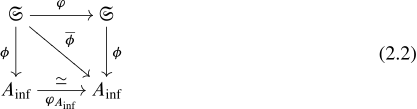
Theorem 2.3
([8
B. Bhatt, M. Morrow, and P. Scholze, Topological Hochschild homology and integral p-adic Hodge theory. Publ. Math. Inst. Hautes Études Sci. 129 (2019), no. 1, 199–310 Zbl 1478.14039 MR 3949030
]). Let be a smooth proper formal scheme. Then there exists an linear cohomology theory equipped with a semi-linear map, with the following properties:- (1)All are Breuil–Kisin modules.
- (2)(étale comparison) After scalar extension along one recovers étale cohomology of the generic fiber
- (3)(Crystalline comparison) After scalar extension along the map which is the Frobenius on and sends to one recovers crystalline cohomology of the special fiber
- (4)(de Rham comparison) After scalar extension along the map one recovers de Rham cohomology
2.2. Perfect modules and Künneth formula
Let be a symmetric monoidal, stable category with biexact tensor product. Firstly, we recall from [2
B. Antieau, A. Mathew, and T. Nikolaus, On the Blumberg–Mandell Künneth theorem for TP. Selecta Math. (N.S.) 24 (2018), no. 5, 4555–4576 Zbl 1410.14017 MR 3874698
, Section 1].Definition 2.4
([2
B. Antieau, A. Mathew, and T. Nikolaus, On the Blumberg–Mandell Künneth theorem for TP. Selecta Math. (N.S.) 24 (2018), no. 5, 4555–4576 Zbl 1410.14017 MR 3874698
, Definition 1.2]). An object is perfect if it belongs to the thick subcategory generated by the unit.For a lax symmetric monoidal, exact functor is naturally an ring. For any we have a natural map
Since is exact, if is perfect, then the map (2.3) is an equivalence, and is a perfect module.
We regard as an algebra via There is a symmetric monoidal functor
Let us study this functor from [8
B. Bhatt, M. Morrow, and P. Scholze, Topological Hochschild homology and integral p-adic Hodge theory. Publ. Math. Inst. Hautes Études Sci. 129 (2019), no. 1, 199–310 Zbl 1478.14039 MR 3949030
, Section 11]. By the base change along there is a natural equivalenceSince the natural map is an equivalence (see [8
B. Bhatt, M. Morrow, and P. Scholze, Topological Hochschild homology and integral p-adic Hodge theory. Publ. Math. Inst. Hautes Études Sci. 129 (2019), no. 1, 199–310 Zbl 1478.14039 MR 3949030
, Proposition 11.7]), we obtain equivalencesSince a morphism of homotopy groups is faithfully flat and there is an isomorphism where (see [8
B. Bhatt, M. Morrow, and P. Scholze, Topological Hochschild homology and integral p-adic Hodge theory. Publ. Math. Inst. Hautes Études Sci. 129 (2019), no. 1, 199–310 Zbl 1478.14039 MR 3949030
, Section 6]), we obtain an isomorphismwhere has degree (see [8
B. Bhatt, M. Morrow, and P. Scholze, Topological Hochschild homology and integral p-adic Hodge theory. Publ. Math. Inst. Hautes Études Sci. 129 (2019), no. 1, 199–310 Zbl 1478.14039 MR 3949030
, Proposition 11.10]).Proposition 2.5.
Any dualizable object in is perfect.
Proof.
By the isomorphism (2.5), is a regular noetherian ring of finite Krull dimension concentrated in even degrees. We obtain the claim by [2
B. Antieau, A. Mathew, and T. Nikolaus, On the Blumberg–Mandell Künneth theorem for TP. Selecta Math. (N.S.) 24 (2018), no. 5, 4555–4576 Zbl 1410.14017 MR 3874698
, Theorem 2.15]. Proposition 2.6.
Suppose are linear categories, and suppose is smooth and proper. Then is perfect in and (resp. ) is a perfect module (resp. module) and the natural map
is an equivalence.
Proof.
Note that functors
and
are lax symmetric monoidal and exact (see [33
T. Nikolaus and P. Scholze, On topological cyclic homology. Acta Math. 221 (2018), no. 2, 203–409 Zbl 1457.19007 MR 3904731
, Corollary I.4.3]). It is enough to show that is perfect in Since the functor2.3. Breuil–Kisin module of stable categories
Let us recall Antieau–Mathew–Nikolaus’s comparison theorem of symmetric monoidal functors from [2
B. Antieau, A. Mathew, and T. Nikolaus, On the Blumberg–Mandell Künneth theorem for TP. Selecta Math. (N.S.) 24 (2018), no. 5, 4555–4576 Zbl 1410.14017 MR 3874698
].Proposition 2.7
([2
B. Antieau, A. Mathew, and T. Nikolaus, On the Blumberg–Mandell Künneth theorem for TP. Selecta Math. (N.S.) 24 (2018), no. 5, 4555–4576 Zbl 1410.14017 MR 3874698
, Proposition 4.6]). Let be symmetric monoidal categories. Let be symmetric monoidal functors, and let be a symmetric monoidal natural transformation. Suppose every object of is dualizable. Then is an equivalence.In [8
B. Bhatt, M. Morrow, and P. Scholze, Topological Hochschild homology and integral p-adic Hodge theory. Publ. Math. Inst. Hautes Études Sci. 129 (2019), no. 1, 199–310 Zbl 1478.14039 MR 3949030
, Proposition 11.10], Bhatt–Morrow–Scholze showed the following: on homotopy groups, there exist isomorphismswhere is of degree and is of degree and
where is of degree Let be the endomorphism of determined by the Frobenius on and Nikolaus–Scholze [33
T. Nikolaus and P. Scholze, On topological cyclic homology. Acta Math. 221 (2018), no. 2, 203–409 Zbl 1457.19007 MR 3904731
] construct two mapsIn [8
B. Bhatt, M. Morrow, and P. Scholze, Topological Hochschild homology and integral p-adic Hodge theory. Publ. Math. Inst. Hautes Études Sci. 129 (2019), no. 1, 199–310 Zbl 1478.14039 MR 3949030
, Proposition 11.10], Bhatt–Morrow–Scholze also showed the morphismis linear and sends to and to and the morphism
is linear and sends to and to Since is an invertible element in induces a map
for an linear stable category We note that on homotopy groups, the morphism
is given by which is semi-linear and sends to
Lemma 2.8.
Let be a smooth proper linear category. Then the following statements hold:
- (1)is a finitely generated module, thus is a finitely generated module for all
- (2)There is a natural number satisfying that for any is an isomorphism.
Proof.
Claim (1) directly follows from Proposition 2.6. Moreover, for any by the calculation of (see [8
B. Bhatt, M. Morrow, and P. Scholze, Topological Hochschild homology and integral p-adic Hodge theory. Publ. Math. Inst. Hautes Études Sci. 129 (2019), no. 1, 199–310 Zbl 1478.14039 MR 3949030
, Proposition 11.10]), we know that the map is an isomorphism. This yields claim (2) by claim (1). Theorem 2.9.
Let be a smooth proper linear category. Then there is a natural number such that the homotopy group has a natural structure of a Breuil–Kisin module for any and the dual also has a natural structure of a Breuil–Kisin module of finite height for any
Proof.
The morphism induces a morphism of modules
By Proposition 2.6, both sides of the map (2.7) yield symmetric monoidal functors from to and the map (2.7) yields a symmetric monoidal natural transformation between them. By Proposition 2.7, the morphism (2.7) is an equivalence. On th homotopy group, is given by Since is flat, one has an isomorphism
for any thus we have an linear isomorphism on homotopy groups
for any
After inverting the morphism induces a morphism of module
Both sides of the map (2.10) yield symmetric monoidal functors from to and the map (2.10) yields a symmetric monoidal natural transformation between them. Thus the morphism (2.10) is an equivalence. Note that the morphism
is an isomorphism (see [8
B. Bhatt, M. Morrow, and P. Scholze, Topological Hochschild homology and integral p-adic Hodge theory. Publ. Math. Inst. Hautes Études Sci. 129 (2019), no. 1, 199–310 Zbl 1478.14039 MR 3949030
, Proposition 11.10]). This yields an isomorphismfor any Let us study the dual of (2.12). We have a morphism
2.4. The comparison between and
In this section, for a smooth proper linear category we will carefully compare with Denote and let be the ring of integers of
Lemma 2.10
([8
B. Bhatt, M. Morrow, and P. Scholze, Topological Hochschild homology and integral p-adic Hodge theory. Publ. Math. Inst. Hautes Études Sci. 129 (2019), no. 1, 199–310 Zbl 1478.14039 MR 3949030
, Corollary 11.8]). For any linear stable category the natural map
is an equivalence which is compatible with action and action. In particular, the natural map
is an equivalence which is compatible with action.
Proof.
The morphism fits into the following commutative diagram:

The diagram yields a map
which is compatible with action. According to [8
B. Bhatt, M. Morrow, and P. Scholze, Topological Hochschild homology and integral p-adic Hodge theory. Publ. Math. Inst. Hautes Études Sci. 129 (2019), no. 1, 199–310 Zbl 1478.14039 MR 3949030
, Proposition 11.7], the natural map is an equivalence. Since is in for any thus the equivalence is equivariant. Proposition 2.11.
For a smooth proper linear category is perfect in In particular, is perfect in
Proof.
We already know is perfect in (see Proposition 2.6). Besides, the functor
is exact and sends to is a perfect object in Since the functor
is exact and sends to it follows that is a perfect object in
Proposition 2.12.
For a smooth proper linear category is a perfect object in
The following is a non-commutative version of the comparison theorem between and in [8
B. Bhatt, M. Morrow, and P. Scholze, Topological Hochschild homology and integral p-adic Hodge theory. Publ. Math. Inst. Hautes Études Sci. 129 (2019), no. 1, 199–310 Zbl 1478.14039 MR 3949030
, Theorem 1.2 (1)].Theorem 2.13.
Let be a smooth proper linear category. Then there is a natural number satisfying that there is a equivariant isomorphism
for any where is the map which sends to and is the Frobenius on and acts on on left-hand side.
Proof.
For a smooth proper linear category consider the following morphism:
where the second map is given by diagram (2.14). The map sends to and is an invertible element in we have a morphism
Let us prove that the map yields an equivalence of module
which is compatible with action. By Proposition 2.6, the left side of the map (2.16) yields a symmetric monoidal functor from to By Proposition 2.11, the right side of the map (2.16) also yields a symmetric monoidal functor from to By [8
B. Bhatt, M. Morrow, and P. Scholze, Topological Hochschild homology and integral p-adic Hodge theory. Publ. Math. Inst. Hautes Études Sci. 129 (2019), no. 1, 199–310 Zbl 1478.14039 MR 3949030
, Section 11], on homotopy groups, the morphismis given by which is linear and sends to thus it is flat by [7
B. Bhatt, M. Morrow, and P. Scholze, Integral p-adic Hodge theory. Publ. Math. Inst. Hautes Études Sci. 128 (2018), no. 1, 219–397 Zbl 1446.14011 MR 3905467
, Lemma 4.30]. We now have a equivariant isomorphism2.5. The comparison between and
In this section, for a smooth and proper linear category we will carefully compare with There exists a Cartesian diagram of ring below.
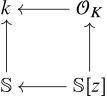
For an linear stable category the diagram yields morphisms
and
Theorem 2.14.
Let be a smooth proper linear category. Then there is a natural number such that the morphism (2.17) is an isomorphism
for any where is the map which sends to and Frobenius on
Proof.
The morphism (2.17) induces a commutative diagram
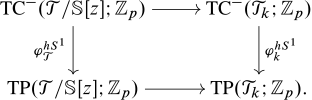
Firstly, we prove that the morphism induces an isomorphism
for any where is a linear and sends to By Theorem 2.9 and [7
B. Bhatt, M. Morrow, and P. Scholze, Integral p-adic Hodge theory. Publ. Math. Inst. Hautes Études Sci. 128 (2018), no. 1, 219–397 Zbl 1446.14011 MR 3905467
, Proposition 4.3], there is such that for any the homotopy group is a Breuil–Kisin module, and is a finite free module. By the isomorphism (2.9) and the fact that is periodic, we obtain that is a finite free module for any Thus, on homotopy groups, one obtains an isomorphismand we see that is a flat graded module. Let us prove the morphism
is an equivalence. Both sides of the map (2.19) yield symmetric monoidal functors from to thus by Proposition 2.7, we know the map (2.19) is an equivalence. By the isomorphism (2.18) and the fact that is periodic, on homotopy groups, we have an isomorphism
for any Combining the isomorphism (2.9) with an equality we obtain an isomorphism
for any
2.6. The comparison theorem between and
Firstly, we prove Künneth formula of local theory for linear categories that admit a geometric realization.
Proposition 2.15.
For linear categories which admit geometric realization, the natural map
is an equivalence.
Proof.
At first, we prove the claim in the case that there exist smooth proper varieties and so that and As a preliminary reduction, we first establish the claim over the completion of with respect to We fix an isomorphism of fields We denote by Due to Thomason [36
R. W. Thomason,
Erratum: “Algebraic K-theory and etale cohomology”
[Ann. Sci. Éc. Norm. Super. (4) 18 (1985), no. 3, 437–552 Zbl 0596.14012 MR 0826102]
Ann. Sci. Éc. Norm. Super. (4)
22
(1989),
no. 4,
675–677
Zbl 0714.14006 MR 1026753
], we have an equivalence Due to Atiyah [3M. F. Atiyah, Vector bundles and the Künneth formula. Topology 1 (1962), no. 3, 245–248 Zbl 0108.17801 MR 0150780
], since a CW complex which comes from a compact complex manifold is finite, we know a natural mapis an equivalence. The isomorphism of fields induces an equivalence of ring spectra We see that there exists a commutative diagram

and we obtain the claim. We now treat the general case. We fix an embedding of fields There exists a subfield such that is finitely generated over and and are defined over Take a variety over such that
the function field is isomorphic to Then we can take varieties over and morphisms over such that the generic fibers of tensored with are respectively. Then, by shrinking we may assume are proper and smooth over Choose a value point on In that case, by using proper smooth base change theorems in étale cohomology and Thomason’s spectral sequence [36
R. W. Thomason,
Erratum: “Algebraic K-theory and etale cohomology”
[Ann. Sci. Éc. Norm. Super. (4) 18 (1985), no. 3, 437–552 Zbl 0596.14012 MR 0826102]
Ann. Sci. Éc. Norm. Super. (4)
22
(1989),
no. 4,
675–677
Zbl 0714.14006 MR 1026753
], we have canonical equivalencesThe claim follows from the case.
Secondly, we prove the claim in the case when and for a smooth variety and a smooth proper variety Choose a good compactification of where each is irreducible. For we write The Verdier quotient induces a fiber sequence
and the Verdier quotient induces a fiber sequence
There is a morphism of fiber sequence (2.22) → (2.23). Note that have a good compactification By the induction on we obtain the claim. The same argument as above proves in the case that and are smooth varieties.
Thirdly, we prove the claim in the case that and for a separated and finite type scheme over and a smooth variety Choose a sequence of closed subschemes of
such that is smooth over for any For any variety over since is characteristic we have an equivalence (see [38
C. A. Weibel, Homotopy algebraic K-theory. In Algebraic K-theory and algebraic number theory (Honolulu, HI, 1987), pp. 61–488, Contemp. Math. 83, American Mathematical Society, Providence, RI, 1989 Zbl 0669.18007 MR 0991991
]), where is the homotopy theory of Using Quillen’s localization theorem, we have fiber sequencesand
and there is a morphism of fiber sequences (2.24) → (2.25). By the induction on we obtain the claim. The same argument as above shows the claim in the case that and are smooth varieties.
For a dg-algebra concentrated in non-positive degrees, using the Dundas–Goodwillie–McCarthy theorem [15
B. I. Dundas, T. G. Goodwillie, and R. McCarthy, The local structure of algebraic K-theory. Algebr. Appl. 18, Springer, London, 2013, 435 pp. Zbl 1272.55002 MR 3013261
], we have a homotopy pullback square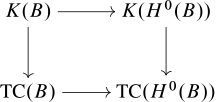
Since has characteristic we have Thus the natural map is an equivalence. For affine derived schemes and whose truncations are separated and of finite type over the claim holds for and For derived schemes and whose truncations are smooth over the claim follows from the case that and are affine derived schemes by [11
D. Clausen, A. Mathew, N. Naumann, and J. Noel, Descent in algebraic K-theory and a conjecture of Ausoni–Rognes. J. Eur. Math. Soc. (JEMS) 22 (2020), no. 4, 1149–1200 Zbl 1453.18011 MR 4071324
, Theorem A.4]. For linear categories which admit geometric realization and the claim follows from the fact that (resp. ) is a retract of (resp. ) (see [1B. Antieau and E. Elmanto, Descent for semiorthogonal decompositions. Adv. Math. 380 (2021), article no. 107600, 37 pp. Zbl 1467.14049 MR 4205113
, Proposition 3.4]). We let denote the category of smooth proper linear categories such that admits a geometric realization.
Let be a smooth proper linear category. Using [6
B. Bhatt, D. Clausen, and A. Mathew, Remarks on K(1)-local K-theory. Selecta Math. (N.S.) 26 (2020), no. 3, article no. 39, 16 pp. Zbl 1454.19004 MR 4110725
, Theorem 2.16], one obtains an equivalence of ring spectra. We recall some results about topological Hochschild homology theory from [6B. Bhatt, D. Clausen, and A. Mathew, Remarks on K(1)-local K-theory. Selecta Math. (N.S.) 26 (2020), no. 3, article no. 39, 16 pp. Zbl 1454.19004 MR 4110725
, 8B. Bhatt, M. Morrow, and P. Scholze, Topological Hochschild homology and integral p-adic Hodge theory. Publ. Math. Inst. Hautes Études Sci. 129 (2019), no. 1, 199–310 Zbl 1478.14039 MR 3949030
, 22L. Hesselholt, On the topological cyclic homology of the algebraic closure of a local field. In An alpine anthology of homotopy theory, pp. 33–162, Contemp. Math. 399, American Mathematical Society, Providence, RI, 2006 Zbl 1217.19002 MR 2222509
]. On homotopy groups, there is an isomorphismwhere is a generator Let be the Bott element. For any linear stable category we have an identification (see [6
B. Bhatt, D. Clausen, and A. Mathew, Remarks on K(1)-local K-theory. Selecta Math. (N.S.) 26 (2020), no. 3, article no. 39, 16 pp. Zbl 1454.19004 MR 4110725
, Theorem 2.16]). The cyclotomic trace map sends to a multiple of (see [22L. Hesselholt, On the topological cyclic homology of the algebraic closure of a local field. In An alpine anthology of homotopy theory, pp. 33–162, Contemp. Math. 399, American Mathematical Society, Providence, RI, 2006 Zbl 1217.19002 MR 2222509
] and [23L. Hesselholt and T. Nikolaus, Topological cyclic homology. In Handbook of homotopy theory, pp. 19–656, CRC Press/Chapman Hall Handb. Math. Ser., CRC Press, Boca Raton, FL, 2020 Zbl 1473.14038 MR 4197995
, Theorem 1.3.6]); the cyclotomic trace map induces a morphismfor any linear category
Theorem 2.16.
Let be a smooth proper linear category. Assume that admits a geometric realization; then the trace map induces an equivalence
In particular, there is a equivariant isomorphism
for any
Proof.
2.7. Non-commutative version of Bhatt–Morrow–Scholze’s comparison theorem
In this section, as a summary of the previous several sections, we prove a non-commutative version of Theorem 2.3.
Theorem 2.17.
Let be a smooth proper linear category. Then there is satisfying the following statements:
- (1)For any is a Breuil–Kisin module.
- (1′)For any is a Breuil–Kisin module of finite height.
- (2)(local K-theory comparison) Assume admits a geometric realization. For any after scalar extension along one recovers local K-theory of generic fiber
- (3)(Topological periodic homology theory comparison) For any after scalar extension along the map which is the Frobenius on and sends to one recovers topological periodic homology theory of the special fiber
Proof.
Corollary 2.18.
For a smooth proper linear category which admits a geometric realization and an integer there is an isomorphism of modules
Proof.
3. Breuil–Kisin module and semi-stable representation
3.1. Breuil–Kisin module
Let us recall the work of H. Gao on Breuil–Kisin module [19
H. Gao, Breuil–Kisin modules and integral p-adic Hodge theory (with appendix A by Yoshiyasu Ozeki, and appendix B by Hui Gao and Tong Liu). J. Eur. Math. Soc. (JEMS) 25 (2023), no. 10, 3979–4032 Zbl 1537.11079 MR 4634688
]. Look at the following diagram: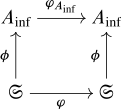
We note that sends to Let be a Breuil–Kisin module. We write to denote Upon taking the tensor product the induced linear isomorphism then gives rise to the isomorphism
Definition 3.1
([19
H. Gao, Breuil–Kisin modules and integral p-adic Hodge theory (with appendix A by Yoshiyasu Ozeki, and appendix B by Hui Gao and Tong Liu). J. Eur. Math. Soc. (JEMS) 25 (2023), no. 10, 3979–4032 Zbl 1537.11079 MR 4634688
, Definition 7.1.1]). Let be a finite free Breuil–Kisin module of finite height, equipped with a continuous semi-linear action on We call a Breuil–Kisin module if this action satisfies the following conditions:- (1)commutes with
- (2)via the embedding
- (3)via the embedding
The equivariant surjective map of rings induces a morphism of ring spectra
Combining an equivalence with Proposition 2.12, we obtain the following proposition.
Proposition 3.2.
For a smooth proper linear category is perfect in
Let us recall the calculation of [8
B. Bhatt, M. Morrow, and P. Scholze, Topological Hochschild homology and integral p-adic Hodge theory. Publ. Math. Inst. Hautes Études Sci. 129 (2019), no. 1, 199–310 Zbl 1478.14039 MR 3949030
]. On homotopy groups,is given by
which is linear and sends to and to where and have degree and has degree Similarly, on homotopy groups,
is given by
which is linear and sends to and to
Theorem 3.3.
Let be a smooth proper linear category. The morphism (3.2) induces an isomorphism
for any In particular, is fixed by
Proof.
The morphism (3.2) yields a morphism
By Propositions 2.12 and 3.2, both sides of the map (3.2) yield symmetric monoidal functors from to and the map (3.5) yields a symmetric monoidal natural transformation between them. Thus the morphism (3.5) is an equivalence. By Theorem 2.9 and [7
B. Bhatt, M. Morrow, and P. Scholze, Integral p-adic Hodge theory. Publ. Math. Inst. Hautes Études Sci. 128 (2018), no. 1, 219–397 Zbl 1446.14011 MR 3905467
, Proposition 4.3], there is such that for any the homotopy group is a Breuil–Kisin module, and is a finite free module. By Theorem 2.13 and the fact that is periodic, is a finite free module for any Thus is a flat graded module, and we obtain the claim. Lemma 3.4.
Let be a smooth proper linear category. Then the following statements hold:
- (1)is a finitely generated module, thus is a finitely generated module for any
- (2)There is a natural number such that for any is an isomorphism.
Proof.
Claim (1) directly follows from Proposition 2.12. For any by the calculation of (see [8
B. Bhatt, M. Morrow, and P. Scholze, Topological Hochschild homology and integral p-adic Hodge theory. Publ. Math. Inst. Hautes Études Sci. 129 (2019), no. 1, 199–310 Zbl 1478.14039 MR 3949030
, Proposition 11.10]), we know that is an isomorphism. By claim (1), we see claim (2). Theorem 3.5.
Let be a smooth proper linear category. There is a natural number such that the cyclotomic Frobenius morphism induces a equivariant isomorphism
for any
Proof.
Cyclotomic Frobenius map yields a morphism
The morphism induces a morphism of module
By Proposition 2.12, both sides of the map (3.7) yield symmetric monoidal functors from to thus the map (3.7) is an equivalence. On homotopy groups, is given by linear map
thus this is an isomorphism. Thus we obtain the isomorphism
for any By Lemma 3.4, there is a natural number such that for any
For a smooth proper linear category we will prove that the free Breuil–Kisin module is a Breuil–Kisin module.
Theorem 3.6.
Let be a smooth proper linear category. There is an such that for any the following statements hold:
- (1)There is a continuous semi-linear action on
- (2)commutes with
- (3)One has the inclusion induced via the embedding
- (4)is fixed by
In particular, is a Breuil–Kisin module.
Proof.
After localization by the morphism induces a morphism of module
Both sides of the map (3.8) yield symmetric monoidal functors from to and the map (3.8) yields a symmetric monoidal natural transformation between them. Thus the morphism (3.8) is an equivalence. Note that the morphism
is an isomorphism (see [8
B. Bhatt, M. Morrow, and P. Scholze, Topological Hochschild homology and integral p-adic Hodge theory. Publ. Math. Inst. Hautes Études Sci. 129 (2019), no. 1, 199–310 Zbl 1478.14039 MR 3949030
, Proposition 11.10]). This yields a equivariant isomorphismCombined with (3.6), this yields a equivariant isomorphism
and we see the isomorphism (3.10) is the same as The group naturally acts on which is semi-linear. Since is flat, the dual of (3.11) becomes the following equivariant isomorphism:
Via this isomorphism, admits a continuous semi-linear action.
Since is flat, we have equivariant isomorphism
Since is finite free module, there is a natural inclusion and it induces a natural inclusion
Thus is fixed by The last claim follows from claims (1)–(4) and [19
H. Gao, Breuil–Kisin modules and integral p-adic Hodge theory (with appendix A by Yoshiyasu Ozeki, and appendix B by Hui Gao and Tong Liu). J. Eur. Math. Soc. (JEMS) 25 (2023), no. 10, 3979–4032 Zbl 1537.11079 MR 4634688
, Lemma 7.1.2]. For a Breuil–Kisin module let denote the composite
where is the composite and is the Frobenius of Let us define a module
If is equipped with a Breuil–Kisin module structure, then inherits a natural structure of a module.
Theorem 3.7.
The following statements hold:
- (1)For a smooth proper linear category and a sufficiently large the module is a lattice of a semi-stable representation.
- (2)We assume admits a geometric realization. Then there is a equivariant isomorphismIn particular, is a semi-stable representation.
Proof.
(1) By Theorem [19
H. Gao, Breuil–Kisin modules and integral p-adic Hodge theory (with appendix A by Yoshiyasu Ozeki, and appendix B by Hui Gao and Tong Liu). J. Eur. Math. Soc. (JEMS) 25 (2023), no. 10, 3979–4032 Zbl 1537.11079 MR 4634688
, Theorem 7.1.7], we obtain the claim.(2) Let be a smooth proper linear category. We assume admits a geometric realization. By the same discussion as in the proof of Theorem 2.16, we have an equivalence
By the functionality of cyclotomic Frobenius we have the following commutative diagram:
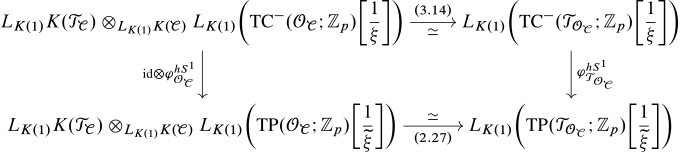
We note in Since is given by the Frobenius on homotopy groups, we have equivariant diagram
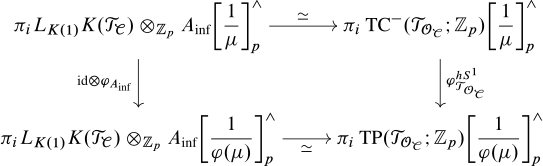
After the base change along the above diagram becomes the following equivariant diagram:

Thus the isomorphism is Frobenius equivariant. Since and are flat and compatible with Frobenius automorphisms, the dual of the isomorphism becomes the Frobenius-equivariant isomorphism
and we obtain the claim.
Remark 3.8.
Similarly, we can obtain that there is an isomorphism of modules
4. modules and crystalline representations
In this section, we will prove Theorem 1.12. We would like to thank H. Gao [20
H. Gao,
Letter to Keiho, private communication (6/9/2023)
] for sharing the strategy and key constructions to prove Theorem 1.12.4.1. Breuil–Kisin modules and modules
Let us recall module from [14
H. Du and T. Liu, A prismatic approach to modules and crystals. J. Eur. Math. Soc. (JEMS) 28 (2026), no. 6, 2581–2636 Zbl 08176145 MR 5045694
]. Let and Du–Liu construct algebras and as the following [14H. Du and T. Liu, A prismatic approach to modules and crystals. J. Eur. Math. Soc. (JEMS) 28 (2026), no. 6, 2581–2636 Zbl 08176145 MR 5045694
, Sections 2.1 and 2.3]. We set Then is algebra via in this way, one can extend Frobenius action on to which is Frobenius on and sends to and to Let be where means freely adjoining elements in the category of completed algebras [14H. Du and T. Liu, A prismatic approach to modules and crystals. J. Eur. Math. Soc. (JEMS) 28 (2026), no. 6, 2581–2636 Zbl 08176145 MR 5045694
, Sections 2.1 and 4.1]. Then is an algebra via The structure map is flat (see [14H. Du and T. Liu, A prismatic approach to modules and crystals. J. Eur. Math. Soc. (JEMS) 28 (2026), no. 6, 2581–2636 Zbl 08176145 MR 5045694
, Proposition 2.2.7]), and is a sub- algebra of where we regard as an algebra via (see [14H. Du and T. Liu, A prismatic approach to modules and crystals. J. Eur. Math. Soc. (JEMS) 28 (2026), no. 6, 2581–2636 Zbl 08176145 MR 5045694
, Section 2.4]). Let us recall the definition of from [14H. Du and T. Liu, A prismatic approach to modules and crystals. J. Eur. Math. Soc. (JEMS) 28 (2026), no. 6, 2581–2636 Zbl 08176145 MR 5045694
, Section 2.3]. Define a Frobenius action on which sends to and to and set Let and it is a sub- algebra of where we regard as an algebra via (see [14H. Du and T. Liu, A prismatic approach to modules and crystals. J. Eur. Math. Soc. (JEMS) 28 (2026), no. 6, 2581–2636 Zbl 08176145 MR 5045694
, Section 2.4]). There is a natural inclusion of algebra which sends to it is a ring map. By construction, we thus obtain an inclusion of sub- algebras of Let us denote and denote We note that there is a commutative diagram (see [14H. Du and T. Liu, A prismatic approach to modules and crystals. J. Eur. Math. Soc. (JEMS) 28 (2026), no. 6, 2581–2636 Zbl 08176145 MR 5045694
, Corollary 2.4.5])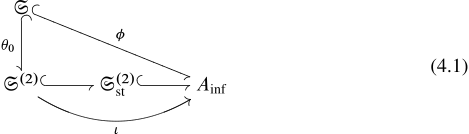
where sends to and to We regard and as algebras via the diagram unless otherwise stated.
Definition 4.1
([14
H. Du and T. Liu, A prismatic approach to modules and crystals. J. Eur. Math. Soc. (JEMS) 28 (2026), no. 6, 2581–2636 Zbl 08176145 MR 5045694
, Definition 3.3.2]). Let be a finite free Breuil–Kisin module of finite height. We call module if it satisfies the following conditions:- (1)There is a continuous semi-linear action on
- (2)commutes with on
- (3)
- (4)acts on trivially.
Remark 4.2.
For a Breuil–Kisin module the adic representation is a lattice of semi-stable representation of non-negative Hodge–Tate weight [19
H. Gao, Breuil–Kisin modules and integral p-adic Hodge theory (with appendix A by Yoshiyasu Ozeki, and appendix B by Hui Gao and Tong Liu). J. Eur. Math. Soc. (JEMS) 25 (2023), no. 10, 3979–4032 Zbl 1537.11079 MR 4634688
, Theorem 7.1.7]. Du–Liu proved that the sub-modules are stable [14H. Du and T. Liu, A prismatic approach to modules and crystals. J. Eur. Math. Soc. (JEMS) 28 (2026), no. 6, 2581–2636 Zbl 08176145 MR 5045694
, Theorem 3.3.3] (see also [30T. Liu, A note on lattices in semi-stable representations. Math. Ann. 346 (2010), no. 1, 117–138 Zbl 1208.14017 MR 2558890
, Proposition 3.1.3]). By Definition 3.1 (3), acts on trivially, thus action on factors through The action on induces the module structure on [14H. Du and T. Liu, A prismatic approach to modules and crystals. J. Eur. Math. Soc. (JEMS) 28 (2026), no. 6, 2581–2636 Zbl 08176145 MR 5045694
, Theorem 3.3.3].4.2. The comparison theorem between and
We regard as an algebra via the map In [29
R. Liu and G. Wang, Topological cyclic homology of local fields. Invent. Math. 230 (2022), no. 2, 851–932 MR 4493328
], Liu–Wang revealed the structure of : there is an isomorphismwhere we identify and (see [29
R. Liu and G. Wang, Topological cyclic homology of local fields. Invent. Math. 230 (2022), no. 2, 851–932 MR 4493328
, Theorem 1.3]). In this section, we will compare with for an linear category We note that the functoris a lax symmetric monoidal; admits an ring structure, and also admits an ring structure. For each we consider the map of ring spectra which in turn induces a morphism of ring spectra
For and an linear category the left unit and right unit are the maps
induced by and respectively. Let us denote by (resp. ) the relative topological Hochschild homology of (resp. ). There is a commutative diagram in
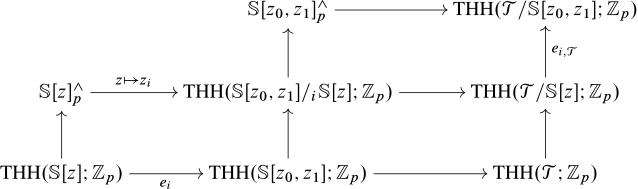
Since the bottom-left square and the bottom square are pushout squares (see [29
R. Liu and G. Wang, Topological cyclic homology of local fields. Invent. Math. 230 (2022), no. 2, 851–932 MR 4493328
, Lemma 2.3]), and similarly, since the right square is a pushout square, the top-right square is also a pushout square. Thus, by the transitivity property of relative we obtain the following equivalence:We also have the following commutative diagram:
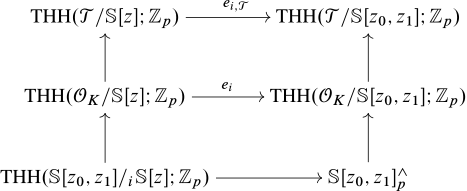
Applying to the equivalence (4.3), we see that the bottom and total squares are pushout squares. We know that the top square is a pushout square. Thus we have the following equivariant equivalence:
Notice an exact symmetric monoidal functor
from to In the case where the linear category is smooth and proper, it follows that is dualizable and perfect in Since the base change functor
is an exact symmetric monoidal functor, we consequently obtain the following lemma:
Lemma 4.3.
For a smooth proper linear category is dualizable and perfect in
Proposition 4.4.
Let be smooth proper linear categories. There are equivalences
Proof.
Proposition 4.5.
Let be smooth proper linear categories. There are equivalences
for
Proof.
For and there is a commutative diagram
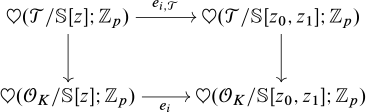
This diagram induces a morphism of module spectra
By Propositions 2.6 and 4.4, both sides of the map (4.5) yield symmetric monoidal functors from to Since every smooth proper linear category is dualizable in by [2
B. Antieau, A. Mathew, and T. Nikolaus, On the Blumberg–Mandell Künneth theorem for TP. Selecta Math. (N.S.) 24 (2018), no. 5, 4555–4576 Zbl 1410.14017 MR 3874698
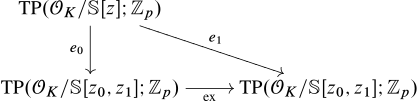
, Proposition 4.6] we obtain the claim. There is an equivalence of ring spectra and it induces a commutative diagram
and an isomorphism of algebra (see also [14
H. Du and T. Liu, A prismatic approach to modules and crystals. J. Eur. Math. Soc. (JEMS) 28 (2026), no. 6, 2581–2636 Zbl 08176145 MR 5045694
, Section 4])By [29
R. Liu and G. Wang, Topological cyclic homology of local fields. Invent. Math. 230 (2022), no. 2, 851–932 MR 4493328
, Corollary 3.7], we see that is periodic and there is an isomorphism by choosing a generator For on homotopy groups, the morphismis given by
which is a linear map sending to for some units
Proposition 4.6.
There is an isomorphism
for any and
Proof.
If by [14
H. Du and T. Liu, A prismatic approach to modules and crystals. J. Eur. Math. Soc. (JEMS) 28 (2026), no. 6, 2581–2636 Zbl 08176145 MR 5045694
, Proposition 2.2.7] the graded-ring morphism (4.7) is flat. We obtain the claim by Proposition 4.5. By the isomorphism (4.6), is also flat. Thus the morphism (4.7) is also flat for 4.3. The comparison theorem between and
We regard as an algebra via the map We will prove the comparison theorem between and for a smooth proper linear category The following lemma is inspired by H. Gao in [20
H. Gao,
Letter to Keiho, private communication (6/9/2023)
].Lemma 4.7.
The natural map is an equivalence which is compatible with action. In particular, the natural map
is an equivalence.
Proof.
There is a diagram
which is compatible with action. For we have an equivariant equivalence [8
B. Bhatt, M. Morrow, and P. Scholze, Topological Hochschild homology and integral p-adic Hodge theory. Publ. Math. Inst. Hautes Études Sci. 129 (2019), no. 1, 199–310 Zbl 1478.14039 MR 3949030
, Proposition 11.7], and we obtain the claim. Lemma 4.8.
The natural map induces an isomorphism
for any
Proof.
The morphism of ring spectra naturally induces an isomorphism Similarly, the composite map also induces an isomorphism
Since there is an equation of morphisms we obtain the claim.
4.4. action on
The construction in this section is inspired by H. Gao [20
H. Gao,
Letter to Keiho, private communication (6/9/2023)
]. Let be a
topological generator and be the lift of satisfying Consider a map which sends to and to We will use the following notations associated with a smooth proper linear category :
- the morphism given by
- the morphism given by the commutative diagram
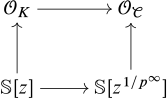
- the morphism given by commutative diagram
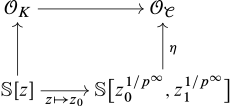
- the morphism given by commutative diagram
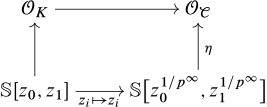
- the morphism given by the commutative diagram
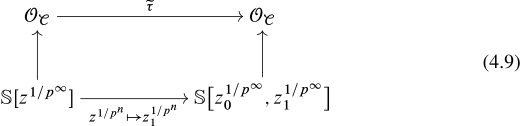
Lemma 4.9.
The following diagram commutes:
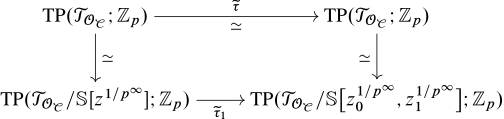
Proof.
Since diagram (4.9) is compatible with ring spectrum structure, we obtain the claim.
The following theorem, inspired by H. Gao [20
H. Gao,
Letter to Keiho, private communication (6/9/2023)
], plays the most important role in the proof of Theorem 1.12.Proposition 4.10.
The following diagram commutes:

Proof.
Diagram (4.9) fits into the following commutative diagram:
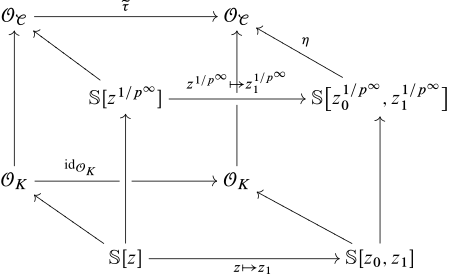
Thus we see that the left square of (4.10) commutes. Look at the following diagram:
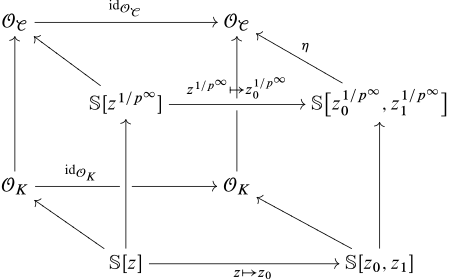
then we see that the right square of (4.10) commutes.
Fix an integer By Proposition 2.6, is a finitely generated module. Choose an generator of We have an equation (see diagram (2.2)); combining isomorphism (2.9) with Theorem 2.13, we see that induces an isomorphism For any element let us write for the image of under the sequence of maps Then it follows that the elements form a set of generators for Choose elements of so that
Proposition 4.11.
For any any choice of generators and any choice of elements it follows that is contained in via the inclusion
Proof.
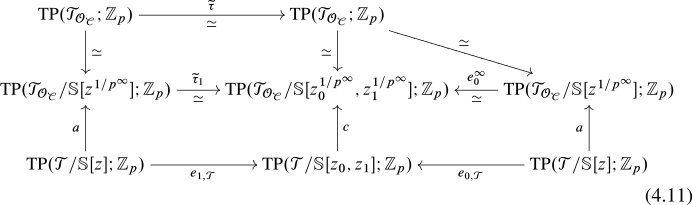
We note that the map is linear. According to the results in Proposition 4.6 and Lemma 4.8, the morphism is explicitly given by the map
By Proposition 4.6, the morphism is given by the natural map and consequently, the set forms an generator set of Therefore, for there are such that
Look at the diagram, then we see an equation and we obtain the claim.
Remark 4.12.
We can apply the same procedure to and we obtain that there are elements of so that where instead of we use a morphism which sends to and to
Let denote the dual action of on the dual module which is defined as Choose an basis of Combining (2.9) with Theorem 2.13, we obtain an isomorphism For any element let us denote by the image of under the natural inclusion Choose elements of so that
Remark 4.12 directly induces the following.
Corollary 4.13.
For any are contained in under the inclusion
4.5. action and crystalline representations
Let be a linear map which sends to The following diagram commutes:
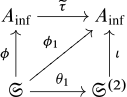
Let denote denote and denote We note that is an integral domain (see [14
H. Du and T. Liu, A prismatic approach to modules and crystals. J. Eur. Math. Soc. (JEMS) 28 (2026), no. 6, 2581–2636 Zbl 08176145 MR 5045694
, Proof of Lemma 2.3.2]), and Firstly, we prove the following lemma.Lemma 4.14.
As sub-rings of there is an equation
of sub-algebra where we regard as a sub-ring of via
Proof.
It suffices to show that contains The map induces a morphism of algebra and induces a morphism of algebra The isomorphism (4.6) induces an isomorphism of algebra which sends to By [14
H. Du and T. Liu, A prismatic approach to modules and crystals. J. Eur. Math. Soc. (JEMS) 28 (2026), no. 6, 2581–2636 Zbl 08176145 MR 5045694
, Lemma 2.2.8 (2)], induces an isomorphism of algebras. Thus we obtain that is given by natural algebra We assume that there exists an element of such that is not contained in From the fact that it follows that, there exists a natural number such that is in and is not in Since is an integral domain, Thus the class is not zero in On the other hand, since Thus the class is zero in This is contradictory to the fact that is injective. Fix a smooth proper linear category and an integer The finite free module carries a natural module structure by Theorem 3.6 and Remark 4.2. By functoriality of we obtain the following commutative diagram:

Hence,
is a equivariant morphism.
We obtain the following commutative diagram:
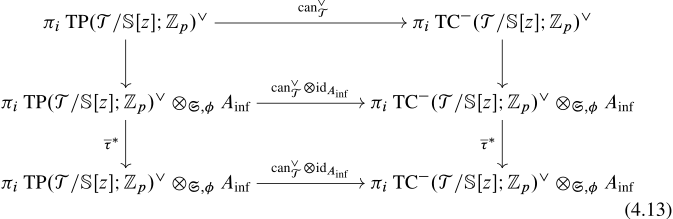
Note that is linear, and is linear.
We choose an basis for the module For any element in this module, we let denote its image under the natural inclusion
Since is an basis of for each there exist elements such that
Proposition 4.15.
For any the elements lie in under the inclusion
Proof.
After inverting both and the inclusion
become isomorphisms (see (2.11)). Hence, for any there exists such that
Choose an basis of There exist elements (for ) such that
in Since the upper square of (4.13) is linear, we have
in Choose elements such that
in By the commutativity of (4.13), we obtain
Since we have
Corollary 4.16.
The adic representation is a lattice of a crystalline representation.
Proof.
By [14
H. Du and T. Liu, A prismatic approach to modules and crystals. J. Eur. Math. Soc. (JEMS) 28 (2026), no. 6, 2581–2636 Zbl 08176145 MR 5045694
, Corollary 3.3.4], it suffices to show that is contained in By Proposition 4.5, we obtain the claim. Remark 4.17.
We expect a more geometric proof of the corollary by showing that, for each the group underlies a prismatic crystal. In particular, the associated descent datum should be induced by the canonical maps
However, we do not currently know whether the natural base change map
is an isomorphism. This result depends on the structure of which is currently not fully understood.
4.6. The proof of Main Theorems
Theorem 4.18.
Let be a smooth proper linear category. Then there exists an integer such that, for all the following statements hold:
- (1)Breuil–Kisin module has a Breuil–Kisin module structure in the sense of [19H. Gao, Breuil–Kisin modules and integral p-adic Hodge theory (with appendix A by Yoshiyasu Ozeki, and appendix B by Hui Gao and Tong Liu). J. Eur. Math. Soc. (JEMS) 25 (2023), no. 10, 3979–4032 Zbl 1537.11079 MR 4634688].
- (2)Breuil–Kisin module has a module structure in the sense of [14H. Du and T. Liu, A prismatic approach to modules and crystals. J. Eur. Math. Soc. (JEMS) 28 (2026), no. 6, 2581–2636 Zbl 08176145 MR 5045694].
- (3)The module is a lattice of a crystalline representation.
- (4)If admits a geometric realization, then there is a equivariant isomorphismof modules.
Proof.
Theorem 4.19
(Main Theorem). Let be a smooth proper linear category. If admits a geometric realization, then Conjecture 1.2 holds for that is, there is an isomorphism of module
which is compatible with action and Frobenius endomorphism.
Proof.
Firstly, we will prove the claim when is large enough. By Remark 3.8, we have a equivariant isomorphism
thus we have an isomorphism
which is equivariant and compatible with Frobenius endomorphism, and there is an identification of rational Dieudonné modules (see [7
B. Bhatt, M. Morrow, and P. Scholze, Integral p-adic Hodge theory. Publ. Math. Inst. Hautes Études Sci. 128 (2018), no. 1, 219–397 Zbl 1446.14011 MR 3905467
, Remark 4.5])By Theorem 2.14, we have an isomorphism Thus we obtain the claim.
Now we prove the general case. For any since is periodic, there is an isomorphism
Moreover, we have an isomorphism (see [36
R. W. Thomason,
Erratum: “Algebraic K-theory and etale cohomology”
[Ann. Sci. Éc. Norm. Super. (4) 18 (1985), no. 3, 437–552 Zbl 0596.14012 MR 0826102]
Ann. Sci. Éc. Norm. Super. (4)
22
(1989),
no. 4,
675–677
Zbl 0714.14006 MR 1026753
]), hence we obtainSimilarly, there is an isomorphism
and we have an isomorphism (see [8
B. Bhatt, M. Morrow, and P. Scholze, Topological Hochschild homology and integral p-adic Hodge theory. Publ. Math. Inst. Hautes Études Sci. 129 (2019), no. 1, 199–310 Zbl 1478.14039 MR 3949030
]), where the twist refers to twisting the Frobenius. Thus we obtainSince we already proved the claim when is large enough, we obtain the claim.
Acknowledgements
The author would like to thank Federico Binda, Lars Hesselholt, Buntaro Kakinoki, Shunsuke Kano, Hyungseop Kim and Hiroyasu Miyazaki for helpful discussions related to this subject. The author would also like to thank Ryomei Iwasa for comments on an earlier draft, Alexender Petrov for useful comments on a draft, Tasuki Kinjo for helpful discussions about derived schemes and Isamu Iwanari, Atsushi Takahashi and Shinnosuke Okawa for helpful discussions about non-commutative algebraic geometry. The author is deeply grateful to Hui Gao for helpful discussions about modules and for sharing his ideas about Theorems 1.11 and 1.12 with us. The author is also grateful to the anonymous referee for a careful reading of the manuscript and for many insightful comments and suggestions, which greatly improved the paper.
Funding
This work was supported by JSPS KAKENHI Grant Numbers 22K13898 and 25KJ0210.
References
- [1] B. Antieau and E. Elmanto, Descent for semiorthogonal decompositions. Adv. Math. 380 (2021), article no. 107600, 37 pp. Zbl 1467.14049 MR 4205113
- [2] B. Antieau, A. Mathew, and T. Nikolaus, On the Blumberg–Mandell Künneth theorem for TP. Selecta Math. (N.S.) 24 (2018), no. 5, 4555–4576 Zbl 1410.14017 MR 3874698
- [3] M. F. Atiyah, Vector bundles and the Künneth formula. Topology 1 (1962), no. 3, 245–248 Zbl 0108.17801 MR 0150780
- [4] M. F. Atiyah and F. Hirzebruch, Vector bundles and homogeneous spaces. In Proc. Sympos. Pure Math., Vol. III, pp. 7–38, American Mathematical Society, Providence, RI, 1961 Zbl 0108.17705 MR 0139181
- [5] D. Bergh, V. A. Lunts, and O. M. Schnürer, Geometricity for derived categories of algebraic stacks. Selecta Math. (N.S.) 22 (2016), no. 4, 2535–2568 Zbl 1360.14058 MR 3573964
- [6] B. Bhatt, D. Clausen, and A. Mathew, Remarks on K(1)-local K-theory. Selecta Math. (N.S.) 26 (2020), no. 3, article no. 39, 16 pp. Zbl 1454.19004 MR 4110725
- [7] B. Bhatt, M. Morrow, and P. Scholze, Integral p-adic Hodge theory. Publ. Math. Inst. Hautes Études Sci. 128 (2018), no. 1, 219–397 Zbl 1446.14011 MR 3905467
- [8] B. Bhatt, M. Morrow, and P. Scholze, Topological Hochschild homology and integral p-adic Hodge theory. Publ. Math. Inst. Hautes Études Sci. 129 (2019), no. 1, 199–310 Zbl 1478.14039 MR 3949030
- [9] A. Blanc, Topological K-theory of complex noncommutative spaces. Compos. Math. 152 (2016), no. 3, 489–555 Zbl 1343.14003 MR 3477639
- [10] A. I. Bondal and M. M. Kapranov, Enhanced triangulated categories (in Russian). Mat. Sb. 181 (1990), no. 1, 669–683. English translation. Math. USSR-Sb. 70 (1991), no. 1, 93–107 Zbl 0729.18008 MR 1055981
- [11] D. Clausen, A. Mathew, N. Naumann, and J. Noel, Descent in algebraic K-theory and a conjecture of Ausoni–Rognes. J. Eur. Math. Soc. (JEMS) 22 (2020), no. 4, 1149–1200 Zbl 1453.18011 MR 4071324
- [12] A. Connes, Cohomologie cyclique et foncteurs Extn. C. R. Acad. Sci. Paris Sér. I Math. 296 (1983), no. 23, 953–958 Zbl 0534.18009 MR 0777584
- [13] S. K. Devalapurkar and A. Raksit, THH(Z) and the image of J. 2025 arXiv:2505.02218v1
- [14] H. Du and T. Liu, A prismatic approach to modules and crystals. J. Eur. Math. Soc. (JEMS) 28 (2026), no. 6, 2581–2636 Zbl 08176145 MR 5045694
- [15] B. I. Dundas, T. G. Goodwillie, and R. McCarthy, The local structure of algebraic K-theory. Algebr. Appl. 18, Springer, London, 2013, 435 pp. Zbl 1272.55002 MR 3013261
- [16] G. Faltings, Crystalline cohomology and p-adic Galois-representations. In Algebraic analysis, geometry, and number theory (Baltimore, MD, 1988), pp. 5–80, Johns Hopkins University Press, Baltimore, MD, 1989 Zbl 0805.14008 MR 1463696
- [17] L. Fargues and J.-M. Fontaine, Courbes et fibrés vectoriels en théorie de Hodge p-adique (with a preface by Pierre Colmez). Astérisque (2018), no. 406, 382 pp. Zbl 1470.14001 MR 3917141
- [18] B. L. Feigin and B. L. Tsygan, Cohomology of Lie algebras of generalized Jacobi matrices (in Russian). Funktsional. Anal. i Prilozhen. 17 (1983), no. 2, 86–87. English translation. Funct. Anal. Appl. 17 (1983), no. 2, 153–155 Zbl 0544.17011 MR 0705056
- [19] H. Gao, Breuil–Kisin modules and integral p-adic Hodge theory (with appendix A by Yoshiyasu Ozeki, and appendix B by Hui Gao and Tong Liu). J. Eur. Math. Soc. (JEMS) 25 (2023), no. 10, 3979–4032 Zbl 1537.11079 MR 4634688
- [20] H. Gao, Letter to Keiho, private communication (6/9/2023)
- [21] L. Hesselholt, On the p-typical curves in Quillen’s K-theory. Acta Math. 177 (1996), no. 1, 1–53 Zbl 0892.19003 MR 1417085
- [22] L. Hesselholt, On the topological cyclic homology of the algebraic closure of a local field. In An alpine anthology of homotopy theory, pp. 33–162, Contemp. Math. 399, American Mathematical Society, Providence, RI, 2006 Zbl 1217.19002 MR 2222509
- [23] L. Hesselholt and T. Nikolaus, Topological cyclic homology. In Handbook of homotopy theory, pp. 19–656, CRC Press/Chapman Hall Handb. Math. Ser., CRC Press, Boca Raton, FL, 2020 Zbl 1473.14038 MR 4197995
- [24] G. Hochschild, B. Kostant, and A. Rosenberg, Differential forms on regular affine algebras. Trans. Amer. Math. Soc. 102 (1962), 383–408 Zbl 0102.27701 MR 0142598
- [25] D. Kaledin, Non-commutative Hodge-to-de Rham degeneration via the method of Deligne-Illusie. Pure Appl. Math. Q. 4 (2008), no. 3, 785–875 Zbl 1189.14013 MR 2435845
- [26] A. A. Khan, The lattice property for perfect complexes on singular stacks. 2023 arXiv:2308.01617v1
- [27] M. Kontsevich, Noncommutative motives. Talk at the conference on Pierre Deligne’s 61st birthday
- [28] M. Kontsevich and Y. Soibelman, Notes on algebras, categories and non-commutative geometry. In Homological mirror symmetry, pp. 53–219, Lecture Notes in Phys. 757, Springer, Berlin, 2009 Zbl 1202.81120 MR 2596638
- [29] R. Liu and G. Wang, Topological cyclic homology of local fields. Invent. Math. 230 (2022), no. 2, 851–932 MR 4493328
- [30] T. Liu, A note on lattices in semi-stable representations. Math. Ann. 346 (2010), no. 1, 117–138 Zbl 1208.14017 MR 2558890
- [31] J. Lurie, Spectral algebraic geometry. Last update: Feb 2018, Preprint
- [32] Z. Mao, Equivariant aspects of de-completing cyclic homology. [v1] 2024, [v3] 2025, arXiv:2410.05994v3
- [33] T. Nikolaus and P. Scholze, On topological cyclic homology. Acta Math. 221 (2018), no. 2, 203–409 Zbl 1457.19007 MR 3904731
- [34] D. Orlov, Smooth and proper noncommutative schemes and gluing of DG categories. Adv. Math. 302 (2016), 59–105 Zbl 1368.14031 MR 3545926
- [35] A. Petrov and V. Vologodsky, On the periodic topological cyclic homology of DG categories in characteristic p. [v1] 2019, [v2] 2023, arXiv:1912.03246v2
- [36] R. W. Thomason, Erratum: “Algebraic K-theory and etale cohomology” [Ann. Sci. Éc. Norm. Super. (4) 18 (1985), no. 3, 437–552 Zbl 0596.14012 MR 0826102] Ann. Sci. Éc. Norm. Super. (4) 22 (1989), no. 4, 675–677 Zbl 0714.14006 MR 1026753
- [37] T. Tsuji, p-Adic étale cohomology and crystalline cohomology in the semi-stable reduction case. Invent. Math. 137 (1999), no. 2, 233–411 Zbl 0945.14008 MR 1705837
- [38] C. A. Weibel, Homotopy algebraic K-theory. In Algebraic K-theory and algebraic number theory (Honolulu, HI, 1987), pp. 61–488, Contemp. Math. 83, American Mathematical Society, Providence, RI, 1989 Zbl 0669.18007 MR 0991991
Cite this article
Keiho Matsumoto, Crystalline representations and -adic Hodge theory for non-commutative algebraic varieties. J. Noncommut. Geom. 20 (2026), no. 3, pp. 953–993
DOI 10.4171/JNCG/661