Cohomologies, deformations and extensions of pre-LieDer pairs
Shanshan Liu
Shenzhen Technology University, P. R. ChinaLiangyun Chen
Northeast Normal University, Changchun, P. R. China
Abstract
In this paper, we use the higher derived bracket to give the controlling algebra of pre-LieDer pairs. We give the cohomology of pre-LieDer pairs by using the twist algebra of this controlling algebra. In particular, we define the cohomology of regular pre-LieDer pairs. We study infinitesimal deformations of pre-LieDer pairs, which are characterized by the second cohomology group of pre-LieDer pairs. We also define the cohomology of regular pre-LieDer pairs with coefficients in an arbitrary representation and using the second cohomology group to classify abelian extensions of regular pre-LieDer pairs.
1. Introduction
Derivations play an important role in the study of various algebraic structures. They can be used to construct higher derived brackets and homotopy Lie algebras [36
T. T. Voronov, Higher derived brackets for arbitrary derivations. In Travaux mathématiques. Fasc. XVI, pp. 163–186, Trav. Math. 16, Univ. Luxemb., Luxembourg, 2005 Zbl 1136.17014 MR 2223157
], deformation formulas [10V. Coll, M. Gerstenhaber, and A. Giaquinto, An explicit deformation formula with non-commuting derivations. In Ring theory 1989 (Ramat Gan and Jerusalem, 1988/1989), pp. 396–403, Israel Math. Conf. Proc. 1, Weizmann, Jerusalem, 1989 Zbl 0684.16016 MR 1029329
] and differential Galois theory [30A. R. Magid, Lectures on differential Galois theory. Univ. Lecture Ser. 7, American Mathematical Society, Providence, RI, 1994, 105 pp. Zbl 0855.12001 MR 1301076
]. They are also important in control theory [1V. Ayala, E. Kizil, and I. De Azevedo Tribuzy, On an algorithm for finding derivations of Lie algebras. Proyecciones 31 (2012), no. 1, 81–90 Zbl 1272.17021 MR 2924691
, 2V. Ayala and J. Tirao, Linear control systems on Lie groups and controllability. In G. Ferreyra, R. Gardner, H. Hermes, and H. Sussmann (eds.), Differential geometry and control, pp. 47–64, Proc. Sympos. Pure Math. 64, American Mathematical Society, Providence, RI, 1999 Zbl 0916.93015 MR 1654529
] and functional analysis [6A. F. Ber, V. I. Chilin, and F. A. Sukochev, Continuous derivations on algebras of locally measurable operators are inner. Proc. Lond. Math. Soc. (3) 109 (2014), no. 1, 65–89 Zbl 1304.46064 MR 3237736
, 7A. F. Ber, B. de Pagter, and F. A. Sukochev, Derivations in algebras of operator-valued functions. J. Operator Theory 66 (2011), no. 2, 261–300 Zbl 1247.47011 MR 2844466
]. Moreover, they also play a fundamental role in the study of gauge theories in quantum field theory via the BV formalism [5I. A. Batalin and G. A. Vilkovisky, Gauge algebra and quantization. Phys. Lett. B 102 (1981), no. 1, 27–31 MR 0616572
]. In [16M. Doubek and T. Lada, Homotopy derivations. J. Homotopy Relat. Struct. 11 (2016), no. 3, 599–630 Zbl 1360.18015 MR 3542099
, 29J.-L. Loday, On the operad of associative algebras with derivation. Georgian Math. J. 17 (2010), no. 2, 347–372 Zbl 1237.18007 MR 2676956
], the authors studied the operad of associative algebras with derivation. Recently, in [33R. Tang, Y. Frégier, and Y. Sheng, Cohomologies of a Lie algebra with a derivation and applications. J. Algebra 534 (2019), 65–99 Zbl 1455.17020 MR 3979066
], the authors studied the cohomology, extensions and deformations of Lie algebras with derivations. Using similar ideas, the author studied associative algebras with derivations [13A. Das and A. Mandal, Extension, deformation and categorification of AssDer pairs. Theory Appl. Categ. 45 (2026), no. 1, 1–32 Zbl 08156150 MR 5018204
] and Leibniz algebras with derivations [12A. Das, Leibniz algebras with derivations. J. Homotopy Relat. Struct. 16 (2021), no. 2, 245–274 Zbl 1477.17018 MR 4266206
].The notion of a pre-Lie algebra (Its other names are left-symmetric algebras, quasi-associative algebras, Vinberg algebras and so on) has been introduced independently by M. Gerstenhaber in the deformation theory of rings and algebras [19
M. Gerstenhaber, The cohomology structure of an associative ring. Ann. of Math. (2) 78 (1963), no. 2, 267–288 Zbl 0131.27302 MR 0161898
]. Pre-Lie algebra arose from the study of affine manifolds and affine structures on Lie groups [24J.-L. Koszul, Domaines bornés homogènes et orbites de groupes de transformations affines. Bull. Soc. Math. France 89 (1961), 515–533 Zbl 0144.34002 MR 0145559
] and homogeneous convex cones [34È. B. Vinberg, The theory of homogeneous convex cones (in Russian). Tr. Moskov. Mat. Obšč. 12 (1963), 303–358. English translation. Trans. Moscow Math. Soc. 12 (1963), 340–403 Zbl 0138.43301 MR 0158414
]. Its defining identity is weaker than associativity. This algebraic structure describes some properties of cochains space in Hochschild cohomology of an associative algebra, rooted trees and vector fields on affine spaces. Moreover, it is playing an increasing role in algebra, geometry and physics due to their applications in nonassociative algebras, combinatorics, numerical analysis and quantum field theory; see also in [3C. Bai, Left-symmetric bialgebras and an analogue of the classical Yang–Baxter equation. Commun. Contemp. Math. 10 (2008), no. 2, 221–260 Zbl 1173.17025 MR 2409367
, 4C. Bai, An introduction to pre-Lie algebras. In Algebra and applications 1: non-associative algebras and categories, pp. 245–273, ISTE, London, 2020 Zbl 1496.17023 MR 4484613
, 8D. Burde, Left-symmetric algebras, or pre-Lie algebras in geometry and physics. Cent. Eur. J. Math. 4 (2006), no. 3, 323–357 Zbl 1151.17301 MR 2233854
, 11A. Connes and D. Kreimer, Hopf algebras, renormalization and noncommutative geometry. Comm. Math. Phys. 199 (1998), no. 1, 203–242 Zbl 0932.16038 MR 1660199
]. There is a close relationship between pre-Lie algebras and Lie algebras: a pre-Lie algebra gives rise to a Lie algebra via the commutator bracket, which is called the subadjacent Lie algebra and denoted by Furthermore, the map defined by for all gives rise to a representation of the subadjacent Lie algebra on The purpose of the paper is to study the cohomology of a pre-LieDer pair and its applications. The motivation for such a study is due to the study of relative difference Lie algebras and relative Rota–Baxter Lie algebras [21
J. Jiang, Y. Li, and Y. Sheng, Cohomologies of difference Lie groups and the van Est theorem. J. Algebra 645 (2024), 116–142 Zbl 1533.13029 MR 4708529
–23J. Jiang and Y. Sheng, Deformations, cohomologies and integrations of relative difference Lie algebras. J. Algebra 614 (2023), 535–563 Zbl 1519.17027 MR 4499354
, 27A. Lazarev, Y. Sheng, and R. Tang, Deformations and homotopy theory of relative Rota–Baxter Lie algebras. Comm. Math. Phys. 383 (2021), no. 1, 595–631 Zbl 1476.17010 MR 4236074
]. We use the higher derived bracket to give the controlling algebra of pre-LieDer pairs. Using the Maurer–Cartan element of this controlling algebra, we construct a twist algebra. We give the cohomology of pre-LieDer pairs by using this twist algebra. Compared to Lie algebras, associative algebras and Leibniz algebras, this is a different way to constructing cohomologies with derivations. Using this cohomology, we study infinitesimal deformations of pre-LieDer pairs. We also define the cohomology of regular pre-LieDer pairs with coefficients in an arbitrary representation and study abelian extensions of regular pre-LieDer pairs.The paper is organized as follows. In Section 2, first, we give the notion of pre-LieDer pairs. Then, by a given representation of a pre-Lie algebra we recall the graded Lie algebra whose Maurer–Cartan elements are Finally, we use this Maurer–Cartan element to give the cohomology of pre-Lie algebras with representations. In Section 3, first, we recall the notion of algebras and higher derived brackets. Then, we use higher derived brackets to construct an algebra. Given a pre-LieDer pair, we can obtain the Maurer–Cartan element of this algebra. Finally, using this Maurer–Cartan element, we construct a twist algebra, which controls deformations of pre-LieDer pairs. In Section 4, first, using the twist algebra constructed from the last section, we give the cohomology of pre-LieDer pairs. Then, we study infinitesimal deformations of pre-LieDer pairs by using this cohomology. We show that equivalent infinitesimal deformations are in the same second cohomology group. Finally, we use this cohomology to give the cohomology of regular pre-LieDer pairs. In Section 5, first, we introduce the notion of representations of regular pre-LieDer pairs. Then, we give cohomologies of regular pre-LieDer pairs with coefficients in an arbitrary representation. Finally, we deal with abelian extensions of regular pre-LieDer pairs. We show that the second cohomology group classifies abelian extensions of regular pre-LieDer pairs.
In this paper, we work over an algebraically closed field of characteristic and all the vector spaces are over
The following are cohomologies that appeared in this paper. We made a summary.
- (1)The cohomology of the cochain complex is called the cohomology of the pre-Lie algebra with coefficients in the representation
- (2)The cohomology of the cochain complex is called the cohomology of the pre-Lie algebra with the representation
- (3)The cohomology of the cochain complex is called the cohomology of the pre-LieDer pair
- (4)The cohomology of the cochain complex is called the cohomology of the regular pre-LieDer pair
- (5)The cohomology of the cochain complex is called the cohomology of the regular pre-LieDer pair with coefficients in the representation
2. Cohomologies of pre-Lie algebras with representations
In this section, first, we define a pre-LieDer pair, which consists of a pre-Lie algebra and a derivation Then, we recall the graded Lie algebra whose Maurer–Cartan element is where is a representation of the pre-Lie algebra Finally, we use this Maurer–Cartan element to give the cohomology of the pre-Lie algebra with the representation
Definition 2.1
([8
D. Burde, Left-symmetric algebras, or pre-Lie algebras in geometry and physics. Cent. Eur. J. Math. 4 (2006), no. 3, 323–357 Zbl 1151.17301 MR 2233854
]). A pre-Lie algebra is a vector space equipped with a bilinear product such that for all the following equality is satisfied:Let be a pre-Lie algebra. The commutator gives a Lie algebra which is denoted by and called the sub-adjacent Lie algebra of
Definition 2.2
([3
C. Bai, Left-symmetric bialgebras and an analogue of the classical Yang–Baxter equation. Commun. Contemp. Math. 10 (2008), no. 2, 221–260 Zbl 1173.17025 MR 2409367
]). A representation of a pre-Lie algebra on a vector space consists of a pair where is a representation of the sub-adjacent Lie algebra on and is a linear map such that for all :We denote a representation of a pre-Lie algebra by Furthermore, let be linear maps, where Then is also a representation, which is called the regular representation.
Definition 2.3.
Let be a representation of a pre-Lie algebra and a linear map such that for all
Then is a derivation of the pre-Lie algebra with respect to the representation A pre-Lie algebra with is called a pre-LieDer pair, which is denoted by In particular, let be a regular representation, then is called a regular pre-LieDer pair and simply denoted by
Example 1.
Let be a basis of dimensional vector space Define a product on by
Then is a pre-Lie algebra. Let More precisely, Then is a regular pre-LieDer pair.
Definition 2.4.
Let and be two pre-LieDer pairs. A homomorphism from to consists of a pre-Lie algebra homomorphism and a linear map such that for all
Let be a representation of a pre-Lie algebra The set of cochains is given by
For all define the coboundary operator by
Theorem 2.5
([17
A. Dzhumadil’daev, Cohomologies and deformations of right-symmetric algebras. J. Math. Sci. 93 (1999), no. 6, 836–876 Zbl 0938.17002 MR 1698758
]). With the above notation, is a chain complex.Definition 2.6
([17
A. Dzhumadil’daev, Cohomologies and deformations of right-symmetric algebras. J. Math. Sci. 93 (1999), no. 6, 836–876 Zbl 0938.17002 MR 1698758
]). The cohomology of the cochain complex is called the cohomology of the pre-Lie algebra with coefficients in the representation The corresponding cohomology group is denoted by Remark 2.7.
We use to denote the coboundary operator of with the coefficients in the regular representation.
A permutation is called an unshuffle if and If and we assume The set of all unshuffles will be denoted by The notion of an unshuffle and the set are defined similarly.
Let be a vector space. It was shown in [9
F. Chapoton and M. Livernet, Pre-Lie algebras and the rooted trees operad. Int. Math. Res. Not. IMRN 2001 (2001), no. 8, 395–408 Zbl 1053.17001 MR 1827084
, 31A. Nijenhuis, Sur une classe de propriétés communes à quelques types différents d’algèbres. Enseign. Math. (2) 14 (1968), 225–277 Zbl 0188.08101 MR 0258898
, 38Q. Wang, Y. Sheng, C. Bai, and J. Liu, Nijenhuis operators on pre-Lie algebras. Commun. Contemp. Math. 21 (2019), no. 7, article no. 1850050, 37 pp. Zbl 1439.17023 MR 4017776
] that the graded vector space equipped with the Matsushima–Nijenhuis bracketis a graded Lie algebra, where is defined by
In particular, defines a pre-Lie algebra if and only if If is a pre-Lie algebra structure, then is a graded derivation of the graded Lie algebra satisfying so that becomes a differential graded Lie algebra.
Let and be vector spaces, and let elements of be denoted by and elements of be denoted by Let be a linear map. We can construct a linear map by
In general, for a given linear map for we define a linear map by
Similarly, for for we define a linear map by
We call the linear map a horizontal lift of or simply a lift. We define The vector space is isomorphic to the direct sum of
Definition 2.8
([37
Q. Wang and J. Liu, Quasi-pre-Lie bialgebras and twisting of pre-Lie algebras. J. Algebra Appl. 23 (2024), no. 10, article no. 2450160, 33 pp. Zbl 07914997 MR 4783276
]). A linear map has a bidegree if the following four conditions hold:- (1)
- (2)If is an element in then
- (3)If is an element in then
- (4)All the other cases,
We denote a linear map with bidegree by
We call a linear map homogeneous if has a bidegree. We denote the set of homogeneous linear maps of bidegree by We have because and
In our later study, the subspaces and will be frequently used. By the above lift, we have the following isomorphisms:
Lemma 2.9
([37
Q. Wang and J. Liu, Quasi-pre-Lie bialgebras and twisting of pre-Lie algebras. J. Algebra Appl. 23 (2024), no. 10, article no. 2450160, 33 pp. Zbl 07914997 MR 4783276
]). If and then has the bidegree Lemma 2.10
([37
Q. Wang and J. Liu, Quasi-pre-Lie bialgebras and twisting of pre-Lie algebras. J. Algebra Appl. 23 (2024), no. 10, article no. 2450160, 33 pp. Zbl 07914997 MR 4783276
]). If (resp. ) and (resp. ), then By Lemmas 2.9 and 2.10, we obtain that is a graded Lie sub-algebra of the graded Lie algebra and is an abelian graded Lie sub-algebra of the graded Lie algebra
For all and we have the following.
Proposition 2.11
([28
J. Liu and Q. Wang, Pre-Lie analogues of Poisson–Nijenhuis structures and Maurer–Cartan equations. J. Algebra Appl. 21 (2022), no. 6, article no. 2250120, 34 pp. Zbl 1517.17001 MR 4429005
]). Let and be two vector spaces. Then is a Maurer–Cartan element of the graded Lie algebra if and only if is a representation of the pre-Lie algebra Let be a representation of a pre-Lie algebra By Proposition 2.11, is a Maurer–Cartan element of It follows from the graded Jacobi identity that is a graded derivation of the graded Lie algebra satisfying Thus, we have the following.
Theorem 2.12.
Let be a pre-Lie algebra and be a representation of Then is a differential graded Lie algebra.
Furthermore, is a representation of the pre-Lie algebra for and if and only if is a Maurer–Cartan element of the differential graded Lie algebra
Let be a representation of the pre-Lie algebra Define the set of cochains to be For we define the set of cochains by
Define the coboundary operator by
Since we obtain that Thus, is a cochain complex.
Definition 2.13
([28
J. Liu and Q. Wang, Pre-Lie analogues of Poisson–Nijenhuis structures and Maurer–Cartan equations. J. Algebra Appl. 21 (2022), no. 6, article no. 2250120, 34 pp. Zbl 1517.17001 MR 4429005
]). The cohomology of the cochain complex is called the cohomology of the pre-Lie algebra with the representation The corresponding cohomology group is denoted by For all where and Then we have
By straightforward computation, we obtain that
3. Maurer–Cartan characterizations and deformations of pre-LieDer pairs
In this section, first, we recall algebras and higher derived brackets. Then, we use higher derived brackets to construct an algebra. Given a pre-LieDer pair, we can obtain the Maurer–Cartan element of this algebra. Finally, we construct a twist algebra by this Maurer–Cartan element, which controls deformations of pre-LieDer pairs.
3.1. algebras and higher derived brackets
Let be a graded vector space. The desuspension operator changes the grading of according to the rule The degree map is defined by sending to its copy
The notion of an algebra was introduced by Stasheff in [32
J. Stasheff, Differential graded Lie algebras, quasi-Hopf algebras and higher homotopy algebras. In P. P. Kulish (ed.), Quantum groups, pp. 120–137, Lecture Notes in Math. 1510, Springer, Berlin, 1992 Zbl 0758.17010 MR 1183483
]. See [25T. Lada and M. Markl, Strongly homotopy Lie algebras. Comm. Algebra 23 (1995), no. 6, 2147–2161 Zbl 0999.17019 MR 1327129
, 26T. Lada and J. Stasheff, Introduction to SH Lie algebras for physicists. Internat. J. Theoret. Phys. 32 (1993), no. 7, 1087–1103 Zbl 0824.17024 MR 1235010
] for more details.Definition 3.1.
An -algebra is a graded vector space equipped with a collection of linear maps of degree with the property that, for any homogeneous elements we have
- (1)(graded symmetry) for every
- (2)(generalized Jacobi identity) for all
where is the Koszul sign for a permutation and
We denote an algebra by
Definition 3.2.
A Maurer–Cartan element of an algebra is an element satisfying
Remark 3.3.
In general, the Maurer–Cartan equation (3.1) makes sense when the algebra is a filtered algebra [14
V. A. Dolgushev and C. L. Rogers, A version of the Goldman–Millson theorem for filtered ‐algebras. J. Algebra 430 (2015), 260–302 Zbl 1327.17019 MR 3323983
]. In the following, the algebra under consideration satisfies for sufficiently big, so the Maurer–Cartan equation makes sense.Let be a Maurer–Cartan element of an algebra Define by
Theorem 3.4
([15
V. Dotsenko, S. Shadrin, and B. Vallette, Maurer–Cartan methods in deformation theory: the twisting procedure. London Math. Soc. Lecture Note Ser. 488, Cambridge University Press, Cambridge, 2024, 177 pp. Zbl 1526.53001 MR 4621635
, 20E. Getzler, Lie theory for nilpotent ‐algebras. Ann. of Math. (2) 170 (2009), no. 1, 271–301 Zbl 1246.17025 MR 2521116
]). With the above notation, is an algebra which is called the twisted algebra by Theorem 3.5
([20
E. Getzler, Lie theory for nilpotent ‐algebras. Ann. of Math. (2) 170 (2009), no. 1, 271–301 Zbl 1246.17025 MR 2521116
]). Let be a twist algebra by Then is a Maurer–Cartan element of the algebra if and only if is a Maurer–Cartan element of the twist algebra Definition 3.6
([35
T. Voronov, Higher derived brackets and homotopy algebras. J. Pure Appl. Algebra 202 (2005), no. 1–3, 133–153 Zbl 1086.17012 MR 2163405
]). A -data consists of a quadruple where- (1)is a graded Lie algebra,
- (2)is an abelian graded Lie subalgebra of
- (3)is a projection, that is whose image is and its kernel is a graded Lie subalgebra of
- (4)is an element in such that
Theorem 3.7
([18
Y. Frégier and M. Zambon, Simultaneous deformations and Poisson geometry. Compos. Math. 151 (2015), no. 9, 1763–1790 Zbl 1383.17009 MR 3406444
, 35T. Voronov, Higher derived brackets and homotopy algebras. J. Pure Appl. Algebra 202 (2005), no. 1–3, 133–153 Zbl 1086.17012 MR 2163405
]). Let be a data. Then the graded vector space is an algebra, whereHere are homogeneous elements of and are homogeneous elements of All the other algebra products that are not obtained from the ones written above by permutations of arguments will vanish.
Moreover, if is a graded Lie subalgebra of that satisfies then is an subalgebra of the above algebra
3.2. The algebra that controls deformations of pre-LieDer pairs
Proposition 3.8.
We have a data as follows:
- (1)Let and be vector spaces. The graded Lie algebra is given by
- (2)The abelian graded Lie subalgebra is given by
- (3)is a projection onto the subspace
- (4)
Consequently, we obtain an algebra where are given by
for homogeneous elements and all the other possible combinations vanish.
Proof.
Obviously, is an abelian graded Lie subalgebra of and is a graded Lie subalgebra of Thus, is a data. By Theorem 3.7, we obtain an algebra
We set by
Now, we give the main result in this subsection.
Theorem 3.9.
With the above notation, is an algebra, where are given by
for homogeneous elements and all the other possible combinations vanish.
Moreover, for all and is a Maurer–Cartan element of the algebra if and only if is a pre-LieDer pair.
Proof.
Obviously, is a graded Lie subalgebra. Since we have Thus, is an algebra. It is straightforward to deduce that
Then, we have
Thus, is a Maurer–Cartan element of the algebra if and only if
By Proposition 2.11, if and only if is a representation of the pre-Lie algebra For all we have
which implies that if and only if is a derivation of the pre-Lie algebra with respect to the representation Thus, is a Maurer–Cartan element of the algebra if and only if is a pre-LieDer pair. This finishes the proof.
Theorem 3.10.
With the above notation, let be a pre-LieDer pair. Then is an algebra, where are given by
Furthermore, for all and is a pre-LieDer pair if and only if is a Maurer–Cartan element of the twist algebra
Proof.
4. Cohomologies and infinitesimal deformations of pre-LieDer pairs
In this section, first, we give the cohomology of pre-LieDer pairs. Then, we study infinitesimal deformations of pre-LieDer pairs by using this cohomology. We show that equivalent infinitesimal deformations are in the same second cohomology group. Finally, we use this cohomology to give the cohomology of regular pre-LieDer pairs.
In this section, We will also denote the pre-Lie multiplication “” by
4.1. Cohomologies of pre-LieDer pairs
Define the coboundary operator by
where and
Theorem 4.1.
is a cochain complex, that is,
Proof.
By Theorem 3.10, we obtain that is an algebra. Thus, we have which implies that
Definition 4.2.
The cohomology of the cochain complex is called the cohomology of the pre-LieDer pair The corresponding cohomology group is denoted by
In the sequel, by straightforward computation, we give the explicit formula of the operator For all and we have
Thus, by (4.1), we have
Lemma 4.3.
With the above notation, for all is given by
Proof.
For all we have
The proof is finished.
For all and we have
By and We obtain the coboundary operator of the pre-LieDer pair
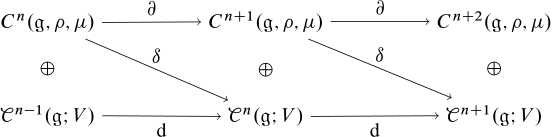
The following diagram well explains the above operators.
At the end of this subsection, we give the relation between various cohomologies groups.
Theorem 4.4.
There is a short exact sequence of the cochain complexes:
where and for all and
Consequently, there is a long exact sequence of the cohomology groups:
where the connecting map is defined by for all
Proof.
By the explicit formula of the coboundary operator we have the short exact sequence of chain complexes which induces a long exact sequence of cohomology groups.
4.2. Infinitesimal deformations of pre-LieDer pairs
Definition 4.5.
Let be a pre-LieDer pair. If for all is a pre-LieDer pair, where and are linear maps. We say that generates an infinitesimal deformation of the pre-LieDer pair
It is direct to check that generates an infinitesimal deformation of the pre-LieDer pair if and only if for all the following equalities are satisfied:
Obviously, (4.2) means that is a cocycle of the pre-Lie algebra with the representation that is, Equation (4.3) means that is a representation of the pre-Lie algebra Equation (4.4) means that (4.5) means that is a pre-LieDer pair. By (4.2) and (4.4), we have
Theorem 4.6.
With the above notation, is a cocycle of the pre-LieDer pair
Definition 4.7.
Let and be two infinitesimal deformations of the pre-LieDer pair We call them equivalent if there exist and such that is a homomorphism from the pre-LieDer pair to the pre-LieDer pair that is, for all the following equalities hold:
An infinitesimal deformation is said to be trivial if it is equivalent to
By direct calculations, and are infinitesimal equivalent deformations if and only if for all the following equalities hold:
We summarize the above discussion into the following conclusion.
Theorem 4.8.
Let be a pre-LieDer pair. If two infinitesimal deformations and are equivalent, then and are in the same cohomology class of
Proof.
which implies that For all by (4.9), we have
which implies that Thus, we have
This finishes the proof.
4.3. Cohomologies of regular pre-LieDer pairs
Let be a regular pre-LieDer pair. Define the set of cochains to be and define the set of cochains to be For define the set of cochains by
For all and Define the embedding by
Denote by Then, we have the following.
Proposition 4.9.
With the above notation, is a subcomplex of the cochain complex
Proof.
For all we have
By (2.1), we have By straightforward computation, we have and The detail is given in Appendix. Thus, we obtain that
which implies that is a subcomplex.
Define the projection by
Then, for we define by More precisely, we have
where is given by
Theorem 4.10.
With the above notation, is a cochain complex, that is,
Proof.
By and we have
This finishes the proof.
Definition 4.11.
The cohomology of the cochain complex is taken to be the cohomology of the regular pre-LieDer pair The corresponding cohomology group is denoted by
5. Abelian extensions of regular pre-LieDer pairs
In this section, first, we introduce the notion of representations of regular pre-LieDer pairs. Then, we give cohomologies of regular pre-LieDer pairs with coefficients in an arbitrary representation. Finally, we study abelian extensions of regular pre-LieDer pairs using this cohomological approach. We show that abelian extensions are classified by the second cohomology group.
Definition 5.1.
A representation of a regular pre-LieDer pair on a vector space with respect to linear map consists of a pair where is a representation of the pre-Lie algebra such that for all the following equalities are satisfied:
We denote a representation by Let be linear maps, where Then is called a regular representation.
We define a bilinear operation by
and a linear map by
Proposition 5.2.
With the above notation, is a regular pre-LieDer pair, which is denoted by and called the semi-direct product of the regular pre-LieDer pair and the representation
Proof.
Since is a representation of the pre-Lie algebra it is obvious that is a pre-Lie algebra. For all by (5.1) and (5.2), we have
which implies that is a derivation of the pre-Lie algebra Thus, is a regular pre-LieDer pair.
Let be a representation of the regular pre-LieDer pair Define the set of cochains to be and define the set of cochains to be For define the set of cochains by
For all and define the coboundary operator by
where is the coboundary operator of the pre-Lie algebra with coefficients in the representation and is defined by
Theorem 5.3.
With the above notation, is a cochain complex, that is,
Proof.
Definition 5.4.
The cohomology of is called the cohomology of the regular pre-LieDer pair with coefficients in the representation The corresponding cohomology group is denoted by
Definition 5.5.
Let and be two regular pre-LieDer pairs. An extension of by is a short exact sequence of pre-LieDer pair morphisms
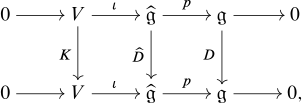
where is a regular pre-LieDer pair.
It is called an abelian extension if is an abelian pre-Lie algebra, that is, for all
Definition 5.6.
A section of an extension of a regular pre-LieDer pair by is a linear map such that
Let be an abelian extension of a regular pre-LieDer pair by and a section. For all define linear maps and respectively, by
And for all define respectively, by
Obviously, is isomorphic to as vector spaces. Transfer the regular pre-LieDer pair structure on to that on we obtain a regular pre-LieDer pair where and are given by
Theorem 5.7.
With the above notation, is a representation of the regular pre-LieDer pair Moreover, this representation is independent of the choice of sections.
Proof.
For all by the definition of a pre-Lie algebra, we have
which implies that
Similarly, we have
For all we have
which implies that
Similarly, we have
Let be another section and be the corresponding representation of the regular pre-LieDer pair Since then we have
which implies that Similarly, we have Thus, this representation is independent of the choice of sections.
Theorem 5.8.
With the above notation, is a cocycle of the regular pre-LieDer pair with coefficients in the representation
Proof.
For all by the definition of a pre-Lie algebra, we have
which implies that For all we have
which implies that
Thus, we obtain that which implies that is a cocycle of the regular pre-LieDer pair with coefficients in the representation The proof is finished.
Definition 5.9.
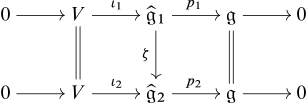
Let and be two abelian extensions of a regular pre-LieDer pair by They are said to be isomorphic if there exists a regular pre-LieDer pair isomorphism such that the following diagram is commutative.
Lemma 5.10.
Let and be two isomorphic abelian extensions of a regular pre-LieDer pair by Then they give rise to the same representation of
Proof.
Let and be two sections of and respectively. By Theorem 5.7, we obtain that and are their representations, respectively. Define by Since is a pre-LieDer pair isomorphism satisfying the commutative diagram in Definition 5.9, by we have
Thus, we obtain that is a section of For all we have
which implies that Similarly, we have This finishes the proof.
So in the sequel, we fixed a representation of a regular pre-LieDer pair and consider abelian extensions that induce the given representation.
Theorem 5.11.
Abelian extensions of a regular pre-LieDer pair by are classified by the second cohomology group
Proof.
Let be an abelian extension of a regular pre-LieDer pair by Choosing a section by Theorem 5.8, we obtain that Now we show that the cohomological class of does not depend on the choice of sections. In fact, let and be two different sections. Define by Then for all we have
which implies that Similarly, we have
Therefore, we obtain that and are in the same cohomological class.
Now we go on to prove that isomorphic abelian extensions give rise to the same element in Assume that and are two isomorphic abelian extensions of a regular pre-LieDer pair by and is a pre-LieDer pair isomorphism satisfying the commutative diagram in Definition 5.9. Assume that is a section of By we have
Thus, we obtain that is a section of Define Since is an isomorphism of pre-LieDer pair and for all we have
Similarly, we have Thus, isomorphic abelian extensions give rise to the same element in
Given two cocycles and we construct two abelian extensions and If then there exists such that and We define by
For all by we have
and for all by we have
Thus, is a pre-LieDer pair isomorphism from to Moreover, it is obvious that the diagram in Definition 5.9 is commutative. This finishes the proof.
A. The proof of Proposition 4.9
For all we have
and
Acknowledgements
We thank the referees for valuable suggestions to improve the paper.
Funding
Liangyun Chen is supported by NNSF of China (No. 12271085).
References
- [1] V. Ayala, E. Kizil, and I. De Azevedo Tribuzy, On an algorithm for finding derivations of Lie algebras. Proyecciones 31 (2012), no. 1, 81–90 Zbl 1272.17021 MR 2924691
- [2] V. Ayala and J. Tirao, Linear control systems on Lie groups and controllability. In G. Ferreyra, R. Gardner, H. Hermes, and H. Sussmann (eds.), Differential geometry and control, pp. 47–64, Proc. Sympos. Pure Math. 64, American Mathematical Society, Providence, RI, 1999 Zbl 0916.93015 MR 1654529
- [3] C. Bai, Left-symmetric bialgebras and an analogue of the classical Yang–Baxter equation. Commun. Contemp. Math. 10 (2008), no. 2, 221–260 Zbl 1173.17025 MR 2409367
- [4] C. Bai, An introduction to pre-Lie algebras. In Algebra and applications 1: non-associative algebras and categories, pp. 245–273, ISTE, London, 2020 Zbl 1496.17023 MR 4484613
- [5] I. A. Batalin and G. A. Vilkovisky, Gauge algebra and quantization. Phys. Lett. B 102 (1981), no. 1, 27–31 MR 0616572
- [6] A. F. Ber, V. I. Chilin, and F. A. Sukochev, Continuous derivations on algebras of locally measurable operators are inner. Proc. Lond. Math. Soc. (3) 109 (2014), no. 1, 65–89 Zbl 1304.46064 MR 3237736
- [7] A. F. Ber, B. de Pagter, and F. A. Sukochev, Derivations in algebras of operator-valued functions. J. Operator Theory 66 (2011), no. 2, 261–300 Zbl 1247.47011 MR 2844466
- [8] D. Burde, Left-symmetric algebras, or pre-Lie algebras in geometry and physics. Cent. Eur. J. Math. 4 (2006), no. 3, 323–357 Zbl 1151.17301 MR 2233854
- [9] F. Chapoton and M. Livernet, Pre-Lie algebras and the rooted trees operad. Int. Math. Res. Not. IMRN 2001 (2001), no. 8, 395–408 Zbl 1053.17001 MR 1827084
- [10] V. Coll, M. Gerstenhaber, and A. Giaquinto, An explicit deformation formula with non-commuting derivations. In Ring theory 1989 (Ramat Gan and Jerusalem, 1988/1989), pp. 396–403, Israel Math. Conf. Proc. 1, Weizmann, Jerusalem, 1989 Zbl 0684.16016 MR 1029329
- [11] A. Connes and D. Kreimer, Hopf algebras, renormalization and noncommutative geometry. Comm. Math. Phys. 199 (1998), no. 1, 203–242 Zbl 0932.16038 MR 1660199
- [12] A. Das, Leibniz algebras with derivations. J. Homotopy Relat. Struct. 16 (2021), no. 2, 245–274 Zbl 1477.17018 MR 4266206
- [13] A. Das and A. Mandal, Extension, deformation and categorification of AssDer pairs. Theory Appl. Categ. 45 (2026), no. 1, 1–32 Zbl 08156150 MR 5018204
- [14] V. A. Dolgushev and C. L. Rogers, A version of the Goldman–Millson theorem for filtered ‐algebras. J. Algebra 430 (2015), 260–302 Zbl 1327.17019 MR 3323983
- [15] V. Dotsenko, S. Shadrin, and B. Vallette, Maurer–Cartan methods in deformation theory: the twisting procedure. London Math. Soc. Lecture Note Ser. 488, Cambridge University Press, Cambridge, 2024, 177 pp. Zbl 1526.53001 MR 4621635
- [16] M. Doubek and T. Lada, Homotopy derivations. J. Homotopy Relat. Struct. 11 (2016), no. 3, 599–630 Zbl 1360.18015 MR 3542099
- [17] A. Dzhumadil’daev, Cohomologies and deformations of right-symmetric algebras. J. Math. Sci. 93 (1999), no. 6, 836–876 Zbl 0938.17002 MR 1698758
- [18] Y. Frégier and M. Zambon, Simultaneous deformations and Poisson geometry. Compos. Math. 151 (2015), no. 9, 1763–1790 Zbl 1383.17009 MR 3406444
- [19] M. Gerstenhaber, The cohomology structure of an associative ring. Ann. of Math. (2) 78 (1963), no. 2, 267–288 Zbl 0131.27302 MR 0161898
- [20] E. Getzler, Lie theory for nilpotent ‐algebras. Ann. of Math. (2) 170 (2009), no. 1, 271–301 Zbl 1246.17025 MR 2521116
- [21] J. Jiang, Y. Li, and Y. Sheng, Cohomologies of difference Lie groups and the van Est theorem. J. Algebra 645 (2024), 116–142 Zbl 1533.13029 MR 4708529
- [22] J. Jiang and Y. Sheng, Representations and cohomologies of relative Rota–Baxter Lie algebras and applications. J. Algebra 602 (2022), 637–670 Zbl 1500.17016 MR 4404533
- [23] J. Jiang and Y. Sheng, Deformations, cohomologies and integrations of relative difference Lie algebras. J. Algebra 614 (2023), 535–563 Zbl 1519.17027 MR 4499354
- [24] J.-L. Koszul, Domaines bornés homogènes et orbites de groupes de transformations affines. Bull. Soc. Math. France 89 (1961), 515–533 Zbl 0144.34002 MR 0145559
- [25] T. Lada and M. Markl, Strongly homotopy Lie algebras. Comm. Algebra 23 (1995), no. 6, 2147–2161 Zbl 0999.17019 MR 1327129
- [26] T. Lada and J. Stasheff, Introduction to SH Lie algebras for physicists. Internat. J. Theoret. Phys. 32 (1993), no. 7, 1087–1103 Zbl 0824.17024 MR 1235010
- [27] A. Lazarev, Y. Sheng, and R. Tang, Deformations and homotopy theory of relative Rota–Baxter Lie algebras. Comm. Math. Phys. 383 (2021), no. 1, 595–631 Zbl 1476.17010 MR 4236074
- [28] J. Liu and Q. Wang, Pre-Lie analogues of Poisson–Nijenhuis structures and Maurer–Cartan equations. J. Algebra Appl. 21 (2022), no. 6, article no. 2250120, 34 pp. Zbl 1517.17001 MR 4429005
- [29] J.-L. Loday, On the operad of associative algebras with derivation. Georgian Math. J. 17 (2010), no. 2, 347–372 Zbl 1237.18007 MR 2676956
- [30] A. R. Magid, Lectures on differential Galois theory. Univ. Lecture Ser. 7, American Mathematical Society, Providence, RI, 1994, 105 pp. Zbl 0855.12001 MR 1301076
- [31] A. Nijenhuis, Sur une classe de propriétés communes à quelques types différents d’algèbres. Enseign. Math. (2) 14 (1968), 225–277 Zbl 0188.08101 MR 0258898
- [32] J. Stasheff, Differential graded Lie algebras, quasi-Hopf algebras and higher homotopy algebras. In P. P. Kulish (ed.), Quantum groups, pp. 120–137, Lecture Notes in Math. 1510, Springer, Berlin, 1992 Zbl 0758.17010 MR 1183483
- [33] R. Tang, Y. Frégier, and Y. Sheng, Cohomologies of a Lie algebra with a derivation and applications. J. Algebra 534 (2019), 65–99 Zbl 1455.17020 MR 3979066
- [34] È. B. Vinberg, The theory of homogeneous convex cones (in Russian). Tr. Moskov. Mat. Obšč. 12 (1963), 303–358. English translation. Trans. Moscow Math. Soc. 12 (1963), 340–403 Zbl 0138.43301 MR 0158414
- [35] T. Voronov, Higher derived brackets and homotopy algebras. J. Pure Appl. Algebra 202 (2005), no. 1–3, 133–153 Zbl 1086.17012 MR 2163405
- [36] T. T. Voronov, Higher derived brackets for arbitrary derivations. In Travaux mathématiques. Fasc. XVI, pp. 163–186, Trav. Math. 16, Univ. Luxemb., Luxembourg, 2005 Zbl 1136.17014 MR 2223157
- [37] Q. Wang and J. Liu, Quasi-pre-Lie bialgebras and twisting of pre-Lie algebras. J. Algebra Appl. 23 (2024), no. 10, article no. 2450160, 33 pp. Zbl 07914997 MR 4783276
- [38] Q. Wang, Y. Sheng, C. Bai, and J. Liu, Nijenhuis operators on pre-Lie algebras. Commun. Contemp. Math. 21 (2019), no. 7, article no. 1850050, 37 pp. Zbl 1439.17023 MR 4017776
Cite this article
Shanshan Liu, Liangyun Chen, Cohomologies, deformations and extensions of pre-LieDer pairs. J. Noncommut. Geom. 20 (2026), no. 4, pp. 1169–1196
DOI 10.4171/JNCG/671