Noncommutative supports, local cohomology and spectral sequences
Abhishek Banerjee
Indian Institute of Science, Bangalore, IndiaSurjeet Kour
Indian Institute of Technology, Delhi, India
Abstract
The purpose of this paper is to study local cohomology in the noncommutative algebraic geometry framework of Artin and Zhang. The noncommutative spaces are obtained by base change of a Grothendieck category that is locally noetherian or strongly locally noetherian. Using what we call elementary objects and their injective hulls, we develop a theory of supports and associated primes in these categories. We apply our theory to study a general functorial setup that requires certain conditions on the injective hulls of elementary objects and gives us spectral sequences for derived functors associated with local cohomology objects, as well as generalized local cohomology and also generalized Nagata ideal transforms.
1. Introduction
If is a field and is a commutative algebra, the category of modules determines the geometry of the affine scheme If is no longer commutative, the category of right modules plays the role of a noncommutative affine scheme. Suppose that is a commutative graded algebra and is its category of graded modules. Then, the geometry of the projective scheme can be understood by means of the category which is the quotient of over torsion modules, that is, modules which are obtained as filtered colimits of bounded graded modules (see [5
M. Artin and J. J. Zhang, Noncommutative projective schemes. Adv. Math. 109 (1994), no. 2, 228–287 Zbl 0833.14002 MR 1304753
]). Accordingly, the category plays the role of a noncommutative projective scheme in the theory of Artin and Zhang [5M. Artin and J. J. Zhang, Noncommutative projective schemes. Adv. Math. 109 (1994), no. 2, 228–287 Zbl 0833.14002 MR 1304753
], where is a noncommutative graded algebra. In general, one can approach noncommutative algebraic geometry by adapting notions from commutative rings and the usual theory of schemes to arbitrary Grothendieck categories.One of the notions that is fundamental in algebraic geometry is that of base change. Let be a field, and let be algebras. Then, a module over the tensor product algebra may be described as an ordinary module equipped with an additional module action. If we replace the category of modules by a general linear abelian category we obtain the category of “module objects in ” These module objects were introduced by Popescu [21
N. Popescu, Abelian categories with applications to rings and modules. London Math. Soc. Monogr. 3, Academic Press, London-New York, 1973, 467 pp. Zbl 0271.18006 MR 0340375
, p. 108] and may be treated as modules over a noncommutative base change of by the abelian category An module object in consists of an object along with a morphism of algebrasIn [6
M. Artin and J. J. Zhang, Abstract Hilbert schemes. Algebr. Represent. Theory 4 (2001), no. 4, 305–394 Zbl 1030.14003 MR 1863391
], Artin and Zhang systematically developed the properties of the abstract module category where is a Grothendieck category, and often a locally noetherian or strongly locally noetherian Grothendieck category. The theory developed by Artin and Zhang in [6M. Artin and J. J. Zhang, Abstract Hilbert schemes. Algebr. Represent. Theory 4 (2001), no. 4, 305–394 Zbl 1030.14003 MR 1863391
] includes tensor products, internal hom, localization, versions of the Hilbert basis theorem, the Nakayama lemma, as well as the derived functors and Several other fundamental constructions on such as ind-objects, coherence and deformation theory, have been developed by Lowen and Van den Bergh [19W. Lowen and M. Van den Bergh, Deformation theory of abelian categories. Trans. Amer. Math. Soc. 358 (2006), no. 12, 5441–5483 Zbl 1113.13009 MR 2238922
]. In [7A. Banerjee, An extension of the Beauville–Laszlo descent theorem. Arch. Math. (Basel) 120 (2023), no. 6, 595–604 Zbl 1527.13010 MR 4598542
], we have also studied descent properties in We note that a number of properties of the category extend to the module category following the idea of noncommutative base change. For example, if is locally finitely generated, so is The version of the Hilbert basis theorem proved by Artin and Zhang in [6
M. Artin and J. J. Zhang, Abstract Hilbert schemes. Algebr. Represent. Theory 4 (2001), no. 4, 305–394 Zbl 1030.14003 MR 1863391
] shows that if is locally noetherian and is a finitely generated algebra, then is also locally noetherian. Since Grothendieck categories abound in nature, the theory of the abstract module category is very general and applies to a wide variety of situations. For instance, could be the category of sheaves of abelian groups on a topological space, comodules over a coalgebra over a field, modules over a ringed space, quasi-coherent sheaves over a scheme or the category of comodules over a flat Hopf algebroid.In this paper, we develop a local cohomology theory in the noncommutative algebraic geometry of Artin and Zhang [5
M. Artin and J. J. Zhang, Noncommutative projective schemes. Adv. Math. 109 (1994), no. 2, 228–287 Zbl 0833.14002 MR 1304753
, 6M. Artin and J. J. Zhang, Abstract Hilbert schemes. Algebr. Represent. Theory 4 (2001), no. 4, 305–394 Zbl 1030.14003 MR 1863391
], by making use of abstract module categories. We let the linear Grothendieck category be strongly locally noetherian, whence it follows that is locally noetherian for any noetherian commutative algebra We should note that our framework will give new results, even in the case we take to be the category of modules over a noncommutative algebra that is strongly locally noetherian, that is, is right noetherian for every commutative noetherian algebra (see [4M. Artin, L. W. Small, and J. J. Zhang, Generic flatness for strongly Noetherian algebras. J. Algebra 221 (1999), no. 2, 579–610 Zbl 0958.16024 MR 1728399
]). If is a coalgebra over a field, its category of comodules is locally noetherian (see [14S. Dăscălescu, C. Năstăsescu, and Ş. Raianu, Hopf algebras: an introduction. Monographs and Textbooks in Pure Appl. Math. 235, Marcel Dekker, New York, 2001, 401 pp. Zbl 0962.16026 MR 1786197
, Section 2.4.8] and [23B. Stenström, Rings of quotients: an introduction to methods of ring theory. Grundlehren Math. Wiss. 217, Springer, New York-Heidelberg, 1975, 309 pp. Zbl 0296.16001 MR 0389953
, Section V.4.3]). As with the theory in [6M. Artin and J. J. Zhang, Abstract Hilbert schemes. Algebr. Represent. Theory 4 (2001), no. 4, 305–394 Zbl 1030.14003 MR 1863391
], we can take to be the category of graded modules over a graded algebra The category is strongly locally noetherian whenever is strongly noetherian in a graded sense (see [6M. Artin and J. J. Zhang, Abstract Hilbert schemes. Algebr. Represent. Theory 4 (2001), no. 4, 305–394 Zbl 1030.14003 MR 1863391
, Section B5]). We can also take for a noncommutative graded algebra These are the noncommutative projective schemes of Artin and Zhang [5M. Artin and J. J. Zhang, Noncommutative projective schemes. Adv. Math. 109 (1994), no. 2, 228–287 Zbl 0833.14002 MR 1304753
]. If is strongly noetherian in a graded sense (but not necessarily commutative), the category is strongly locally noetherian and (see [6M. Artin and J. J. Zhang, Abstract Hilbert schemes. Algebr. Represent. Theory 4 (2001), no. 4, 305–394 Zbl 1030.14003 MR 1863391
, Section B8]).The aims of our paper are threefold. First, we build a theory of associated primes and supports in the abstract module category using what we call elementary objects in If is the category of modules over a commutative algebra then an elementary object in behaves somewhat like a quotient over a prime ideal. Accordingly, the injective hulls of these elementary objects in play a key role in our theory.
Our second purpose is to develop local cohomology in In fact, we work with a more general framework, extending the local cohomology with respect to a pair of ideals introduced by Takahashi, Yoshino and Yoshizawa [24
R. Takahashi, Y. Yoshino, and T. Yoshizawa, Local cohomology based on a nonclosed support defined by a pair of ideals. J. Pure Appl. Algebra 213 (2009), no. 4, 582–600 Zbl 1160.13013 MR 2483839
]. One of the key aspects of the theory in [24R. Takahashi, Y. Yoshino, and T. Yoshizawa, Local cohomology based on a nonclosed support defined by a pair of ideals. J. Pure Appl. Algebra 213 (2009), no. 4, 582–600 Zbl 1160.13013 MR 2483839
] is that local cohomology is based on a nonclosed support In order to study the two-variable local cohomology objects in we will need the support theory, associated primes and elementary objects in If is a finitely generated object, we show that the set is finite. For an ideal the question of the finiteness of the set of associated primes of local cohomology objects is very interesting in commutative algebra and is also related to Faltings’ local-global-principle for finiteness dimensions (see [16G. Faltings, Der Endlichkeitssatz in der lokalen Kohomologie. Math. Ann. 255 (1981), no. 1, 45–56 Zbl 0451.13008 MR 0611272
], and also [13M. P. Brodmann and R. Y. Sharp, Local cohomology: an algebraic introduction with geometric applications, 2nd edn., Cambridge Stud. Adv. Math. 136, Cambridge University Press, Cambridge, 2013, 491 pp. Zbl 1263.13014 MR 3014449
, Section 9.6.2]). In fact, a number of questions related to the supports and associated primes of local cohomology have been studied extensively in the literature (see, for instance, [9M. Brodmann, Asymptotic stability of . Proc. Amer. Math. Soc. 74 (1979), no. 1, 16–18 Zbl 0395.13008 MR 0521865
-12M. P. Brodmann and A. Lashgari Faghani, A finiteness result for associated primes of local cohomology modules. Proc. Amer. Math. Soc. 128 (2000), no. 10, 2851–2853 Zbl 0955.13007 MR 1664309
, 17M. Hellus, On the set of associated primes of a local cohomology module. J. Algebra 237 (2001), no. 1, 406–419 Zbl 1027.13009 MR 1813886
, 18C. Huneke, D. Katz, and T. Marley, On the support of local cohomology. J. Algebra 322 (2009), no. 9, 3194–3211 Zbl 1186.13016 MR 2567416
, 22C. Rotthaus and L. M. Şega, Some properties of graded local cohomology modules. J. Algebra 283 (2005), no. 1, 232–247 Zbl 1105.13021 MR 2102081
]). We give a condition for to be finite, where is finitely generated and is a finitely generated subobject. This generalizes a result of Brodmann and Faghani [12M. P. Brodmann and A. Lashgari Faghani, A finiteness result for associated primes of local cohomology modules. Proc. Amer. Math. Soc. 128 (2000), no. 10, 2851–2853 Zbl 0955.13007 MR 1664309
] to the two-variable local cohomology context, as well as to the abstract module category In particular, by taking we have a condition for the collection of associated primes of to be finite.Finally, using properties of the injective hull of elementary objects, we apply our theory to describe a general functorial setup that is similar to the one recently introduced by Àlvarez Montaner, Boix and Zarzuela in [2
J. Àlvarez Montaner, A. F. Boix, and S. Zarzuela, On some local cohomology spectral sequences. Int. Math. Res. Not. IMRN 2020 (2020), no. 19, 6197–6293 Zbl 1486.13024 MR 4165477
] (see also [3J. Àlvarez Montaner, R. García López, and S. Zarzuela Armengou, Local cohomology, arrangements of subspaces and monomial ideals. Adv. Math. 174 (2003), no. 1, 35–56 Zbl 1050.13009 MR 1959890
]). By considering systems of functors on satisfying certain conditions with respect to their values on injective hulls of elementary objects in we obtain a general spectral sequence for their derived functors in this context. In particular, this gives us a spectral sequence for two-variable local cohomology objects in In fact, it is striking that the nonclosed supports from [24R. Takahashi, Y. Yoshino, and T. Yoshizawa, Local cohomology based on a nonclosed support defined by a pair of ideals. J. Pure Appl. Algebra 213 (2009), no. 4, 582–600 Zbl 1160.13013 MR 2483839
] appear naturally in the theory developed in [2J. Àlvarez Montaner, A. F. Boix, and S. Zarzuela, On some local cohomology spectral sequences. Int. Math. Res. Not. IMRN 2020 (2020), no. 19, 6197–6293 Zbl 1486.13024 MR 4165477
].We conclude by showing two further applications of the spectral sequence in this formalism. The first is with generalized local cohomology functors given by derived functors of
where is a finitely generated module and is the internal hom of an module with respect to an object of The second is the “generalized Nagata ideal transform” (see [2
J. Àlvarez Montaner, A. F. Boix, and S. Zarzuela, On some local cohomology spectral sequences. Int. Math. Res. Not. IMRN 2020 (2020), no. 19, 6197–6293 Zbl 1486.13024 MR 4165477
, Section 4] and [15K. Divaani-Aazar and R. Sazeedeh, Cofiniteness of generalized local cohomology modules. Colloq. Math. 99 (2004), no. 2, 283–290 Zbl 1072.13011 MR 2079733
]) that we extend to as follows:where is again a finitely generated module. In each case, we obtain spectral sequences for their derived functors.
2. elementary objects, associated primes and injectives
Let be a field. Throughout, we let be a strongly locally noetherian linear category. We let be a commutative and noetherian algebra. Accordingly, the category of module objects in is locally noetherian. By [6
M. Artin and J. J. Zhang, Abstract Hilbert schemes. Algebr. Represent. Theory 4 (2001), no. 4, 305–394 Zbl 1030.14003 MR 1863391
, Section B3], there is a “tensor product” that is right exact in both variables. If is a flat module, then the functor is exact. Since is a field, the functor is exact for any Consequently, is exact for the algebra (see [6M. Artin and J. J. Zhang, Abstract Hilbert schemes. Algebr. Represent. Theory 4 (2001), no. 4, 305–394 Zbl 1030.14003 MR 1863391
, Section C1]). We will typically write We also note that an module object in may be described by giving and a “structure map” satisfying analogues of the usual associativity and unit conditions (see [6M. Artin and J. J. Zhang, Abstract Hilbert schemes. Algebr. Represent. Theory 4 (2001), no. 4, 305–394 Zbl 1030.14003 MR 1863391
, Section B3.14]). For notions such as finitely generated objects, noetherian objects and locally noetherian categories that we will need throughout this paper, we refer the reader to [1J. Adámek and J. Rosický, Locally presentable and accessible categories. London Math. Soc. Lecture Note Ser. 189, Cambridge University Press, Cambridge, 1994, 316 pp. Zbl 0795.18007 MR 1294136
].We will now introduce some notation. Let denote the endomorphism induced on by We set the annihilator to be the ideal
It is clear that if then For any and any element we form the short exact sequence
Since is a Grothendieck category, an object is said to be finitely generated (see, for instance, [23
B. Stenström, Rings of quotients: an introduction to methods of ring theory. Grundlehren Math. Wiss. 217, Springer, New York-Heidelberg, 1975, 309 pp. Zbl 0296.16001 MR 0389953
, Section V.3]) if for any directed family of subobjects of in such that there exists some such that For any we denote by the collection of finitely generated subobjects of in We also let denote the collection of finitely generated subobjects in such that is a prime ideal in Definition 2.1.
We will say that an object is elementary if it satisfies the following two conditions:
- (a)is finitely generated.
- (b)There is a prime ideal such that for any non-zero subobject we have
For we will say that a prime ideal is an associated prime of if there exists an elementary object such that We denote by the collection of associated primes of
Our first purpose is to show that associated primes exist for every non-zero For this, we first prove the following result.
Lemma 2.2.
Let Then, there exists a finitely generated subobject in such that is a prime ideal, that is, is non-empty.
Proof.
Because is locally noetherian, the object must have non-zero finitely generated subobjects. Since is noetherian, we can choose an ideal such that is maximal among annihilators of finitely generated non-zero subobjects of Suppose that for some We claim that is prime. Otherwise, suppose we have such that but
Since we have which implies that factors through the kernel Hence, where is the canonical epimorphism Since is a morphism of module objects, we obtain Since is an epimorphism, it follows that that is,
Since is locally noetherian, we note that is finitely generated. Since we know that Clearly, Then, which contradicts the maximality of
Proposition 2.3.
Let Then,
Proof.
Suppose that By Lemma 2.2, we know that As such, we may choose such that is a prime ideal. Since cannot be an associated prime of we can choose such that Again by Lemma 2.2, we know that Accordingly, we can choose such that is a prime ideal. But then,
By repeating the argument, we obtain an infinite increasing chain of prime ideals in This contradicts the fact that is noetherian.
Proposition 2.4.
Suppose that is a short exact sequence in Then, we have
Proof.
From Definition 2.1, it is clear that We now consider and an elementary object such that We set Suppose that Then, we have
Accordingly, Otherwise, suppose that Then, is also elementary with By Definition 2.1, it is clear that
Proposition 2.5.
Let be finitely generated. Then, there exists a finite filtration
such that each successive quotient is elementary. Additionally,
Proof.
Let By Proposition 2.3, we can choose a subobject that is elementary. If we are done. Otherwise, we continue by applying Proposition 2.3 to which gives us a filtration as in (2.1). The filtration must be finite because is a locally noetherian category and is a finitely generated object. The last assertion follows by applying Proposition 2.4 repeatedly to the short exact sequences
Corollary 2.6.
Let be finitely generated. Then, the set is finite.
Proof.
This is clear from Proposition 2.5.
Since is a Grothendieck category, a subobject of is said to be essential if for every non-zero subobject (see, for instance, [23
B. Stenström, Rings of quotients: an introduction to methods of ring theory. Grundlehren Math. Wiss. 217, Springer, New York-Heidelberg, 1975, 309 pp. Zbl 0296.16001 MR 0389953
, Section V.2]).Corollary 2.7.
Let and let be an essential subobject. Then,
Proof.
Since is a Grothendieck category, every object has an injective hull, which we will denote by We will now prove the main result of this section, which describes the injectives of in terms of injective envelopes of elementary objects.
Theorem 2.8.
Let be a strongly locally noetherian Grothendieck category, and let be a commutative noetherian algebra. Then, every injective object in can be expressed as a direct sum of injective hulls of elementary objects.
Proof.
We choose a family of subobjects of satisfying the following two conditions:
- (1)Each is isomorphic to the injective hull of an elementary object in
- (2)The sum is direct, that is, for each
Since finite limits commute with filtered colimits in condition (2) is equivalent to for each and any finite Accordingly, by Zorn’s lemma, we may choose a maximal such family inside
We now set Since is locally noetherian, the direct sum of injectives must be injective. Accordingly, we can split as If the result is already proved. If it follows from Proposition 2.3 that there is an elementary object Since is injective, the injective hull This contradicts the maximality of the family
If is a multiplicatively closed set, the localization of an object with respect to is given by (see [6
M. Artin and J. J. Zhang, Abstract Hilbert schemes. Algebr. Represent. Theory 4 (2001), no. 4, 305–394 Zbl 1030.14003 MR 1863391
, Section B6]). The localization may also be expressed as the filtered colimit of copies of connected by morphisms over all (see [6M. Artin and J. J. Zhang, Abstract Hilbert schemes. Algebr. Represent. Theory 4 (2001), no. 4, 305–394 Zbl 1030.14003 MR 1863391
, Section B6.1]). Accordingly, the kernel of the canonical map is given by the filtered colimit (see [6M. Artin and J. J. Zhang, Abstract Hilbert schemes. Algebr. Represent. Theory 4 (2001), no. 4, 305–394 Zbl 1030.14003 MR 1863391
, Proposition B6.2])Moreover, since is a flat module, it follows from [6
M. Artin and J. J. Zhang, Abstract Hilbert schemes. Algebr. Represent. Theory 4 (2001), no. 4, 305–394 Zbl 1030.14003 MR 1863391
, Proposition C1.7] that localization is an exact functor on If is a prime ideal, we denote by the localization with respect to We now have the following definition.Definition 2.9.
Let Then, the support of consists of all prime ideals such that
Proposition 2.10.
We now have the following result:
- (a)Let and let Then,
- (b)If is finitely generated, then the collection of prime ideals containing
- (c)For a short exact sequence in we have
Proof.
We conclude this section by establishing some properties of injective hulls in that we will need throughout this paper. We begin with the following result.
Lemma 2.11.
Let and let be a multiplicatively closed subset. Then, any subobject of is of the form for some subobject in
Proof.
Let be a subobject. We set up the following two pullback diagrams

Proposition 2.12.
Let be an injective object, and let be a multiplicatively closed subset. Then, the localization is an injective object in
Proof.
Let be a set of noetherian generators for Since is strongly locally noetherian, it follows from [6
M. Artin and J. J. Zhang, Abstract Hilbert schemes. Algebr. Represent. Theory 4 (2001), no. 4, 305–394 Zbl 1030.14003 MR 1863391
, Proposition B5.1, Corollary B3.17] that is a set of noetherian generators for We choose one of these generators and consider a subobject in Applying Lemma 2.11, we have a subobject in such that the localization We note that since is noetherian, so is Since is injective, it follows that we have a surjection As mentioned above, the localization may be expressed as a filtered colimit of copies of Since are finitely generated, we have induced surjections In other words, we have a surjection Applying Baer’s criterion (see [23
B. Stenström, Rings of quotients: an introduction to methods of ring theory. Grundlehren Math. Wiss. 217, Springer, New York-Heidelberg, 1975, 309 pp. Zbl 0296.16001 MR 0389953
, Proposition V.2.9]) to the Grothendieck category it follows that is injective. We now need the following fact, which does not seem to have appeared before in the literature.
Lemma 2.13.
Let be a locally noetherian category. Then, a filtered colimit of essential monomorphisms in is an essential monomorphism.
Proof.
Let be a filtered system of essential monomorphisms. Then, is a monomorphism, and we claim that is essential. For this, we consider a subobject and suppose that Since every object in is the sum of its finitely generated subobjects, it is enough to consider the case where is finitely generated.
Accordingly, we can choose large enough such that the inclusion factors through the canonical morphism Then, must be a monomorphism. Since is essential, we have Since it follows that which is a contradiction.
Proposition 2.14.
Let be a multiplicatively closed subset. Let and let be its injective hull. Then, the localization is the injective hull of in
Proof.
Proposition 2.15.
Let be a strongly locally noetherian Grothendieck category, and let be a commutative noetherian algebra. Let be an essential subobject in Then,
Proof.
According to Proposition 2.14, it is clear that In general, if is essential, there is an inclusion Accordingly,
3. Local cohomology objects for a pair of ideals
Let be ideals in If and is any family of subobjects of we write (resp. ) for the direct sum (resp. the sum in ) of all the objects in We now define
The definition in (3.1) is motivated by the notion of local cohomology for modules with respect to a pair of ideals introduced by Takahashi, Yoshino and Yoshizawa in [24
R. Takahashi, Y. Yoshino, and T. Yoshizawa, Local cohomology based on a nonclosed support defined by a pair of ideals. J. Pure Appl. Algebra 213 (2009), no. 4, 582–600 Zbl 1160.13013 MR 2483839
]. We will say that is torsion if We will say that is torsion free if When we will denote simply by Lemma 3.1.
We start with the following result:
- (a)For the family is closed under subobjects and finite sums. Further, any finitely generated lies in the family
- (b)is a left exact functor on
Proof.
(a) It is clear that is closed under subobjects. We consider with and Then, we have
Hence, is closed under finite sums. Now if is finitely generated, it follows from the definition in (3.1) that lies within a finite sum of objects in Since is closed under subobjects and finite sums, the result is now clear.
(b) Let be a morphism in For any the quotient satisfies Accordingly, if then This determines a morphism In particular, if is a monomorphism, we have Hence,
As defined in [24
R. Takahashi, Y. Yoshino, and T. Yoshizawa, Local cohomology based on a nonclosed support defined by a pair of ideals. J. Pure Appl. Algebra 213 (2009), no. 4, 582–600 Zbl 1160.13013 MR 2483839
], we now consider for the pair of ideals the setWhen we note that the set of prime ideals containing
Lemma 3.2.
Let be finitely generated. Then, if and only if for
Proof.
Since is finitely generated, it follows from Proposition 2.10 that First, we suppose that Then, if that is, we see that that is,
Conversely, suppose that If is a prime ideal containing then there is such that Since is noetherian, there are only finitely many primes minimal over It follows that we can find such that Again since is noetherian, some power of lies in and the result follows.
It follows from Lemma 3.2 that is the sum of all finitely generated subobjects satisfying We note that this implies We will now describe the associated primes of
Proposition 3.3.
For we have
Proof.
Since we have If we consider an elementary object such that By Lemmas 3.1 and 3.2, we see that Hence,
Conversely, we take and consider an elementary object such that Since we can take such that Hence, and therefore This gives
If is an abelian category, we recall (see, for instance, [8
A. Beligiannis and I. Reiten, Homological and homotopical aspects of torsion theories. Mem. Amer. Math. Soc. 188 (2007), no. 883, 207 pp. Zbl 1124.18005 MR 2327478
, Section 1.1]) that a torsion theory on consists of a pair of strict and full subcategories such that for any and any fits into a short exact sequence with and Additionally, is said to be hereditary if the torsion class is closed under subobjects.Proposition 3.4.
For ideals the pair of full subcategories of where
forms a hereditary torsion theory in
Proof.
We consider in where We consider Then, and hence Now for any we consider the short exact sequence
By Lemma 3.1, it is clear that If there is some such that Then, we have a short exact sequence
where is the preimage of in Then, and hence which implies that Hence, is a torsion theory on The fact that is closed under subobjects is also clear from Lemma 3.2.
Definition 3.5.
Let and let be ideals. Then, for any the th local cohomology object of with respect to is given by the th right derived functor of that is,
When we set and refer to as the local cohomology objects with respect to
We will now show that if is torsion, then for This will be achieved by a sequence of steps. We will start by showing that the torsion theory satisfies the property that the torsion part of an injective in is still an injective.
Lemma 3.6.
Let be an injective object. Then, for any ideal is also an injective object in
Proof.
We will show that for any finitely generated and any subobject a morphism extends to a morphism Since is locally noetherian, it has a set of finitely generated generators. Accordingly, it will follow from Baer’s criterion [23
B. Stenström, Rings of quotients: an introduction to methods of ring theory. Grundlehren Math. Wiss. 217, Springer, New York-Heidelberg, 1975, 309 pp. Zbl 0296.16001 MR 0389953
, Proposition V.2.9] that is injective.Since is finitely generated, we can choose such that Since is injective, the morphism extends to a morphism In particular, Since is finitely generated, so is Applying the version of Artin–Rees lemma proved in [6
M. Artin and J. J. Zhang, Abstract Hilbert schemes. Algebr. Represent. Theory 4 (2001), no. 4, 305–394 Zbl 1030.14003 MR 1863391
, Proposition D1.8], we can find such that for all we havePutting it follows from (3.2) that We now note that
Accordingly, it follows from (3.3) that Now since
the morphism induces such that and Again since is injective, there exists extending We now see that
whence it follows that This proves the result.
The next step is to make use of the directed sets defined in [24
R. Takahashi, Y. Yoshino, and T. Yoshizawa, Local cohomology based on a nonclosed support defined by a pair of ideals. J. Pure Appl. Algebra 213 (2009), no. 4, 582–600 Zbl 1160.13013 MR 2483839
, Section 3] as follows: the elements of are ideals satisfying for For we will say that if We observe that each is filtered.Lemma 3.7.
Let Then,
Proof.
We set and consider some Since is filtered, we choose such that that is, for some Since we may choose such that Then, and hence Conversely, we consider some Then, we have for some Then, and we have Accordingly, we have and hence because is locally noetherian.
Proposition 3.8.
Let be an injective object. Then, for any ideals is also an injective object in
Proof.
Since is injective, it follows from Lemma 3.6 that is injective for each We now consider some finitely generated a subobject and a morphism By Lemma 3.7, we know that Since is filtered and is finitely generated, we can find such that factors through Since is injective, we now have extending Composing with the canonical map we obtain an extension of to a morphism Since is a locally noetherian category, it now follows from Baer’s criterion (see [23
B. Stenström, Rings of quotients: an introduction to methods of ring theory. Grundlehren Math. Wiss. 217, Springer, New York-Heidelberg, 1975, 309 pp. Zbl 0296.16001 MR 0389953
, Proposition V.2.9]) that is injective. Lemma 3.9.
Let be an torsion object. Then, its injective hull is also torsion.
Proof.
Since is injective, Proposition 3.8 implies that is also injective in Accordingly, we have a direct sum decomposition We already know that is an torsion object, and it is clear from the definition in (3.1) that lies inside the torsion part of Then, But is essential in whence it follows that that is,
Proposition 3.10.
Let be an torsion object. Then, for
Proof.
By Lemma 3.9, we know that the injective hull of an torsion object is also torsion. By Proposition 3.4, we know that the torsion class is closed under both quotients and subobjects. Accordingly, we can obtain a resolution consisting of injective objects that are torsion. Therefore, applying the functor leaves this sequence unchanged. By definition, the cohomology of the resolution vanishes in positive degrees, and this proves the result.
Corollary 3.11.
Let Then,
- (a)for
- (b)is torsion for any
Proof.
By Proposition 3.10, we know that for The result of (a) is now clear from the long exact sequence of cohomologies obtained by applying to the short exact sequence To prove (b), we note that are, by definition, the homology objects of where is an injective resolution. Since each lies in the hereditary torsion class so does its subquotient
4. Associated primes of local cohomology objects
In this section, we study finiteness conditions on local cohomology objects and their associated primes. We give a condition for the set of associated primes of the local cohomology object with respect to an ideal pair in an abstract module category to be finite. For we say that is a non-zero divisor on if is a monomorphism.
Lemma 4.1.
Let be a zero divisor on Then, lies in some associated prime of
Proof.
By definition, we know that Using Proposition 2.3, we pick a prime ideal Then, for some elementary object Then,
Lemma 4.2.
Let be ideals, and let be a finitely generated object such that Then, contains a non-zero divisor on
Proof.
Suppose that all elements of are zero divisors on By Lemma 4.1, Since is finitely generated, is finite by Corollary 2.6. By prime avoidance, there is some such that Hence,
Now since is an associated prime of there is an elementary object such that Then, and hence which is a contradiction.
For any in and subobjects we set
It is clear that any such is an ideal in
Lemma 4.3.
Let in and let be a finitely generated subobject. Then, there exists a finitely generated subobject such that
- (1)The quotient map restricts to an epimorphism
- (2)
Proof.
We put Since finitely generated subobjects of form a filtered system and we can find such that This proves (1). To prove (2), for any we consider the commutative diagram
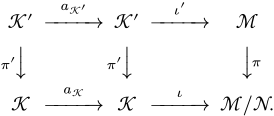
If that is, we get which gives that is, Conversely, if we get Since is an epimorphism and is a monomorphism, we get or
Proposition 4.4.
Let be finitely generated, and let be ideals. Suppose that is such that is finitely generated for all Then, for any finitely generated such that the collection is finite.
Proof.
For we know that is finitely generated, and the result is clear. We will proceed by induction on By Corollary 3.11, we know that for Also, we know that Accordingly, we may suppose that is finitely generated with and it follows from Lemma 4.2 that we can find which is a non-zero divisor on
By Corollary 3.11, we know that is torsion, that is, Since is finitely generated, it follows from Lemma 3.1 that for some Accordingly, we have We now consider the short exact sequence
Applying to (4.1), the long exact sequence of derived functors gives us
for every Since is locally noetherian, the collection of finitely generated objects in is closed under extensions, subobjects and quotients (see [23
B. Stenström, Rings of quotients: an introduction to methods of ring theory. Grundlehren Math. Wiss. 217, Springer, New York-Heidelberg, 1975, 309 pp. Zbl 0296.16001 MR 0389953
, Section V.4.2]). Since is finitely generated for all it follows from (4.2) that is finitely generated for Since we also have the following diagram where the top row is exact and the vertical morphisms are epimorphisms

We now observe that This gives us the short exact sequence
where we have used Since is finitely generated, so is its subobject Then, the quotient of is also finitely generated.
On the other hand, we have the short exact sequence
By assumption, is finitely generated, and hence so is its subquotient Also since is finitely generated, so is Again since is locally noetherian, it follows from (4.4) that is finitely generated. Additionally, we note that
We now put and By the induction assumption, we see that is a finite set. Since is finitely generated, from the short exact sequence (4.3), it now follows from Proposition 2.4 that is finite.
Since is finitely generated, so is its image To prove the result, it now suffices to show that
Accordingly, we choose some prime ideal Then, there is an elementary object such that Applying Lemma 4.3, we can choose a finitely generated subobject such that restricts to an epimorphism and We now consider the short exact sequence

By Proposition 2.4, we get Since does not lie in we obtain
We know that is finitely generated. Again since is torsion, it follows that for some But since we get that is, Again since we obtain and hence Then,
Theorem 4.5.
Let be finitely generated, and let be ideals. Suppose that is such that is finitely generated for all Suppose that is finitely generated. Then, for any finitely generated the collection is finite.
Proof.
Since and are both finitely generated, so is By Proposition 4.4, it now follows that is finite. We now consider the short exact sequence
Corollary 4.6.
Let be finitely generated, and let be ideals. Suppose that is such that is finitely generated for all Suppose that is finitely generated. Then, the collection is finite.
Proof.
This follows directly from Theorem 4.5 by setting
We conclude this section with the following fact, which extends a result of Brodmann, Rotthaus and Sharp [11
M. Brodmann, Ch. Rotthaus, and R. Y. Sharp, On annihilators and associated primes of local cohomology modules. J. Pure Appl. Algebra 153 (2000), no. 3, 197–227 Zbl 0968.13010 MR 1783166
].Proposition 4.7.
Let be such that the collection of maximal elements in is finite. Let be an ideal. Suppose that for each there is such that If then
Proof.
We consider some It is clear that Since is locally noetherian, we know that is finitely generated. From (2.2), we see that for each we have
Since the union on the right-hand side of (4.6) is filtered, we can find such that Let be the ideal generated by the collection It is clear that Since is not contained in any of the prime ideals in and is finite, it follows from prime avoidance that we can choose an element From Lemma 4.1, it is clear that must be a non-zero divisor on But multiplication by is zero on the subobject Hence, It follows that
5. Spectral sequences for local cohomology type functors on
In this section, we will show that we can construct spectral sequences for “local cohomology type” functors on by creating an axiomatic setup similar to Àlvarez Montaner, Boix and Zarzuela [2
J. Àlvarez Montaner, A. F. Boix, and S. Zarzuela, On some local cohomology spectral sequences. Int. Math. Res. Not. IMRN 2020 (2020), no. 19, 6197–6293 Zbl 1486.13024 MR 4165477
]. Our main tools will be the properties of injective hulls of elementary objects proved in Section 2. We will then exhibit three different situations where this axiomatic setup can be used to obtain spectral sequences.Let be a finite poset, and let denote the category of systems of objects in indexed over We suppose from now on that has enough projectives. Then, it follows from Artin and Zhang [6
M. Artin and J. J. Zhang, Abstract Hilbert schemes. Algebr. Represent. Theory 4 (2001), no. 4, 305–394 Zbl 1030.14003 MR 1863391
, Lemma D3.2] that has enough projectives. Then, we know that has enough projectives and has enough injectives (see, for instance, [25C. A. Weibel, An introduction to homological algebra. Cambridge Stud. Adv. Math. 38, Cambridge University Press, Cambridge, 1994, 450 pp. Zbl 0797.18001 MR 1269324
, Section 2.3]). We also note that and are Grothendieck categories.For any functor we consider the complex given by
where is induced by deleting the th term in the sequence Because is a finite poset, it follows from the proof of [20
A. Neeman, Triangulated categories. Ann. of Math. Stud. 148, Princeton University Press, Princeton, NJ, 2001, 449 pp. Zbl 0974.18008 MR 1812507
, Lemma A.3.2] that this complex computes the derived functor of the inverse limit over that is, for any we have Similarly, for any functor we consider the complex given by
where is induced by deleting the th term in the sequence Then, it follows from [20
A. Neeman, Triangulated categories. Ann. of Math. Stud. 148, Princeton University Press, Princeton, NJ, 2001, 449 pp. Zbl 0974.18008 MR 1812507
, Section B.1.2] that this complex computes the derived functor of the direct limit over that is, for any we have From now onwards, we fix an ideal We suppose that may be expressed as where are ideals of As in [2
J. Àlvarez Montaner, A. F. Boix, and S. Zarzuela, On some local cohomology spectral sequences. Int. Math. Res. Not. IMRN 2020 (2020), no. 19, 6197–6293 Zbl 1486.13024 MR 4165477
, Section 2], we let denote the finite poset whose elements are all the possible different sums of the ideals ordered by reverse inclusion. By we will mean the poset obtained by adding a final element to (even if already has a final element). The Alexandrov topology on (see [2J. Àlvarez Montaner, A. F. Boix, and S. Zarzuela, On some local cohomology spectral sequences. Int. Math. Res. Not. IMRN 2020 (2020), no. 19, 6197–6293 Zbl 1486.13024 MR 4165477
, Section 2.2.1]) is that whose open sets satisfy the property that if and then If has the Alexandrov topology, we know (see [2J. Àlvarez Montaner, A. F. Boix, and S. Zarzuela, On some local cohomology spectral sequences. Int. Math. Res. Not. IMRN 2020 (2020), no. 19, 6197–6293 Zbl 1486.13024 MR 4165477
, Lemma 2.9]) that the basic open set is contractible for each For any we will denote by the sum of ideals corresponding to We now fix an ideal and an additive functor that satisfies the following conditions analogous to [2
J. Àlvarez Montaner, A. F. Boix, and S. Zarzuela, On some local cohomology spectral sequences. Int. Math. Res. Not. IMRN 2020 (2020), no. 19, 6197–6293 Zbl 1486.13024 MR 4165477
, Setup 4.3].- (1)For each the functor is left exact and preserves direct sums.
- (2)Let be an elementary object. Let be the injective hull of and let Then, for any maximal ideal in there are objects and such that for we have
- (3)For any the natural transformation satisfies, for any elementary object and maximal ideal
We also set Moreover, for and any we let denote the direct system of derived functors
Lemma 5.1.
Let be such that the localization for every maximal ideal Then,
Proof.
We consider any Since localization is exact, we have inclusions and hence for each maximal ideal Since is finitely generated, it follows from Proposition 2.10 that Hence, we have that is, Since is locally noetherian, is the sum of all its finitely generated subobjects. Hence,
Lemma 5.2.
Let be an injective object. Then, the complex
is exact.
Proof.
Since localizations are exact, it follows from Lemma 5.1 that it suffices to show that is exact for each maximal ideal Since is injective, we know from Theorem 2.8 that can be expressed as a direct sum of injective hulls of elementary objects. Since and preserve direct sums, it now suffices to check that is exact for each maximal ideal where is an elementary object and its injective hull. We now set The rest of the proof now follows exactly as in [2
J. Àlvarez Montaner, A. F. Boix, and S. Zarzuela, On some local cohomology spectral sequences. Int. Math. Res. Not. IMRN 2020 (2020), no. 19, 6197–6293 Zbl 1486.13024 MR 4165477
, Lemma 4.4]. Theorem 5.3.
Let be a strongly locally noetherian Grothendieck category, and let be a commutative noetherian ring. Then, for any we have a spectral sequence
Proof.
For we consider an injective resolution We now consider the following bicomplex that is concentrated in the “second quadrant.”
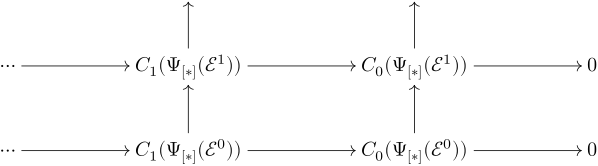
Here, we write to facilitate cohomological notation. As in [2
J. Àlvarez Montaner, A. F. Boix, and S. Zarzuela, On some local cohomology spectral sequences. Int. Math. Res. Not. IMRN 2020 (2020), no. 19, 6197–6293 Zbl 1486.13024 MR 4165477
, Theorem 4.6], we can now consider the two spectral sequences associated with the first and second filtrations of this bicomplex. Since the th column of this complex is given by and is finite, the columns of this bicomplex vanish for and hence both spectral sequences converge. Further, by Lemma 5.2, the rows of this bicomplex are exact up to the th position, and the cohomologies at the th position are given by It follows that the common abutment of these two spectral sequences is given by the cohomology groups of the complexSince is an injective resolution, it is clear that the cohomologies of (5.2) are given by Taking the cohomology of the columns of (5.1), one obtains Now applying the cohomology of the rows of (5.1), we finally obtain the spectral sequence
This proves the result.
In the following three subsections, we will now apply the formalism above to three separate contexts in order to obtain spectral sequences of derived functors. The first of these will be the local cohomology objects in with respect to a pair of ideals
5.1. Spectral sequences for
We continue with the ideal and the partially ordered set consisting of all possible sums of the ideals as defined above. For an ideal and we set and
Lemma 5.4.
Let be ideals. Then, the functor preserves direct sums.
Proof.
We consider a collection of objects in and set From the definition in (3.1), it is evident that On the other hand, we consider such that for Since is finitely generated, we must have for some finite subcollection of objects from Let denote the canonical projections for We now note that
for each We now note that which gives
Lemma 5.5.
Let be an elementary object, and let Let be an ideal. If then we have
Proof.
Lemma 5.6.
Let be an elementary object, and let Let be an ideal.
- (a)Suppose that Then, we have
- (b)If for some maximal ideal then
Proof.
Proposition 5.7.
For any we have a spectral sequence
Proof.
5.2. Generalized local cohomology objects on
Let be an module. By [6
M. Artin and J. J. Zhang, Abstract Hilbert schemes. Algebr. Represent. Theory 4 (2001), no. 4, 305–394 Zbl 1030.14003 MR 1863391
, Section B4], we know that has a right adjoint The bifunctor is left exact in both variables and satisfies for any The right derived functors of are denoted by If are modules, it also follows from the adjunction that Given an module and any ideal we denote by the inverse system given by We now set
It is immediate from (5.3) that is left exact, and we denote by the right derived functors of
Proposition 5.8.
Let be an module, and let be an ideal. Then, for any we have
Proof.
For the sake of convenience, we set for any From the definition in (5.3), it follows that The derived functors give a family of cohomological functors that is universal. Similarly, for each the derived functors are universal functors on Since filtered colimits in are also exact, we see that is also a family of functors. For any injective the derived functor vanishes for and hence so does It follows that is a universal functor and since we must have for every
In order to understand the functor better, we define, for any ideal and
where is a set of generators for
Lemma 5.9.
Let be an ideal and Then,
Proof.
If is a set of generators for we note that and hence
Therefore, it suffices to check the result for a principal ideal In that case, is a free presentation of and it follows from [6
M. Artin and J. J. Zhang, Abstract Hilbert schemes. Algebr. Represent. Theory 4 (2001), no. 4, 305–394 Zbl 1030.14003 MR 1863391
, (B4.2)] thatis exact. The result is now clear.
For the rest of this subsection, we suppose that is a finitely generated module. We note here the following fact.
Lemma 5.10.
Let be a finitely generated module. Then, the functor preserves filtered colimits.
Proof.
Let be a filtered system of objects in We will show that
for any Since is locally noetherian, any object of may be expressed as a filtered colimit of its finitely generated subobjects. Accordingly, it suffices to check (5.5) for finitely generated. If is finitely generated, we have
for finitely generated. But we are given that is a finitely generated module, that is, a quotient of for some Then, is a quotient of and hence is finitely generated in The result is now clear.
Proposition 5.11.
Let be a finitely generated module and an ideal. Then, for any we have In particular, preserves direct sums.
Proof.
The last statement is clear from Lemma 5.10 and from the fact that preserves direct sums.
Lemma 5.12.
Let be an extension of algebras. For any module and any we have an isomorphism
Proof.
We write as the cokernel of free modules. Then, is expressed as the cokernel By definition (see [6
M. Artin and J. J. Zhang, Abstract Hilbert schemes. Algebr. Represent. Theory 4 (2001), no. 4, 305–394 Zbl 1030.14003 MR 1863391
, (B4.2)]), is given as the kernel of the induced map Similarly, is also given by the kernel Lemma 5.13.
Let be the localization of with respect to a multiplicatively closed subset Then, for any finitely generated module and any we have
Proof.
We now return to the ideal and the partially ordered set consisting of all possible sums of the ideals as before. We fix and a finitely generated module For we set and
Lemma 5.14.
Let be an elementary object, and let Let be an ideal.
- (a)If then we have
- (b)Suppose that Then, we have
Proof.
Lemma 5.15.
Let be an elementary object, and let Let be an ideal. If for some maximal ideal then
Proof.
If we already have by Lemma 5.14 (a). Otherwise, suppose Then, Lemma 5.14 (b) gives us Because is finitely generated, applying Lemma 5.13 gives us
for any maximal ideal Since we have by Lemma 5.6 that which shows that
Proposition 5.16.
Let be a finitely generated module. Then, for any we have a spectral sequence
Proof.
5.3. Generalized Nagata ideal transforms on
We let be a finitely generated module and be an ideal. We define the generalized Nagata ideal transform on as follows:
It is immediate that the functor is left exact. Since is finitely generated, it is also clear from Lemma 5.10 that preserves direct sums. We now need the following result.
Lemma 5.17.
Let be an injective object. Then, the functor is exact.
Proof.
We already know that is left exact. Let be an inclusion of modules. We will show that is an epimorphism. Accordingly, we set to be the cokernel
In this section, we have assumed that has enough projectives. We choose an epimorphism in with projective. This induces an epimorphism in Also, we know that composing the structure map of with the morphism induced by the unit gives the identity in Accordingly, is an epimorphism in since the underlying morphism in is an epimorphism. We now have an epimorphism in
Since is projective, the adjoint isomorphism shows that is projective. Hence, the following sequence is exact:
Since is a field, the inclusion induces a monomorphism Since is injective, it now follows that is an epimorphism. Using (5.7), we now have which shows that
Using Lemma 5.17, we see that if is an injective object, then
is exact for any Taking filtered colimits, we have a short exact sequence
For our setup with and we now set for each and
Lemma 5.18.
Let be an elementary object, and let Let be an ideal.
- (a)If then we have
- (b)If we have
Proof.
Accordingly, the short exact sequence in (5.8) gives us
Lemma 5.19.
Let be an elementary object, and let Let be an ideal. If for some maximal ideal then
Proof.
Proposition 5.20.
Let be a finitely generated module. For any we have a spectral sequence
Proof.
References
- [1] J. Adámek and J. Rosický, Locally presentable and accessible categories. London Math. Soc. Lecture Note Ser. 189, Cambridge University Press, Cambridge, 1994, 316 pp. Zbl 0795.18007 MR 1294136
- [2] J. Àlvarez Montaner, A. F. Boix, and S. Zarzuela, On some local cohomology spectral sequences. Int. Math. Res. Not. IMRN 2020 (2020), no. 19, 6197–6293 Zbl 1486.13024 MR 4165477
- [3] J. Àlvarez Montaner, R. García López, and S. Zarzuela Armengou, Local cohomology, arrangements of subspaces and monomial ideals. Adv. Math. 174 (2003), no. 1, 35–56 Zbl 1050.13009 MR 1959890
- [4] M. Artin, L. W. Small, and J. J. Zhang, Generic flatness for strongly Noetherian algebras. J. Algebra 221 (1999), no. 2, 579–610 Zbl 0958.16024 MR 1728399
- [5] M. Artin and J. J. Zhang, Noncommutative projective schemes. Adv. Math. 109 (1994), no. 2, 228–287 Zbl 0833.14002 MR 1304753
- [6] M. Artin and J. J. Zhang, Abstract Hilbert schemes. Algebr. Represent. Theory 4 (2001), no. 4, 305–394 Zbl 1030.14003 MR 1863391
- [7] A. Banerjee, An extension of the Beauville–Laszlo descent theorem. Arch. Math. (Basel) 120 (2023), no. 6, 595–604 Zbl 1527.13010 MR 4598542
- [8] A. Beligiannis and I. Reiten, Homological and homotopical aspects of torsion theories. Mem. Amer. Math. Soc. 188 (2007), no. 883, 207 pp. Zbl 1124.18005 MR 2327478
- [9] M. Brodmann, Asymptotic stability of . Proc. Amer. Math. Soc. 74 (1979), no. 1, 16–18 Zbl 0395.13008 MR 0521865
- [10] M. Brodmann and M. Hellus, Cohomological patterns of coherent sheaves over projective schemes. J. Pure Appl. Algebra 172 (2002), no. 2–3, 165–182 Zbl 1011.13009 MR 1906872
- [11] M. Brodmann, Ch. Rotthaus, and R. Y. Sharp, On annihilators and associated primes of local cohomology modules. J. Pure Appl. Algebra 153 (2000), no. 3, 197–227 Zbl 0968.13010 MR 1783166
- [12] M. P. Brodmann and A. Lashgari Faghani, A finiteness result for associated primes of local cohomology modules. Proc. Amer. Math. Soc. 128 (2000), no. 10, 2851–2853 Zbl 0955.13007 MR 1664309
- [13] M. P. Brodmann and R. Y. Sharp, Local cohomology: an algebraic introduction with geometric applications, 2nd edn., Cambridge Stud. Adv. Math. 136, Cambridge University Press, Cambridge, 2013, 491 pp. Zbl 1263.13014 MR 3014449
- [14] S. Dăscălescu, C. Năstăsescu, and Ş. Raianu, Hopf algebras: an introduction. Monographs and Textbooks in Pure Appl. Math. 235, Marcel Dekker, New York, 2001, 401 pp. Zbl 0962.16026 MR 1786197
- [15] K. Divaani-Aazar and R. Sazeedeh, Cofiniteness of generalized local cohomology modules. Colloq. Math. 99 (2004), no. 2, 283–290 Zbl 1072.13011 MR 2079733
- [16] G. Faltings, Der Endlichkeitssatz in der lokalen Kohomologie. Math. Ann. 255 (1981), no. 1, 45–56 Zbl 0451.13008 MR 0611272
- [17] M. Hellus, On the set of associated primes of a local cohomology module. J. Algebra 237 (2001), no. 1, 406–419 Zbl 1027.13009 MR 1813886
- [18] C. Huneke, D. Katz, and T. Marley, On the support of local cohomology. J. Algebra 322 (2009), no. 9, 3194–3211 Zbl 1186.13016 MR 2567416
- [19] W. Lowen and M. Van den Bergh, Deformation theory of abelian categories. Trans. Amer. Math. Soc. 358 (2006), no. 12, 5441–5483 Zbl 1113.13009 MR 2238922
- [20] A. Neeman, Triangulated categories. Ann. of Math. Stud. 148, Princeton University Press, Princeton, NJ, 2001, 449 pp. Zbl 0974.18008 MR 1812507
- [21] N. Popescu, Abelian categories with applications to rings and modules. London Math. Soc. Monogr. 3, Academic Press, London-New York, 1973, 467 pp. Zbl 0271.18006 MR 0340375
- [22] C. Rotthaus and L. M. Şega, Some properties of graded local cohomology modules. J. Algebra 283 (2005), no. 1, 232–247 Zbl 1105.13021 MR 2102081
- [23] B. Stenström, Rings of quotients: an introduction to methods of ring theory. Grundlehren Math. Wiss. 217, Springer, New York-Heidelberg, 1975, 309 pp. Zbl 0296.16001 MR 0389953
- [24] R. Takahashi, Y. Yoshino, and T. Yoshizawa, Local cohomology based on a nonclosed support defined by a pair of ideals. J. Pure Appl. Algebra 213 (2009), no. 4, 582–600 Zbl 1160.13013 MR 2483839
- [25] C. A. Weibel, An introduction to homological algebra. Cambridge Stud. Adv. Math. 38, Cambridge University Press, Cambridge, 1994, 450 pp. Zbl 0797.18001 MR 1269324
Cite this article
Abhishek Banerjee, Surjeet Kour, Noncommutative supports, local cohomology and spectral sequences. J. Noncommut. Geom. 20 (2026), no. 4, pp. 1197–1224
DOI 10.4171/JNCG/693